

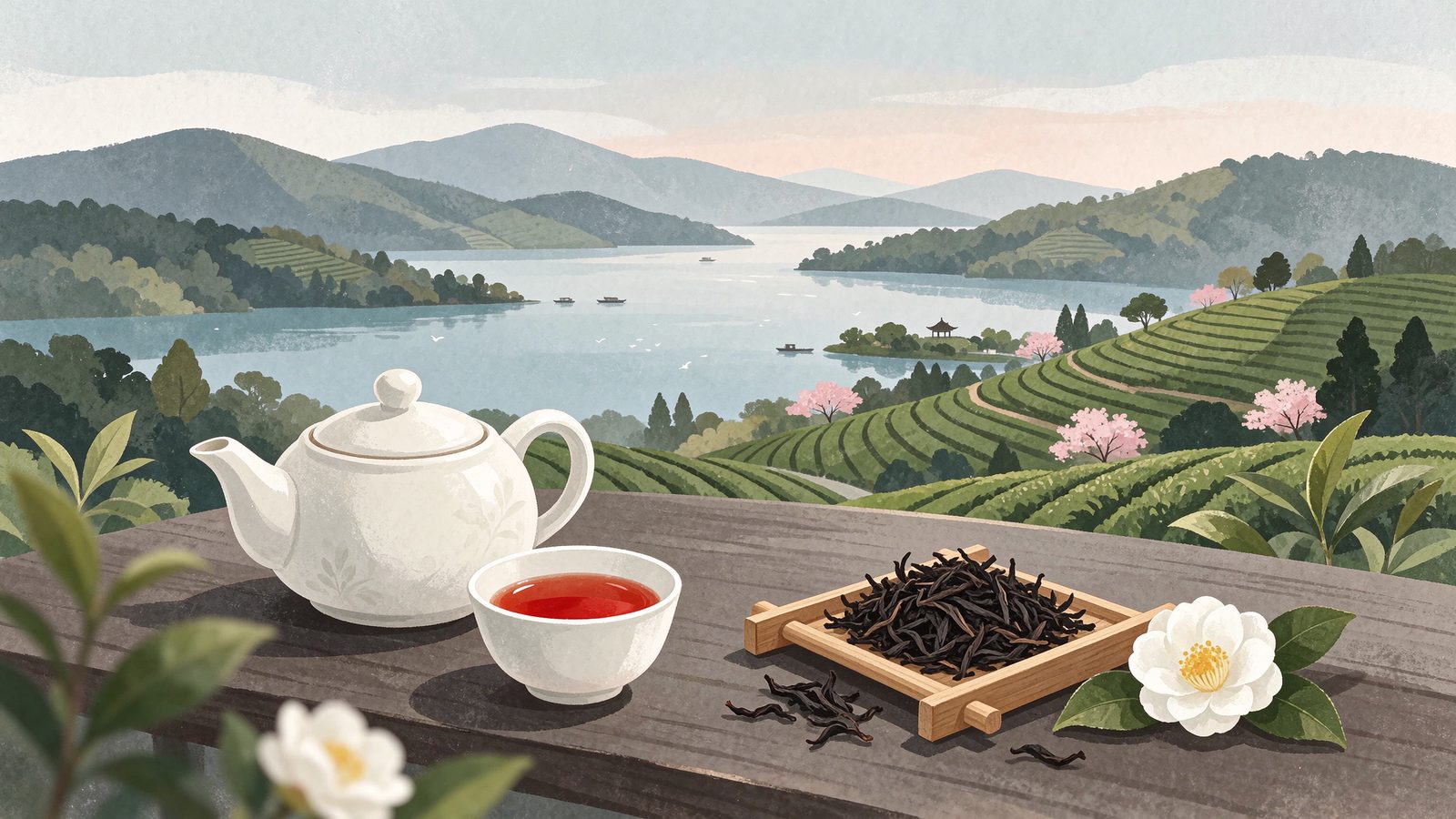
Taiwan is one of the most process-dense oolong regions in China: Wenshan pouchong, Dong Ding, Alishan and Oriental Beauty form a flavour band from low hills to high mountains.
The short answer
Taiwan's tea areas concentrate in Nantou, Chiayi, Taipei, Taoyuan, Hsinchu and Miaoli. From Wenshan pouchong in the north to Dong Ding and Alishan in the centre, and Oriental Beauty in the桃竹苗 hills, altitude and process create high flavour resolution. Read Taiwan through four variables — cultivar, altitude, oxidation and roast — not through the single phrase “high-mountain tea”.
Geography and growing conditions
Taiwan is mountainous, with the Central Range running north-south; tea areas run from northern hills to 1,000–2,000-metre gardens in the centre. Wenshan and Pinglin in the north are wet and suited to pouchong; Lugu, Ren'ai, Xinyi and Alishan have strong diurnal range and cloud, giving high-mountain oolong a lifted aroma and soft body. Taitung and Hualien in the east also produce small amounts of black tea and oolong. Typhoons, earthquakes and soil conservation are long-term constraints.
Terroir and craft
Taiwan’s tea regions run through Nantou, Chiayi, Taipei, Taoyuan, Hsinchu and Miaoli, from northern low hills to Alishan and Lishan above 2,000 metres. Qingxin oolong, Jinxuan, Cuiyu and Qingxin Dayou are made into pouchong, ball-rolled oolong, tieguanyin, Oriental Beauty, black and green tea. Oxidation and roast span a wide range.
History and industry
Tea arrived with Fujian migrants in the nineteenth century; Wenshan pouchong and oolong became export goods in the late Qing. Under Japanese rule, Assam cultivars were introduced for black tea and a tea research system was built. In the second half of the twentieth century, exports declined and domestic demand rose, making Dong Ding and high-mountain oolong the market centre. After the 1980s, competition tea, premium tea and hand-shaken drinks broadened consumption.
Tea types and everyday drinking
Wenshan pouchong is lightly oxidised with a lifted floral aroma; Dong Ding is medium-oxidised and medium-roasted with a fuller body; Alishan high-mountain oolong is fine, sweet and soft; Oriental Beauty is bitten by leafhoppers and carries honey and fruit; Taiwan black tea, mostly Assam, is bright red. Everyday drinking runs from hot gongfu tea to cold brew and hand-shaken milk tea — tea is both farm product and pop-drink ingredient.
Industry and market
Taiwanese tea mainly serves domestic and specialty markets. Alishan, Lishan, Shanlinxi, Dongding, Wenshan pouchong and Oriental Beauty each have brands; competition tea and gift boxes are expensive, while everyday tea and drink-shop leaf are large volume. Imports fill the low-price end, and origin traceability is increasingly important.
The cup and brewing
Taiwanese oolong ranges from golden to amber, with flower, milk, fruit and roast sweetness. Pouchong is lighter, Oriental Beauty honeyed and fruity, black tea fuller. Brew light oolong at 90°C and fast; heavier roast can take 95°C. Visit Nantou and Chiayi from October to April, when spring and winter tea are most aromatic.
Buying and boundaries
For Taiwan tea, check altitude, season, cultivar, oxidation and roast; “high mountain” alone is not a grade. Spring and winter teas from the same garden differ. Competition tea has a grade and price system, but fakes are common; for Oriental Beauty, check bite intensity and natural honey aroma. Brew oolong at 95–100°C in a small pot with quick pours; pouchong at 90–95°C; black tea at about 90°C.
Myths and boundaries
“Taiwan only makes oolong” ignores pouchong, black, green and Oriental Beauty. Taiwan is an oolong core, but its range is wide. Nor does “high mountain” equal best: low-elevation Wenshan pouchong, Dongding and Oriental Beauty have their own value.
Competitions and origin names
Taiwanese tea is named by competition and origin: Wenshan pouchong, Dongding oolong, Oriental Beauty, Sun Moon Lake black tea and high-mountain tea. Farmer associations grade competition teas, and price follows aroma. Gardens sit on slopes in the centre, north and Nantou at 300–2,000 m, with the winter northeast monsoon in the north and stronger sun in the south.
Teas in this region
Further reading
Source boundary
Taiwan's tea areas span a wide altitude range; “Taiwan oolong” is not one thing. High-mountain fame has produced blends and impersonation. Dong Ding and Alishan are place names, not legal quality certificates; cultivar and process still need labels and traceability.
