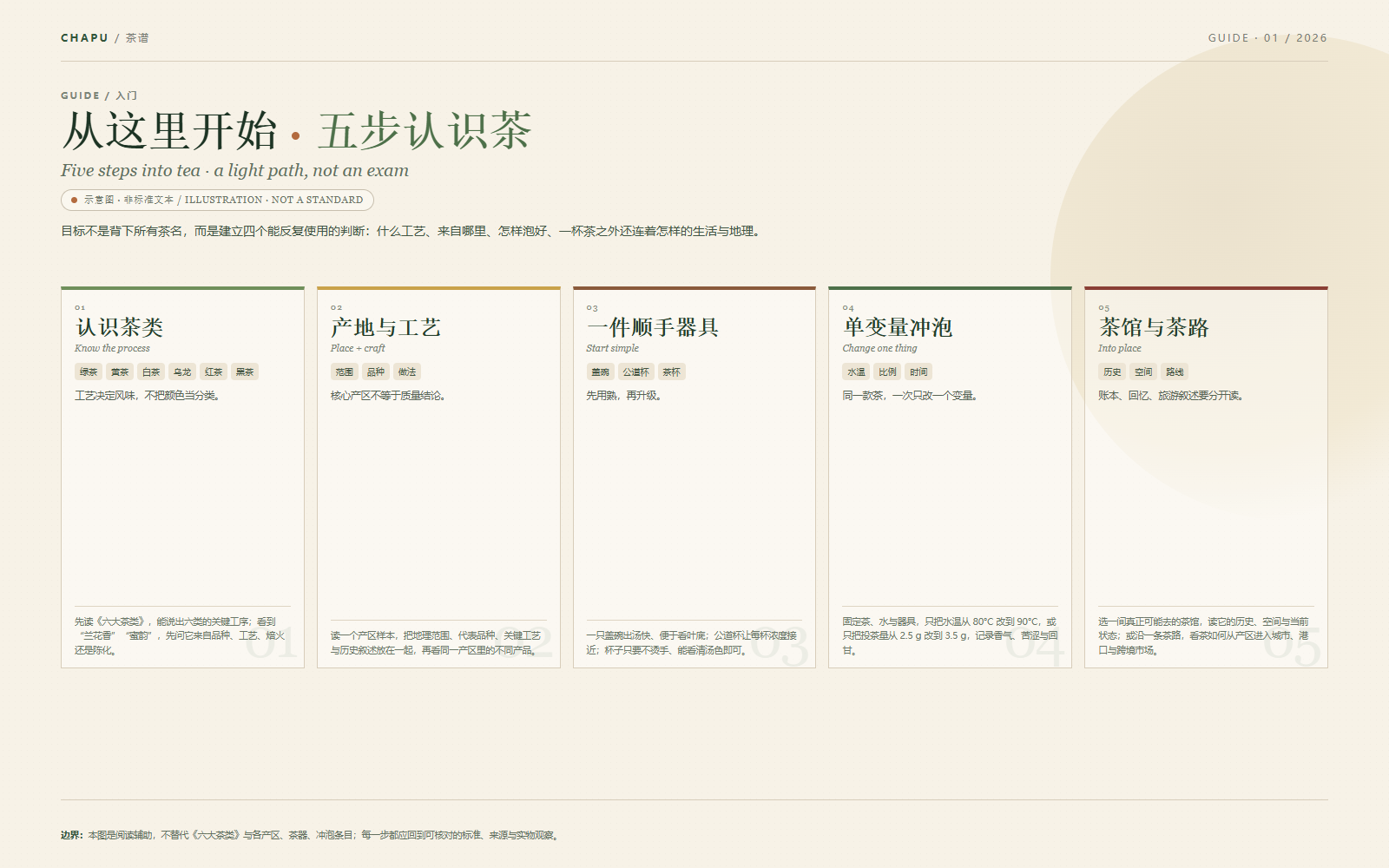
Colour is a result, not a definition
Names such as “green tea”, “black tea” and “white tea” can make colour look like the basis of classification. Colour matters, but it is an outcome of processing, not the place to begin.
GB/T 30766-2014, the Chinese national standard for the classification of tea, starts from processing technology and product characteristics, then takes cultivar, fresh-leaf material and production region into account. In ordinary language: ask what happened to the fresh leaf. Was it fixed by heat? Was it withered? How far was it oxidised? Was it yellowed, shaken, pile-fermented or roasted? Colour, shape and aroma follow from those choices.
This is why a tea can be dark green in the cup and still be a black tea by process, or pale in colour and belong to a fully oxidised family. The process name is more reliable than the colour name.
The six basic families
| Family | Key processing | Oxidation / fermentation | Typical direction |
|---|---|---|---|
| Green tea | Fixing by heat, rolling, drying | Normally unoxidised | Fresh, green, chestnut or soybean notes |
| Yellow tea | Fixing, yellowing, drying | Mainly a moist-heat yellowing step, not black-tea oxidation | Mellow, rounded, yellow liquor and leaf |
| White tea | Withering, drying | Light oxidation; usually no fixing or rolling | Downy aroma, clean sweetness, dried-grass notes |
| Oolong tea | Withering, shaking, fixing, rolling, roasting | Partial oxidation | Floral, fruity, roasted notes |
| Black tea | Withering, rolling, oxidation, drying | Full enzymatic oxidation | Sweet, honeyed, fruity, red liquor and leaf |
| Dark tea | Fixing, rolling, pile fermentation or later fermentation, drying | Microbial activity with heat and moisture | Aged, deep, mellow, dark liquor |
The table is a reading aid, not a quality ranking. Within one family, cultivar, garden, picking standard, roasting and storage can change the cup dramatically. The same batch of fresh leaf can also be directed toward different families. “Green tea must be fresh”, “black tea must be sweet” and “dark tea must taste old” are habits of expectation, not rules.
One useful correction: in English, “black tea” usually means what Chinese calls 红茶 (red tea), while Chinese 黑茶 (dark tea) is a different family. The mismatch is a reminder to ask about processing rather than trust a colour word in translation.
Reprocessed tea is not a seventh family
Scented tea, compressed tea, tea bags and powdered tea are generally treated as reprocessed products, not as a seventh basic family alongside the six. Scented tea is made by letting a tea base absorb the aroma of fresh flowers; the base can be green, black or oolong. Compressed tea is steamed and pressed into a shape, often associated with dark tea and Pu-erh, but pressing a leaf into a cake does not create a new basic process. Tea bags and powdered tea change the product format and the brewing method, not the underlying path from fresh leaf to tea.
This matters when reading a shop label. “Flower tea” may describe a scented tea, a herb blend or a flavoured product; “cake tea” may describe a compressed dark tea or a white tea pressed for storage. The format is not the family.
Where Pu-erh fits
Pu-erh is often listed separately in markets and in older data. It uses sun-dried large-leaf material from Yunnan and is divided into raw (sheng) and ripe (shou) forms. Ripe Pu-erh undergoes pile fermentation, which gives it a craft kinship with dark tea. But a market habit of listing Pu-erh on its own does not make it a seventh basic family.
Read Pu-erh in at least two dimensions: raw versus ripe, and young versus aged. A newly pressed raw cake, a stored raw cake and a ripe cake are not interchangeable, even when all three carry the same broad name. The useful question is not “is Pu-erh a dark tea?” but “which Pu-erh, made how, stored how, and at what age?”
Herbal infusions sit outside the tea family
Chrysanthemum, cassia seed and yerba mate can all be drunk like tea, but they do not necessarily come from Camellia sinensis. They are herbal infusions or other plant drinks, not tea families. Blending them with tea is a product decision, not a new basic category.
How to use the map
Start with the process path, then look at origin, cultivar, roasting or ageing. When a new name appears, ask four questions in order:
- Was it fixed by heat? Fixing is central to green tea, yellow tea, dark tea and many oolongs.
- Was it withered and shaken? That points toward white tea or oolong, depending on the rest of the process.
- Was it fully oxidised? That points toward black tea; a red name does not automatically mean a red-tea process.
- Was it pile-fermented or aged for a long time? That points toward dark tea or ripe Pu-erh.
Then ask where it came from and which cultivar was used. Process answers “what is it?”; place and cultivar answer “why does it taste like this?” Neither question can replace the other.
Boundaries
The six-family map is a working classification, not a quality scale. Standards, trade habits and marketing names do not always line up. The legacy data on this site once listed Pu-erh, scented tea and other products separately; this page preserves that historical position but puts them back into the basic-family and reprocessed-product frame. For any specific product, the declared standard, ingredients and manufacturer’s process notes remain the final reference.