This is a short path, not a syllabus. The aim is not to memorise every famous tea. It is to build four judgements you can reuse: what process made this tea, where it comes from, how to brew it, and what kind of life or landscape it belongs to beyond the cup.
You can move through the five steps in order, or start with the question that is currently annoying you. The sequence is a scaffold, not a rule.
Step one: learn the families before the names
Begin with Six tea families. Learn the basic processing differences between green, yellow, white, oolong, black and dark tea. The important sentence is not “green tea is green”. It is “the process decides the direction”.
Fixation by heat, yellowing, withering, oxidation, pile fermentation, roasting and drying are actions. A tea’s colour, aroma and body are consequences of those actions, not the definition itself. Once you can ask “what happened to the fresh leaf?”, a long list of names becomes easier to place.
When you meet words such as “orchid aroma”, “honey sweetness” or “rock bone”, ask whether they come from cultivar, processing, roasting or ageing. Then decide whether they are a reason to buy the tea or merely a pleasant description.
Step two: read place and craft together
The same tea family, made from different cultivars in different places and with different hands, will not taste the same. Read one region properly rather than ten regions superficially. A useful sample is the West Lake region in Hangzhou, read alongside Longjing tea.
Put three things on the same page: the geographical range, the cultivars commonly used, and the key steps in processing. A region page should answer where the boundary lies, what the representative teas are, how they are made, and which parts of the story belong to historical records, local memory or current marketing.
“Core production area” is not an explanation. It is a claim that needs a boundary, a standard, a price and a taste to support it.
Step three: choose teaware you will actually use
You do not need a full tea table to begin. A covered bowl, a sharing pitcher and a few cups are enough. A gaiwan releases the leaf quickly and lets you watch it open. A pitcher equalises the strength of each cup. Cups should be comfortable in the hand and light enough to show the liquor.
The teaware site maintains separate guides to a first set and to the gaiwan; this page only points to that door. Use what you have until the movements become boring, then upgrade the one object that is actually limiting you. Buying the whole set first is usually a way to postpone practice.
Step four: practise one variable at a time
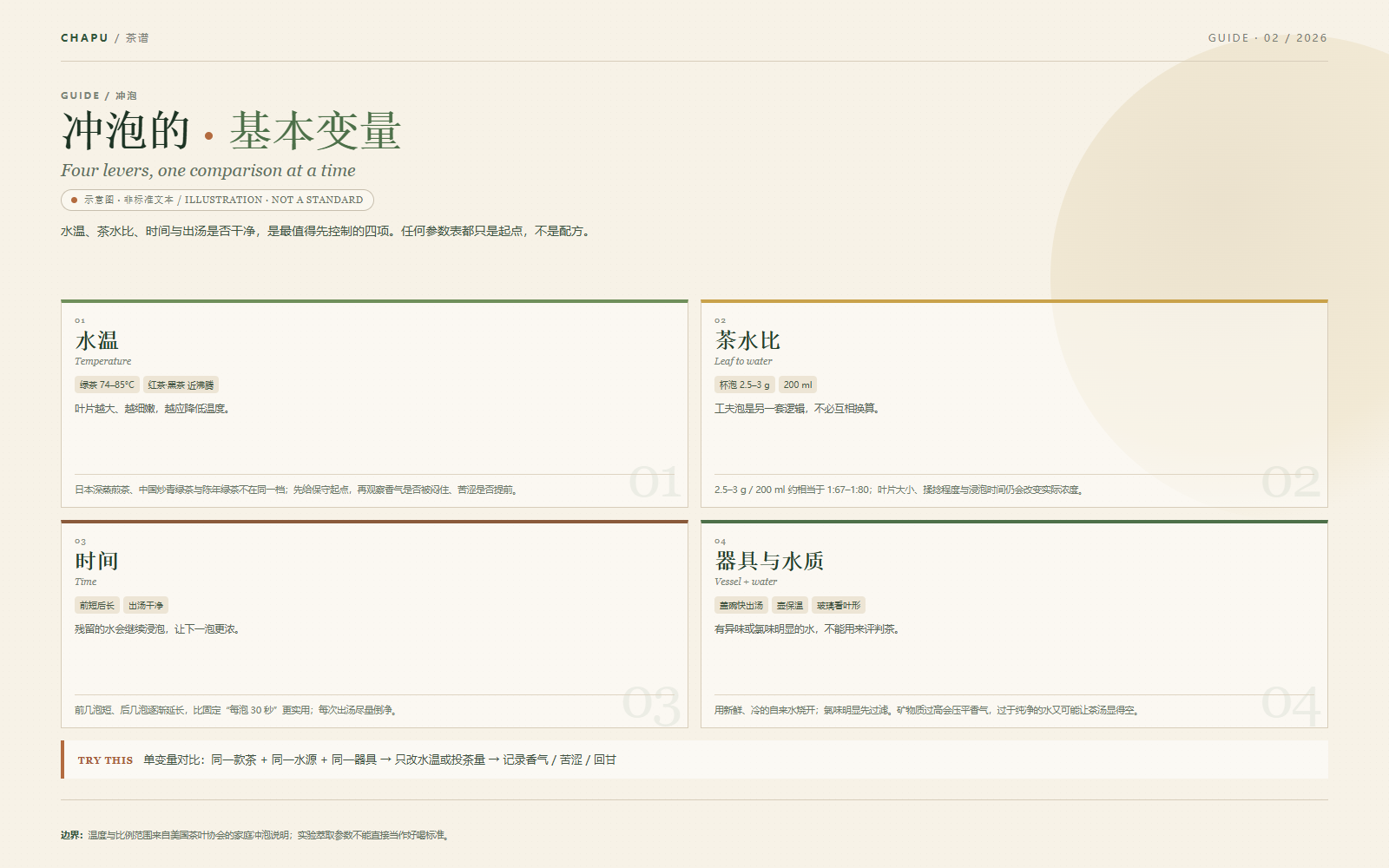
Water temperature, leaf-to-water ratio, steeping time and whether you empty the vessel cleanly matter more than elaborate gestures. Read Brewing variables, then brew the same tea two or three times and change only one thing.
If you change the temperature, keep the leaf and the time fixed. If you change the leaf quantity, keep the water and the time fixed. Write down what changed in aroma, bitterness, sweetness and aftertaste. Two or three honest comparisons will teach you more than a page of universal numbers.
The Tea Association of the U.S.A. leaflet also treats its figures as starting points. Two teas both sold as “green tea” may tolerate very different temperatures: a fine early-spring bud tea and a larger late-season leaf are not the same material.
Step five: go out to teahouses and tea routes
Teahouses and trade routes return tea to ordinary life and geography. Choose one teahouse you might actually visit, and read its history, space and present condition. Or follow one trade route and ask how tea moved from a producing area into a city, a port and a cross-border market.
Those pages are published by the teahouse and tea-route sections of this project; this guide only provides the entry point. As you read, separate three kinds of material: contemporary ledgers, contracts and local gazetteers; later memoirs and literature; and today’s tourism copy. All three can be useful. They are not the same kind of evidence.
How to use the path
- One question at a time. Spend a week on tea families, then a week on temperature. Do not open all five fronts at once.
- Anchor everything to one tea. Choose a tea you already own and run each step through it. That is more useful than reading ten regions in the abstract.
- Keep a comparison note. Same tea, same water, one changed variable. Record aroma, bitterness, sweetness and finish. Repetition builds calibration.
- Ask who is speaking. Before arguing with a claim, ask who made it, in which period, and for what audience. Then ask who still uses it today.
Where to go next
You do not have to finish in order. Start with Six tea families if the names are still a blur, or go straight to Brewing variables if you already have a tea you like but cannot reproduce it.
After each page, try to say three things in your own words without looking. If you cannot, go back to the text rather than collecting more vocabulary. The test of an introduction is not how many terms it installs. It is whether you can make one better decision the next time you brew.
All migrated pages are currently marked reviewed, but sources and wording will continue to be revised. If you find an error, correct the Markdown and record the evidence in the source note rather than patching only the rendered page.