Start with four controls
Water temperature, leaf-to-water ratio, steeping time and whether you empty the vessel cleanly are the four controls worth learning first. Tea type, leaf size, compression, roast level and personal taste all change the answer. Every table of numbers is a starting point, not a recipe.
It helps to think of these controls as levers that trade against one another. Hotter water usually brings bitterness forward. More leaf raises concentration and body, but not necessarily aroma in the same proportion. A longer steep fills out the texture and also pulls the rougher tail of the leaf. Know which lever you are moving before arguing about the number.
Water temperature
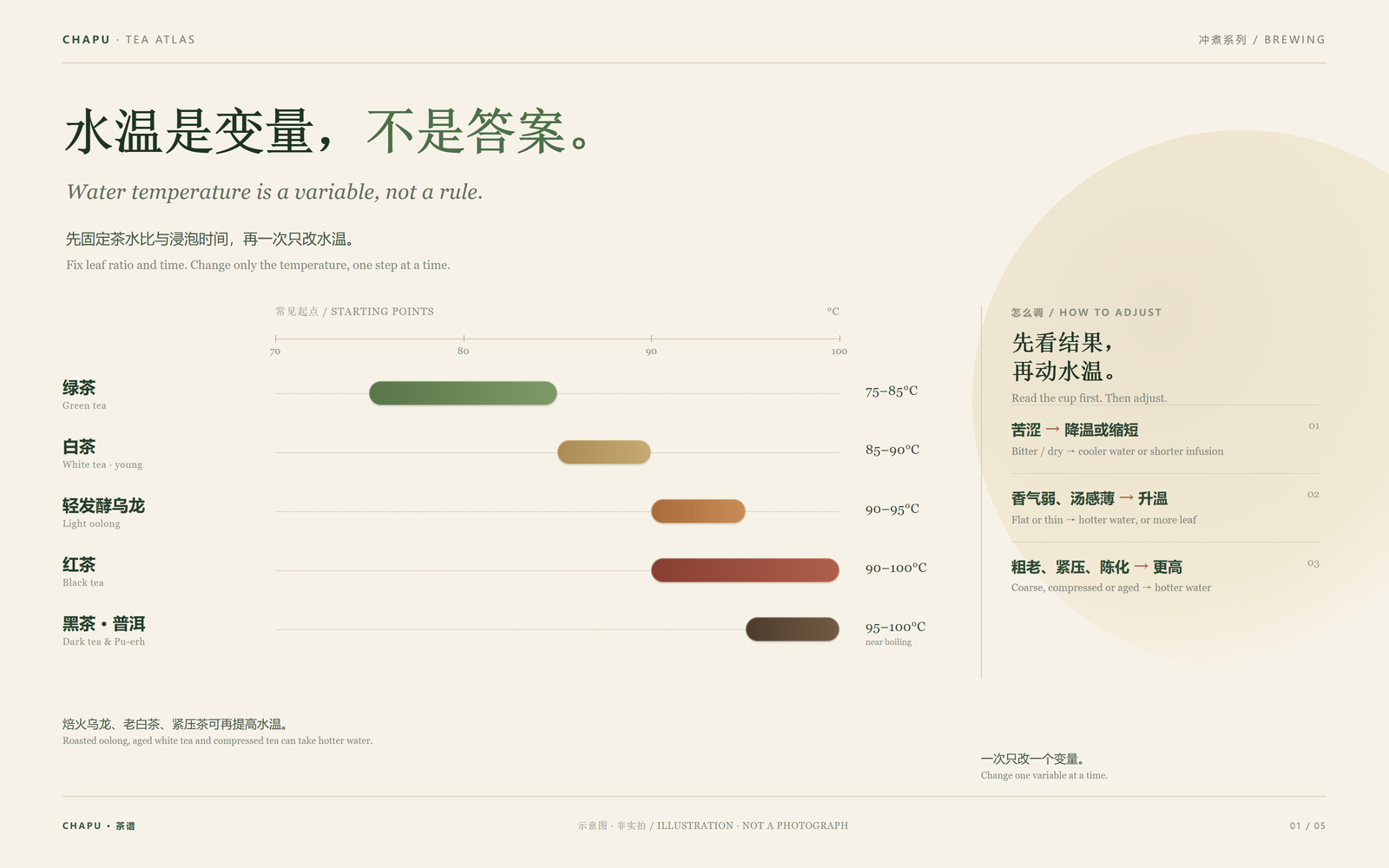
Temperature determines which compounds are extracted quickly and in what proportion. The Tea Association of the U.S.A. places green tea at roughly 165–185°F (about 74–85°C), and notes that larger or more delicate leaves should receive cooler water. Black tea, dark tea and compressed tea generally need water close to boiling. That direction is more useful than memorising one figure.
“Green tea at 80°C” is not a law. An early-spring bud tea, a larger late-season leaf, a steamed Japanese sencha, a pan-fired Chinese green and an aged green do not tolerate the same treatment. Start conservatively for the type, then watch the first infusion: is the aroma muted or cooked? Does bitterness arrive before sweetness? Adjust from evidence, not from the label alone.
The same logic applies to oolong. A light, floral balled oolong can be bruised by water that is too hot; a heavily roasted strip oolong may taste thin at the temperature used for a green tea. White tea is often treated as delicate, but leaf grade and bud proportion matter more than the colour of the dry leaf.
Ratio and time
For Western-style cup brewing, a common starting range is 2.5–3 g of leaf to 200 ml of water. That is roughly 1:67 to 1:80 by weight. The actual strength still depends on leaf size, rolling and steep time. A gongfu session usually uses more leaf in a smaller vessel and compensates with much shorter infusions, so the same tea can be pleasant under two very different sets of numbers. Do not convert one regime into the other as if they were the same experiment.
Time is not a simple “longer equals more flavour”. Short early infusions followed by gradually longer ones usually give a clearer arc than a fixed thirty seconds for every round. Green tea and fine white tea often benefit from a short first pour; black, oolong and dark tea can be judged by aroma and body as they open. Empty the vessel cleanly each time. Water left behind continues to extract and makes the next infusion start from a stronger place.
A common mistake is to add more leaf when a cup tastes thin. If aroma is present but the body is light, first try a little more time or a little more heat. If the cup is already bitter, reduce time or temperature rather than adding leaf. More leaf usually magnifies the bitter edge along with the strength.
Vessel and water
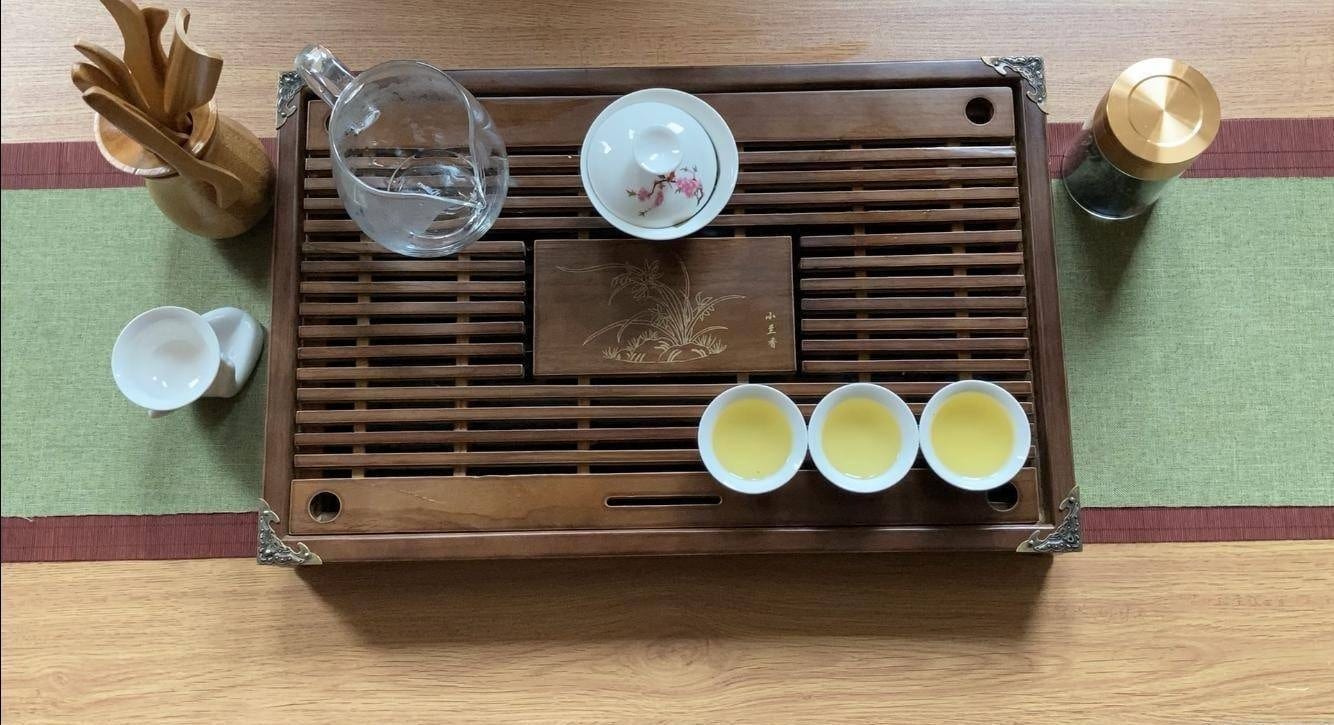
A gaiwan pours quickly and lets you watch the leaf and smell the lid. A teapot holds heat, but may pour slowly; it suits teas that need sustained high temperature. Glass shows leaf shape and liquor colour but loses heat quickly, which can be an advantage with tender green tea. None of these vessels is inherently better. The useful question is whether the vessel makes temperature and timing easier for you to control.
Water quality affects aroma and texture. Water with a noticeable chlorine smell should be filtered before boiling. Very hard water can flatten aroma and make the liquor feel coarse; water that is too pure can make the cup taste hollow. The Tea Association leaflet gives a plain rule: use fresh, cold tap water, bring it to a full boil, and filter first if the water has objectionable odours. Expensive bottled water is not a shortcut to good tea, but water with an off-flavour is a poor judge of any leaf.
Make one clean comparison
Take one green tea. Fix 2.5 g to 200 ml and two minutes, then change only the water temperature from 80°C to 90°C. Record three things: whether the aroma became more open or more cooked, whether bitterness arrived earlier, and whether the finish lasted longer. In a second round, fix the temperature and change only the leaf from 2.5 g to 3.5 g.
Two comparisons like this tell you whether the tea is more sensitive to heat or to concentration. If you change temperature, leaf and time together, you will know that the cup changed but not why. A handful of single-variable trials is worth more than ten parameter tables.
Keep the water, vessel and pouring style constant while you do this. If you switch from a gaiwan to a teapot between trials, you have changed the thermal history as well as the variable you meant to test.
Laboratory extraction is not a brewing recipe
The PubMed study on green tea catechins compares extraction yield at 80°C for 30 minutes and at a water-to-tea ratio of 50:1 mL/g, among other conditions. It answers a different question from “what makes a pleasant cup”. A thirty-minute steep would usually be far too strong and bitter for drinking. The study is useful for understanding how temperature and ratio change extraction, not for copying a laboratory protocol onto a tea table.
When reading this kind of paper, first ask what was measured: total catechins, individual aroma compounds, amino acids, caffeine, or a sensory score. Different targets produce different “optimum” values. Treat the experimental conditions as evidence about the variables, not as instructions for your next pot.
Status and sources
This page is a brewing guide. Its figures are common starting points, not universal rules. The Tea Association leaflet supplies industry ranges for temperature, leaf quantity and time; the PubMed study supplies experimental evidence on temperature, ratio and extraction. Neither replaces repeated comparisons with the particular tea in front of you. All migrated pages are currently marked reviewed, but sources and wording will continue to be revised.