What it is
Longjing is a pan-fired green tea from the Hangzhou area of Zhejiang. It is known for flat, straight leaves, a fresh fragrance and a sweet, refreshing taste. The traditional phrase “green colour, rich aroma, sweet taste, beautiful shape” summarises its aesthetic, but it is not a substitute for a product standard. Not every flat green tea is Longjing.
Origin and protected area
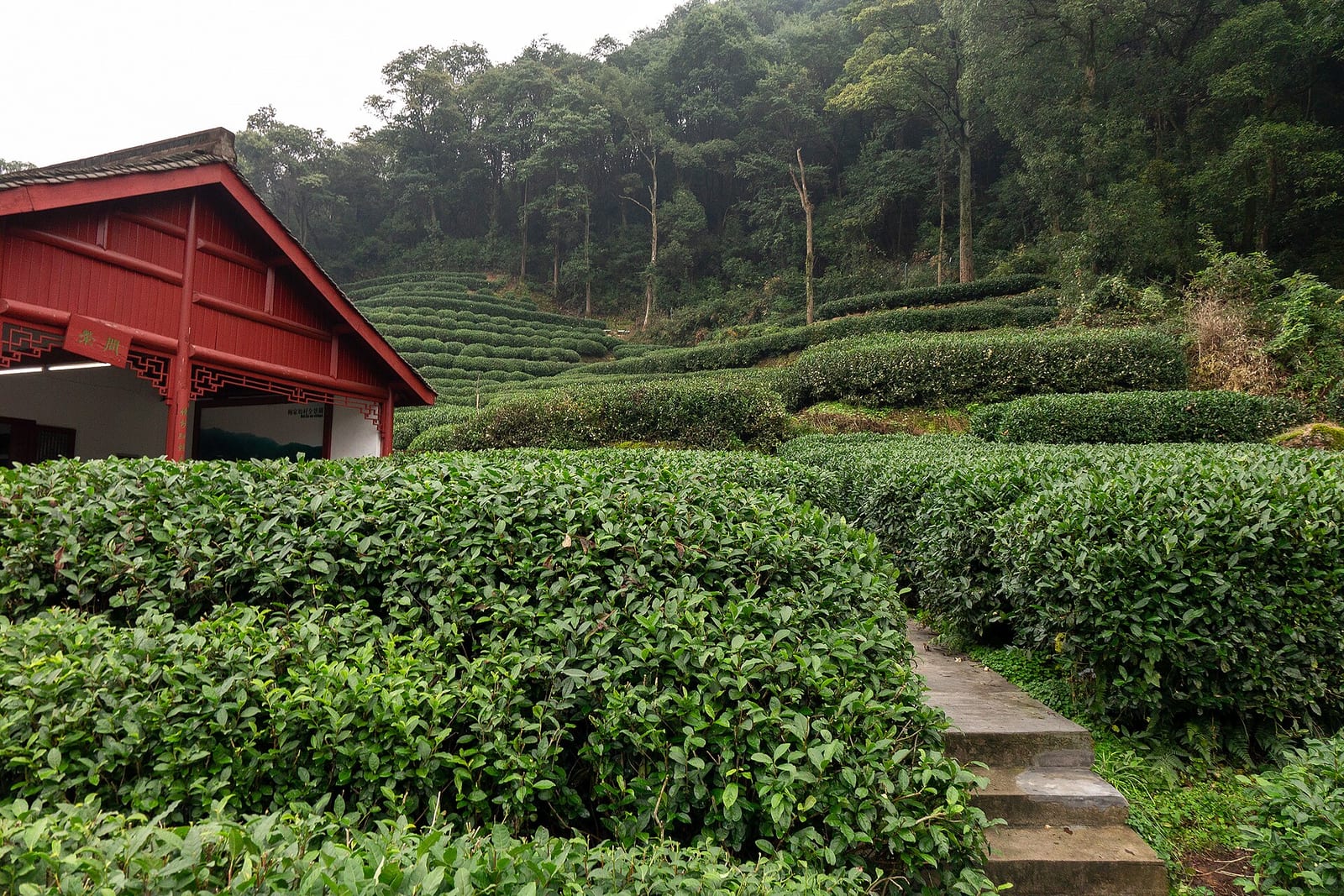
The protected area, natural environment, cultivars and processing requirements are defined by GB/T 18650-2008. The market often speaks of West Lake, Qiantang and Yuezhou production areas; the exact boundaries, permitted cultivars and product requirements should be checked against the current standard and geographical indication announcement. Within the West Lake area, the traditional labels Shi, Long, Yun, Hu and Mei refer to local sites and reputations, not administrative districts or uniform grades.
Cultivars
The standard lists suitable cultivars including Longjing population, Longjing 43, Longjing Changye, Yingshuang and Jiukeng. Population cultivars usually sprout later and vary more between plants; Longjing 43 sprouts early and is relatively uniform, and is widely planted. Cultivar affects sprouting time, leaf shape and aroma, but the same cultivar can taste different under different sites and processing.
Processing
Traditional Longjing is pan-fired: spreading, first firing, resting, final firing and sieving. The first firing removes moisture and begins shaping; the final firing dries, shapes and develops aroma. Both hand and machine processing can produce compliant Longjing, and the standard includes requirements for mechanical processing. Temperatures, leaf load and hand movements vary by factory, product and maker; no single set of numbers describes all Longjing.
Quality and flavour
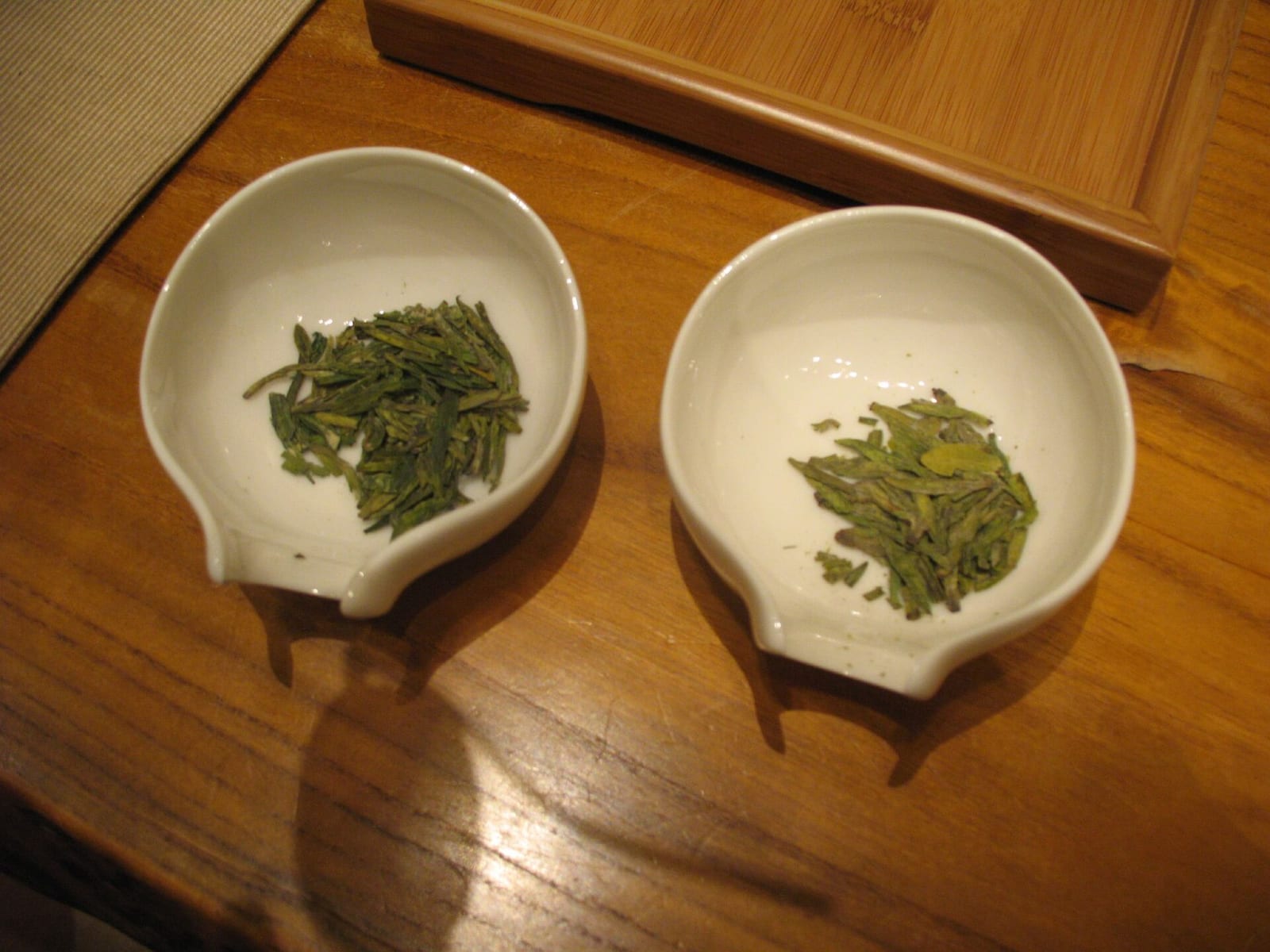
Dry leaves are flat and straight, yellow-green to emerald. The liquor is pale green and bright, with fresh, bean or chestnut aromas and a refreshing taste; sweetness and aftertaste depend on material and processing. Aroma type, intensity and durability change with origin, cultivar, picking date and processing.
Brewing
Use a glass or gaiwan with water around 80–85°C. Add a little water first to wet the leaf, then fill along the wall and infuse briefly. Water that is too hot or an infusion that is too long can amplify bitterness. Adjust leaf quantity to taste; a glass is convenient for watching the leaves open, but it is not the only correct vessel.
History
The Classic of Tea records tea production at Tianzhu and Lingyin monasteries in Qiantang, showing that tea was documented in the Hangzhou area in the Tang dynasty. Tea culture among monasteries and literati flourished in the Song, and Longjing’s reputation expanded in the Ming and Qing. The story of the Qianlong emperor and the “eighteen imperial tea bushes” at Shifeng is widely told as local lore; its details and date still require archival and gazetteer verification. The traditional processing technique is on China’s national intangible heritage list.
Timeline
| Period | Event | Note |
|---|---|---|
| Tang | Tea in Qiantang recorded in The Classic of Tea | Lu Yu notes tea at Tianzhu and Lingyin monasteries |
| Song–Yuan | Monastery and literati tea culture develops | Hangzhou tea enters literati records |
| Ming–Qing | Longjing’s reputation expands | Pan-firing, flat shape and origin name gradually fixed |
| 2008 | Current geographical indication standard issued | GB/T 18650-2008 replaces the earlier standard |
Common misconceptions
- Flat shape does not make a tea Longjing. Protected Longjing also requires the defined area, cultivars and processing.
- “Mingqian” and “Yuqian” are picking times, not grades. Early picking does not automatically mean better quality.
- Hand-made is not automatically better. Hand and machine processing can both produce good tea; control and material matter.
- “Imperial tea” is cultural narrative. The Qianlong story should not be treated as verified history without sources.
Sources
- GB/T 18650-2008, Geographical indication product — Longjing tea.
- Lu Yu, The Classic of Tea.
- Legacy Zhejiang tea record, retained for provenance.
This page is an AI-edited translation based on the reviewed Chinese source. It is not a human-expert endorsement. The standard text, historical sources and production-area details should be checked before formal publication.