In one sentence
Anji Baicha is a green tea with a misleading name. “Baicha” means white tea, but the product is fixed and dried like a green tea. The whiteness comes from the cultivar: Baiye Yihao produces jade-white spring shoots with green veins when the weather is cool. The cup is pale yellow, strikingly fresh, sweet and almost free of bitterness — a tea that sells “spring” more than “age”.
Why it is not a white tea
Chinese tea categories are based on processing, not on the colour of the leaf. White tea (bai cha) is made by withering and drying fresh leaves with minimal fixing and rolling; it is not a green tea.
Anji Baicha is made from fresh leaves of Baiye Yihao, fixed in a hot pan or machine, shaped and dried. That is a green-tea process. The “white” in the name refers to the pale leaf colour during the spring albino stage, not to the white-tea category.
GB/T 20354-2006 defines Anji Baicha as a green tea produced within the protected area from the Baiye Yihao cultivar, processed to the standard's requirements.
The pale-leaf mechanism
Baiye Yihao is a temperature-sensitive cultivar. In spring, when the new shoot is growing and the temperature is relatively low, chlorophyll formation is suppressed. The young leaves look jade-white to pale yellow, while the veins remain light green — the classic “white leaf, green vein” look.
When the temperature rises above about 23°C, the leaf gradually turns white-green and then green. The pale stage is a window, not a permanent trait. Pick too early and the shoot is small; pick too late and the leaf has turned green and the distinctive style is gone.
During the pale stage, the balance of amino acids and polyphenols shifts: the tea tends to have more free amino acids and relatively less bitterness. That is why the cup tastes so sweet and fresh. It is a biological effect of the cultivar and the weather, not a flavouring.
Where it grows
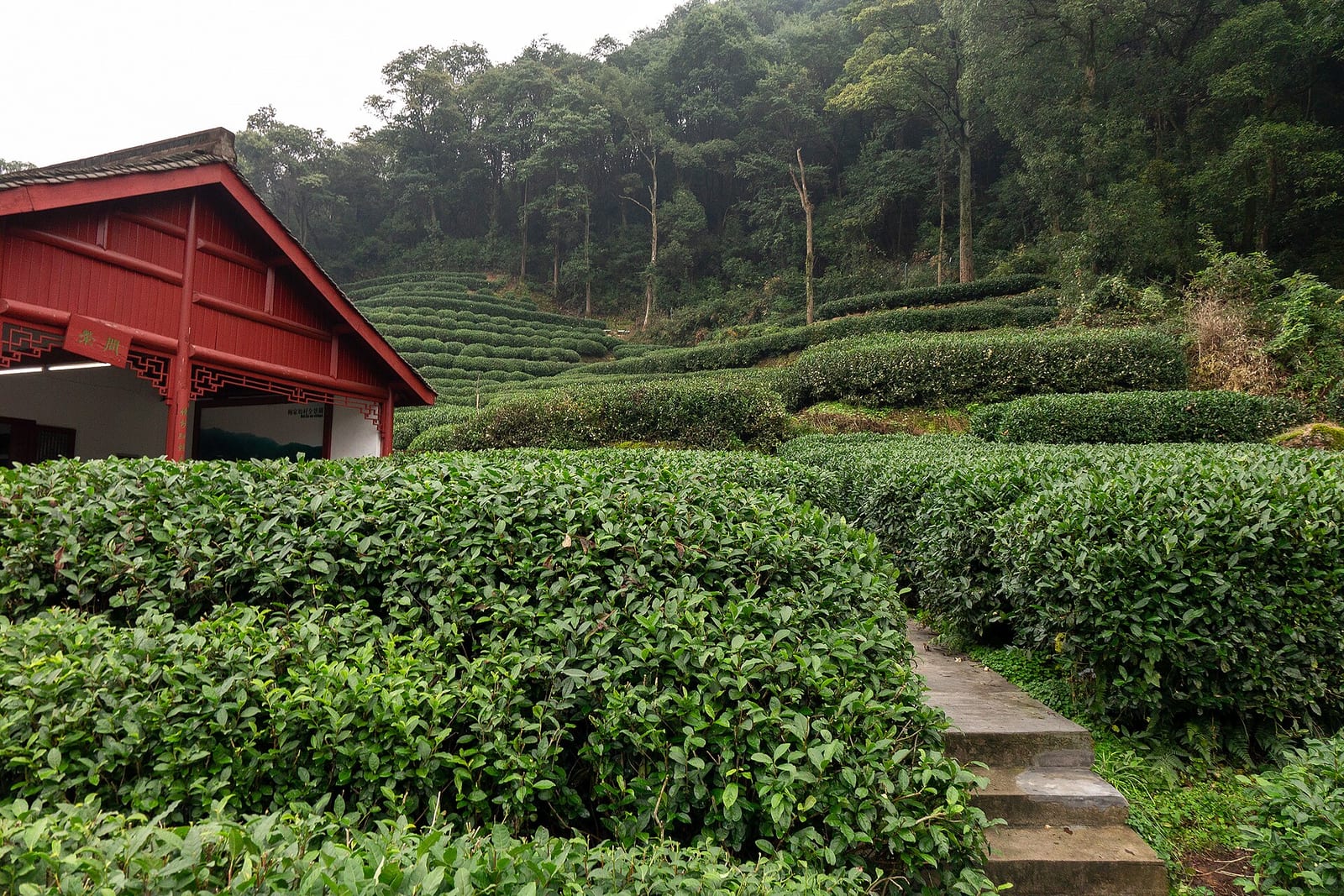
The protected area is the entire administrative area of Anji county, Huzhou, Zhejiang. Anji sits at the northern foot of the Tianmu Mountains, with a subtropical monsoon climate, distinct seasons, ample rain and frequent cloud. Tea gardens are on hills and slopes, with acidic yellow or red soils that drain well and carry good organic matter.
High-elevation gardens have a longer cool spring and a longer pale stage, so the shoots are thicker and the flavour more concentrated. Low-elevation gardens sprout earlier and crop heavier, but the pale window is shorter and the aroma can be lighter. Altitude is a factor; it is not a quality guarantee.
Picking
The 2006 standard requires one bud and one initial leaf to one bud and three leaves. Diseased and frozen leaves are rejected. In practice, the top grades use one bud and one initial leaf; lower grades extend to two or three leaves.
Picking runs from around Qingming to Grain Rain, with the pale stage as the core window. The fresh leaf is spread thin to wither — never piled and heated — so the grassy note fades and the leaf softens for fixing.
Craft
The 2006 standard lists two product shapes:
Phoenix-shaped (凤形): withering → fixing → straightening → rolling and first baking → cooling → final baking → sorting.
Dragon-shaped (龙形): withering → fixing → cooling → drying.
The phoenix shape is a straight, slightly curved strip; the dragon shape is flatter and pressed. The 2026 revision adds an orchid-shaped style, but the core logic is the same: fix quickly, shape gently, dry slowly, and preserve the pale colour and fresh taste.
- Fixing: high heat, fast, to stop oxidation. Under-fixed leaf is grassy and dull; over-fixed leaf turns yellow and loses the fresh edge.
- Straightening/shaping: the leaf is pulled straight or pressed flat while warm. Too much pressure breaks the tender shoots; too little leaves a soft, uneven strip.
- Baking: low temperature, in stages, to bring moisture below the safe limit without cooking the aroma.
The standard's principle is “preserve green, preserve freshness”. Anji Baicha is not a tea for heavy roasting or deep pan-firing.
Taste
- Dry leaf: straight or flat strips, bright green with golden-yellow lights, white down visible.
- Liquor: pale yellow to apricot-yellow, clear.
- Aroma: fresh, tender, chestnut or orchid; light and clean rather than intense.
- Mouthfeel: fresh, sweet, mellow, almost no bitterness; a soft, Spring-water texture.
- Leaf base: jade-white to pale yellow, green veins, tender and intact.
“Fresh as chicken soup” is a marketing metaphor, not a standard term. The freshness comes from the cultivar, the pale stage, the amino acid balance and a clean, light firing. A poorly made Anji Baicha can be grassy, flat or cooked; the name alone does not guarantee the effect.
Brewing
- Water: 80–85°C. The shoots are tender; boiling water flattens the freshness.
- Leaf: 3–4 g per 200 ml glass.
- Method: glass, water first then leaf, so the shoots open slowly. A gaiwan works if you pour quickly.
- Timing: 20–30 seconds for the first infusions, then lengthen. Do not cover and stew.
- Vessel: glass shows the pale leaf and green veins; white porcelain shows the liquor colour.
Grades and buying
The 2006 standard grades the tea; the market uses “special”, “first” and “second”. Look for:
- Origin. Anji county, within the protected area; the package should carry the geographical-indication mark.
- Cultivar. Baiye Yihao. Not every pale-leaf tea is Anji Baicha.
- Shape. Phoenix: straight, slightly curved strips; dragon: flat and upright. White down natural, not a surface dusting.
- Aroma. Fresh, tender, chestnut or orchid; not grass, smoke or perfume.
- Taste. Fresh, sweet, low bitterness; not flat or astringent.
- Leaf base. Jade-white, green veins, tender and intact.
- Standard. GB/T 20354-2006 or GB/T 20354-2026. Before 2027-04-01, the old standard may still be lawfully applied.
History and the name
The name “Anji Baicha” has caused confusion for decades. Some old marketing text claims it is the “white tea” recorded by Emperor Huizong in the Treatise on Tea (大观茶论). That is not accurate: the Song text describes a different white-leaf tea of its own time, not the modern Anji cultivar, and the processing is different.
What is verifiable: Baiye Yihao was discovered and selected in Anji in the late 20th century, then propagated and promoted as a green tea; GB/T 20354-2006 brought the product into the geographical-indication system; and the 2026 revision updates the standard for the next stage of the industry.
Status
This English entry is an independent editorial rewrite, not a sentence-by-sentence translation. It uses GB/T 20354-2006 for the definition, cultivar, picking, product shapes and quality framework; the Anji county government's 2026 article for the transition period and the new orchid-shaped style; and the national standards platform for the 2026 dates. The old claims of “6–10% amino acids, two to three times normal tea”, “extremely low polyphenols”, the Huizong connection, the “only mother tree”, and exact output values were removed. The page is marked reviewed; sources and wording will continue to be revised.