“This tea smells amazing.” It is easy to say and hard to unpack. Tea aroma is not a substance called “tea flavour”. It is a blend of dozens or even hundreds of volatile molecules, each at a different concentration and each with its own odour threshold. One drinker smells orchids, another notices fresh grass, a third remembers roast. None of them is wrong; a cup of tea is a mixture.
You do not need the chemical names first. Separate three questions: where the aroma comes from, where processing pushes it, and how much brewing releases. Once those layers are distinct, words such as “high aroma”, “fine aroma” and “aroma in the liquor” start to mean something.
Aroma is molecules, not adjectives
Tea volatiles include alcohols, aldehydes, ketones, esters, lactones, terpenes, pyrazines and furans. They do not all need to be abundant. Some are perceived at extremely low concentrations; these low-threshold, high-impact compounds often shape the first impression of a cup.
A “fragrant” tea is therefore not simply a tea with a large total volatile load. One molecule may stand out, or may be masked by another stronger odour. When assessing aroma, look at four dimensions:
- Type. Grassy, floral, fruity, sweet, nutty/roasted, woody, aged.
- Intensity. Is the aroma obvious, and does it overpower everything else?
- Definition. Is it one blunt note, or a layered, changing profile?
- Persistence and infusion. Does it stay on the lid and in the empty cup, or does it enter the liquor and return after swallowing?
“High aroma” is mostly intensity. “Fine aroma” is more about composition and layering. “Aroma in the liquor” is the ability of volatile compounds to be perceived with the liquid, including after swallowing. They are not the same quality.
Six common formation routes
Tea aroma can be grouped into six broad routes. They are not mutually exclusive lab categories; several proceed in the same leaf at the same time:
| Route | Main precursors | Typical odour direction | Where it shows up |
|---|---|---|---|
| Carotenoid degradation | β-carotene, xanthophylls | Floral, fruity, violet-like sweetness | Black-tea oxidation, oolong shaking |
| Fatty-acid oxidation | Linolenic acid, linoleic acid | Grass, cucumber, green apple | Fresh leaf before kill-green, green tea |
| Terpenes | Terpene alcohols, glycosides | Floral, citrus, woody | Oolong, white tea, floral black tea |
| Phenylpropanoid/benzenoid | Phenylalanine and relatives | Floral, sweet, clove-like | Oxidation, drying |
| Glycoside hydrolysis | Aromatic alcohol glycosides | Floral and fruity, released slowly | Brewing, shaking, withering |
| Maillard reaction | Amino acids, reducing sugars | Roast, nut, caramel, sweet | Roasting, drying, dark tea |
The table is most useful when it connects a note to a process. Floral notes in oolong often come from terpenes and glycoside hydrolysis; floral notes in black tea may come from carotenoid breakdown and phenylpropanoid routes. A sweet note may be a released glycoside or a Maillard product from roasting. Similar smells do not always share a source.
Where processing pushes the aroma
Kill-green: preserve “green”, or decide to go “roasted”
Green tea uses high heat to quickly deactivate enzymes, preserving the green colour and low-boiling grassy notes. Too little kill-green leaves a raw, grassy edge; too much brings bean or scorched notes and reduces freshness. “Green” is not a defect here; it is part of the style.
Withering and shaking: release what was locked away
White tea and oolong both rely on withering. As the leaf loses water slowly, glycoside precursors hydrolyse and some floral and fruity notes begin to emerge. Oolong adds shaking or “doing green”: the leaf edges are lightly bruised, and oxidation and aroma conversion proceed in a controlled way. Light shaking gives a clearer floral profile; heavier shaking brings fruit and sweetness, but can also bring back greenness and bitterness.
Oxidation: turn grass toward sweet and floral
Black-tea oxidation is not “adding fragrance”. It is an enzymatic rearrangement of substrates. Catechins oxidise, carotenoids break down, amino acids enter Maillard reactions, and grassy notes fall while sweet, floral and fruity notes rise. Under-oxidised tea can taste green and astringent; over-oxidised tea can smell dull and look dark.
Drying and roasting: the final fix, and a risk
Drying stabilises quality and removes some low-boiling volatiles. Higher roasting temperatures drive Maillard reactions and caramelisation, producing nutty, caramel and roasted notes. Too much heat or time can bury the floral character and create scorch. The “fire” of a roasted oolong is exactly this trade-off: enough to finish the tea, not so much that the cultivar’s aroma disappears.
Smell in more than one place
Dry leaf, the gaiwan lid, the liquor and the wet leaf do not smell the same. Judging from one position is a common source of error.
- Dry leaf. Check for aged, storage, smoke or obvious added-perfume notes. Dry aroma is a reference, not a prediction of the brewed cup.
- Lid / gaiwan aroma. High heat makes floral, sweet and roasted notes easy to catch. A strong lid aroma does not guarantee aroma in the liquor.
- Liquor. Aroma perceived through the back of the nose while drinking is closer to what you actually taste.
- Wet leaf. The infused leaf retains some volatiles and helps judge whether the process is clean or stewed.
Temperature changes perception. Hot smelling emphasises volatile, sharp top notes; warm smelling is closer to overall balance; cold smelling reveals lingering sweetness, wood or aged notes. Professional tasting often records all three stages.
Brewing: release, but also loss
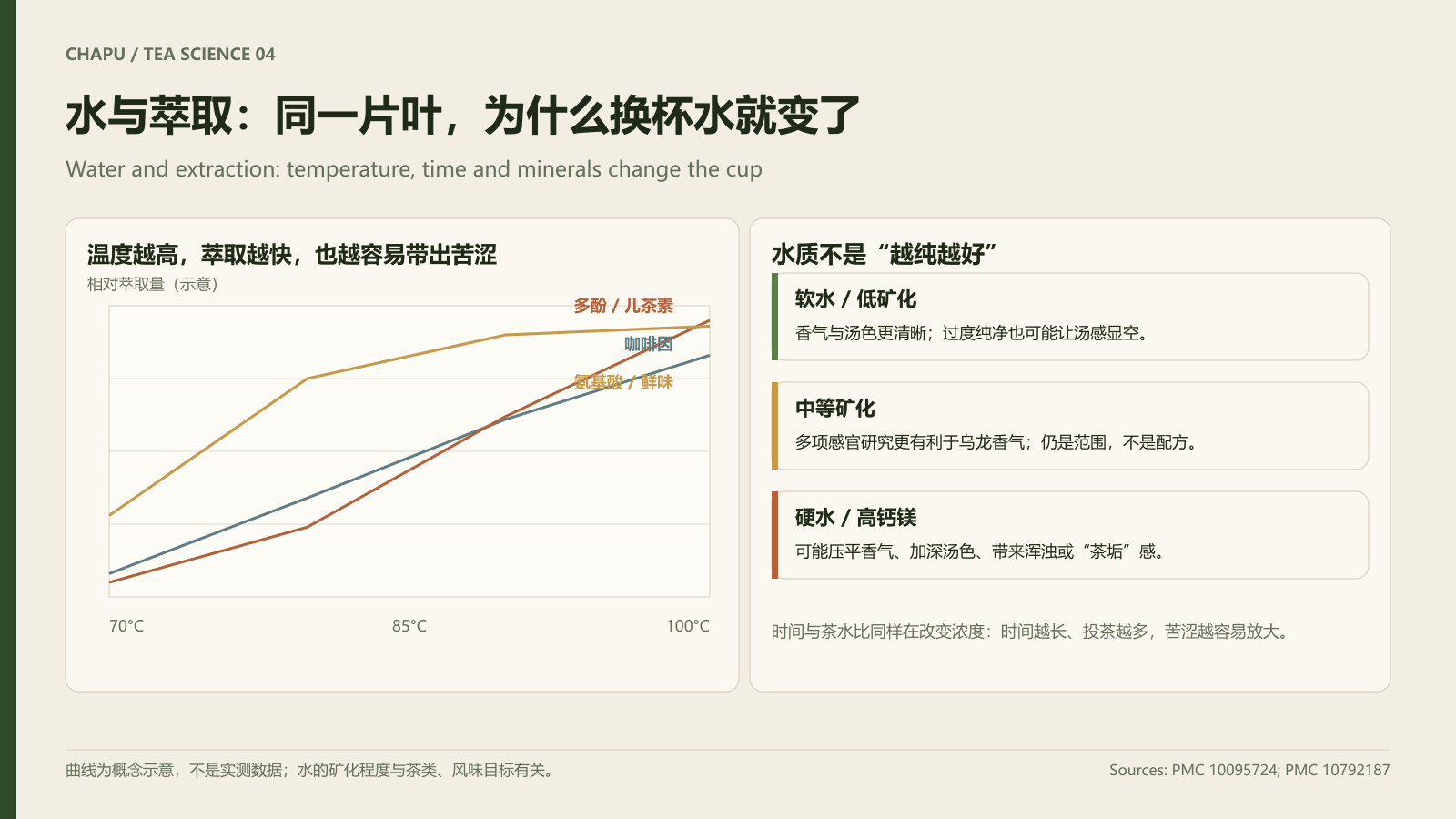
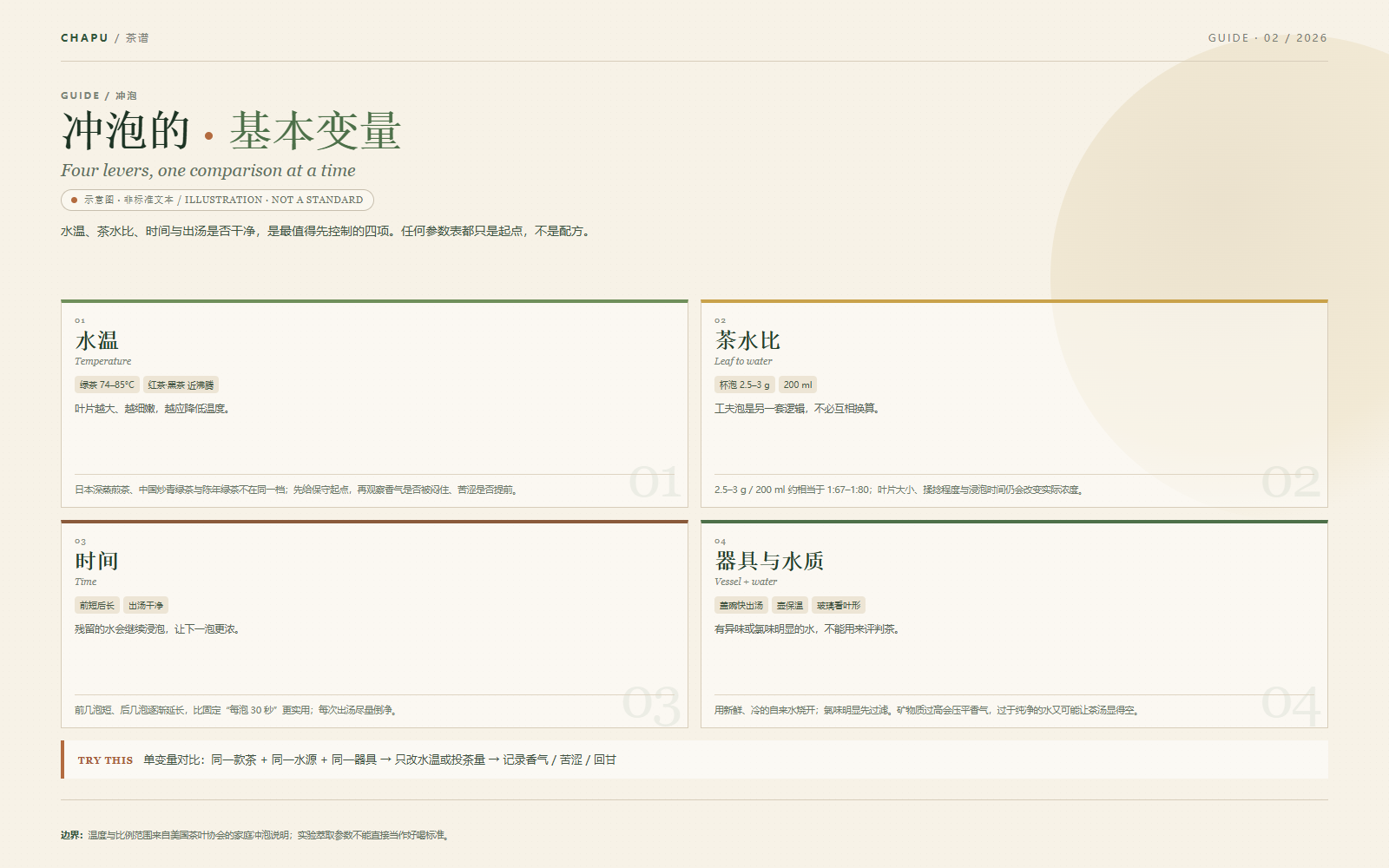
Aroma molecules differ in boiling point and solubility. Hot water releases them quickly, but can also drive off the lightest ones; cooler water keeps the aroma tight, sometimes making the liquor seem closed. There is no universal “best temperature”; it depends on the tea and on which part you want to highlight.
Useful variables:
- Water temperature. Green tea and heavily peached whites often use cooler water to protect freshness; oolong and dark tea can take hotter water to open aroma.
- Vessel. A gaiwan concentrates aroma and makes lid-smelling easy; a small-mouthed pot concentrates it differently and changes heat retention.
- Pour. A high pour agitates the leaf and releases aroma, but can also bring up astringency; a low pour is softer. Higher is not automatically better.
- Decanting. Short early steeps keep the aroma from stewing; later steeps lengthen to draw out what remains.
- Water. Low-mineral water usually keeps aroma clearer; very hard water can flatten aroma and darken the liquor.
Four common misunderstandings
| Claim | What is wrong | A more careful reading |
|---|---|---|
| “The stronger the aroma, the better the tea” | Intensity is not definition or persistence | Also ask whether the profile is clean, whether it enters the liquor, and whether it balances the taste |
| “Strong aroma means added perfume” | High-aroma cultivars and processing can also produce it | Compare dry leaf, liquor and wet leaf; look for unnatural persistence or off-notes |
| “Aged note means good old tea” | Clean aged aroma differs from damp, mouldy storage | Clean age tends toward wood, herb and date; dampness is a storage problem |
| “Obvious cold aroma means good tea” | Cold smelling amplifies some lingering volatiles | Cold aroma is one dimension, not a substitute for hot smelling and the liquor |
Source boundary
This page can confirm: tea aroma is a blend of many volatile organic compounds, and low-threshold compounds can shape perception; carotenoid degradation, fatty-acid oxidation, terpenes, phenylpropanoids, glycoside hydrolysis and Maillard reactions are common routes; kill-green, withering, shaking, oxidation, drying and roasting change the aroma mix; and aroma can be assessed from dry leaf, lid, liquor and wet leaf.
This page does not confirm: the exact volatile composition of a particular tea; that smelling alone can determine origin, cultivar or quality; or that a stronger aroma is healthier. Aroma is a sensory and chemical result that needs repeated brewing and comparison.