Water is more than 99% of a cup of tea. Its temperature, mineral content, pH and residual chlorine all change what ends up in the liquor. Attributing a good cup entirely to the leaf ignores the other half of the equation.
This page is about extraction: how water pulls polyphenols, caffeine, amino acids and aroma out of the leaf, and why the same tea changes when you change the water, temperature or time. It does not offer a universal recipe; it explains how the variables trade off.
Water is a solvent, not a backdrop
Tea solubles include polyphenols, caffeine, amino acids, sugars, organic acids, aroma compounds and minerals. They differ in solubility and extraction speed: amino acids and some sugars arrive early, polyphenols and caffeine later, and aroma is strongly affected by temperature and time.
“Steep longer for more flavour” is only half true. Longer time raises concentration, but also pulls late-stage roughness, woody notes and bitterness. The real task is to control temperature, leaf-to-water ratio, time and how completely you drain the leaf.
Temperature: freshness first, astringency later
Higher temperature speeds molecular motion and extraction. Studies from 40°C to 100°C show polyphenol and caffeine yields rising with temperature; 100°C extracts more than 90°C. But “more extracted” is not “better tasting”: heat also brings bitterness and roughness forward.
A rough order:
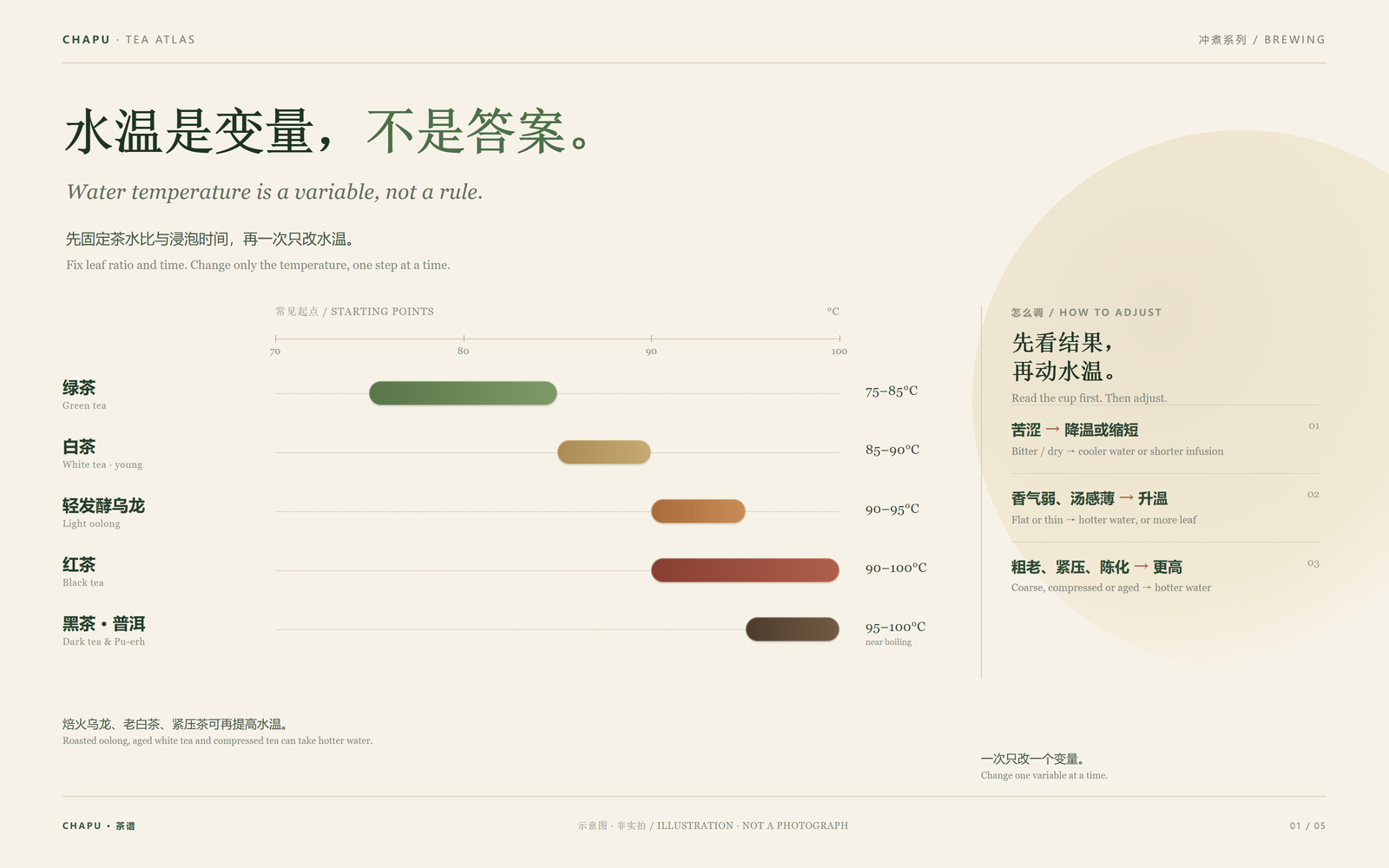
- Lower temperatures (about 70–85°C): amino acids, some sugars and aroma arrive first; the cup is sweeter and lighter, suited to tender green tea, some white tea and aromatic oolong.
- Medium-high temperatures (about 85–95°C): polyphenols and caffeine extract more strongly; suits most oolong, black tea and some raw pu-erh.
- Near boiling (about 95–100°C): suits coarse leaf, compressed tea, roasted tea and dark tea; tender green tea can turn bitter and stewed.
This is not a fixed table. Leaf size, rolling, compression, roast level and personal taste all matter. Japanese deep-steamed sencha and Chinese pan-fired green tea do not sit in the same band; two teas labelled “green” can differ by 10°C in their sensible range.
Time and ratio: two levers for strength
Strength depends on leaf quantity and how much dissolves. More leaf and more time raise concentration, but extraction is not linear: after a point, concentration plateaus while bitterness may keep climbing.
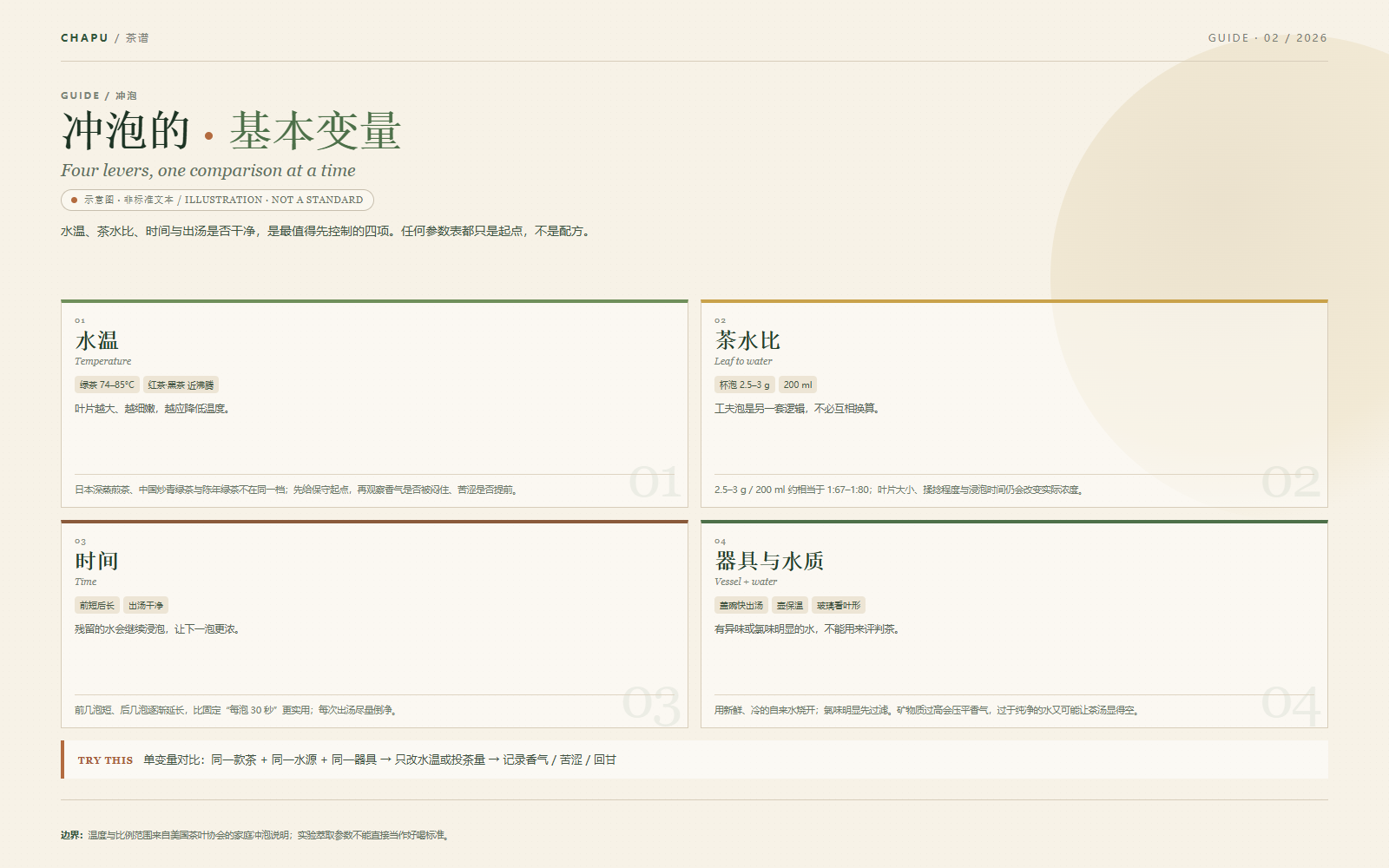
For a western-style cup, start around 2.5–3 g of leaf to 200 ml water. Gongfu brewing usually uses more leaf and shorter individual steeps so that the same leaf unfolds across many infusions. The two logics need not be converted into each other: one is “how much leaf in one cup”, the other is “how many cups from one portion”.
If the tea tastes weak, first ask whether aroma or body is missing. Weak aroma may mean water too cool or leaf not opened; thin body with bitterness already present may mean too little leaf, too short a steep, or water that flattens the texture. Do not solve every problem by adding more leaf.
Minerals: hard water turns the volume down
Water mineralisation is often described by calcium, magnesium or hardness. For tea, the point is not “more minerals is healthier” but how they interact with polyphenols and aroma compounds.
- Soft / low-mineral water. Aroma and liquor colour are usually clearer; suited to tender green tea and aromatic tea. Over-purified water can make the body feel hollow and thin.
- Moderate mineralisation. Some studies find that moderately mineralised spring or natural water supports oolong aroma; it is a range, not a formula.
- Hard / high calcium and magnesium. Calcium and magnesium can bind polyphenols, create sediment or haze, flatten aroma, darken liquor and leave a “tea scale” sensation. Very hard water is especially likely to make tender green tea taste stewed.
A 2024 Tieguanyin study compared pure water, mountain spring water, mineral water and natural water. Mineral water produced a flatter taste and turbid aroma through complex calcium, magnesium and flavour interactions; moderately mineralised natural and spring waters were more favourable to aroma. The conclusion is limited to that tea and those water samples; it does not generalise to all tea.
“Purer is better” is also false. Pure water has little mineral buffering, and some teas taste thin in it. Tap water is not automatically bad either; chlorine, hardness and off-flavours are the things to check. If chlorine is noticeable, filter or let the water stand rather than masking it with fragrance.
Chlorine, pH and vessels
Residual chlorine reacts with aroma compounds and can give a swimming-pool or disinfectant note. When tap water smells of chlorine, filter it, boil it or let it stand; do not judge a tea through bad water.
pH affects catechin stability and liquor colour. Alkaline water can dull green-tea colour and make astringency more obvious; acidic water can brighten colour but shift the flavour balance. There is no need to “adjust pH” at home; start with water that has no off-flavour and moderate mineralisation.
The vessel changes the real temperature and the speed of pouring: a thick-walled pot holds heat, a thin gaiwan loses it, and a slow-pouring pot keeps the leaf in water a few seconds longer. When comparing water, use the same vessel, leaf quantity and time, or you will not know which variable caused the difference.
A practical water comparison
Choose one tea and fix 3 g / 200 ml, 90°C and 2 minutes. Change only the water:
- Tap water, boiled and left open for one minute;
- Filtered or low-mineral bottled water;
- Moderately mineralised spring water (check calcium and magnesium on the label; avoid “high mineral”).
Record three things: clarity of aroma, fullness of body and how early bitterness appears. Do not change three waters and the parameters at the same time; only a single-variable comparison gives information.
If the three waters taste almost the same, the tea is not very water-sensitive, or your parameters are masking the difference. If hard water makes the tea dull, try softer water next time; if pure water makes it hollow, try moderate mineralisation. Two comparisons teach you more than a “best water” table.
Boundary
This page can confirm: higher temperature increases polyphenol and caffeine extraction; common green-tea guidance is 80–90°C for 3–4 minutes; calcium and magnesium in hard water can bind polyphenols, cause haze and flatten aroma; moderately mineralised water was more favourable to aroma in one Tieguanyin study; chlorine and off-flavours affect taste.
This page does not confirm: a “best hardness” for all tea; a temperature that simultaneously maximises aroma, sweetness and health compounds; or that “pure water is always better” or “mineral water is always better”. Water choice depends on tea type, flavour goal and personal taste; the reliable method is still a single-variable comparison.