

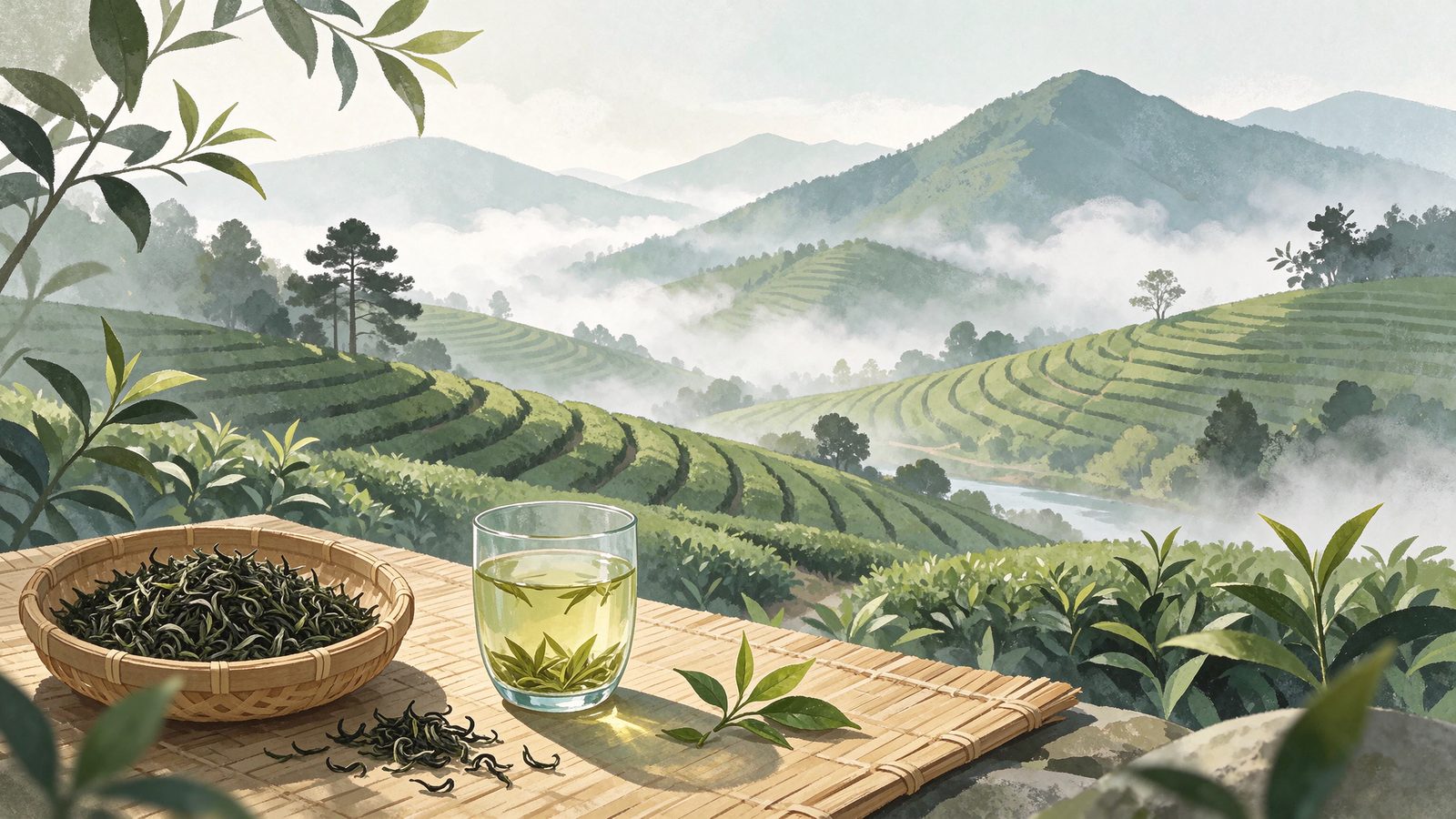
Jiangxi is an inland region built on green tea but known abroad for red tea: Wuyuan green, Suichuan Gougunao, Ninghong and Fuliang black tea.
The short answer
Jiangxi's tea gardens lie in the hills and mountains of the north, centre and south, with Wuyuan, Fuliang, Suichuan, Xiushui and Lushan as key coordinates. Wuyuan green tea is known as “Wulü”, Suichuan Gougunao is a fine needle green, and Xiushui Ninghong is a historically export-oriented black tea. Read Jiangxi by separating these brands rather than saying “Jiangxi green tea” as one thing.
Geography and growing conditions
Jiangxi is ringed by mountains on the east, south and west, with the Poyang Lake plain in the centre; gardens mostly sit at 300–1,000 metres. Northern Wuyuan and Fuliang belong to the Huangshan–Huaiyu ranges, with cloud, mist and acid soils. Southern Suichuan and Jinggangshan are lower-latitude and warm earlier; Xiushui in the northwest mixes mountains and river valleys. The province is humid subtropical; spring picking runs from late March to April, earlier in the south.
Terroir and craft
Jiangxi tea spreads across the northern, central and southern hills, with Wuyuan, Fuliang, Suichuan, Xiushui and Lushan as key names, at roughly 300–1,000 metres. Local populations and Fuding, Longjing 43 introductions are made into green, black, oolong and white tea. Wuyuan green is fine and tight, Fuliang black sweet, Suichuan Gougounao craft-driven, Lushan Yunwu cool and high-grown.
History and industry
Wuyuan green tea appears in Tang records and was exported with Huizhou merchants in the Ming and Qing. Fuliang was a major Tang tea market, fixed in memory by Bai Juyi's line about buying tea there. Xiushui Ninghong became an export black tea in the nineteenth century and was once mentioned alongside Qimen. Suichuan Gougunao won a 1915 Panama Exposition award and later became Jiangxi's premium green-tea reference. State factories and export systems shaped the industry after 1949.
Tea types and everyday drinking
Wuyuan green tea is mostly curled or flat, with high aroma and bright green liquor; Gougunao is tight, downy and fresh; Ninghong is fine, sweet and floral-fruity with red liquor. Lushan Yunwu, Fuliang black and Jinggang black also exist. Everyday drinking is plain: Wulü and Gougunao in glass at 80–85°C; Ninghong at about 90°C, plain or with milk.
Industry and market
Jiangxi produces a moderate volume. Wuyuan green, Fuliang black, Suichuan Gougounao and Lushan Yunwu are regional brands sold within the province and nationally. Brands are fragmented, and prices range from everyday tea to handmade famous lots. Nanchang and Jiujiang also have tea markets.
The cup and brewing
Wuyuan green is tender green, with chestnut, orchid and fresh sweetness. Fuliang black is bright red, with honey and fruit. Gougounao is finer and more aromatic; Lushan Yunwu has a cool, bean-like highland note. Brew green at 80–85°C; black at 90–95°C. Visit Wuyuan in March–April; Lushan and Suichuan work in spring or autumn.
Buying and boundaries
For Wuyuan green tea, check whether the leaf is from Wuyuan or a blend; pre-Qingming and pre-Grain Rain grades differ sharply. For Gougunao, ask for the core Suichuan area and pluck standard; for Ninghong, check fermentation and clean aroma. Jiangxi brands range from everyday to gift packaging; “Jiangxi famous tea” is not a grade. Keep green tea cold and dark; keep black tea dry and away from odours.
Myths and boundaries
“Jiangxi only makes green tea” ignores Fuliang black, Suichuan Gougounao and white/oolong trials. Jiangxi is a multi-category origin, but green tea is better known. Nor is “Wuyuan” the whole province: southern and western Jiangxi have distinct styles.
Wuyuan, Xiushui and Lushan
Jiangxi tea follows the mountains of the northeast and northwest: Wuyuan is known for green tea and chrysanthemum, Xiushui is the home of Ninghong gongfu, and Lushan Yunwu grows in the humid air of Poyang Lake. Today Wuyuan makes green tea, black tea and chrysanthemum blends, Xiushui has revived Ninghong, and Suichuan Gougunao remains a high-mountain green. The season runs from March to May, with heavy spring rain.
Teas in this region
Further reading
Source boundary
Jiangxi spans several mountain systems, and Wuyuan, Suichuan and Xiushui differ in terroir and process. Historical famous teas have many market versions; factory and grade should be read from the label and traceability, not from a generic regional name.
