Yongchuan Xiuya is a needle-shaped green tea from Yongchuan, Chongqing. The name is literal: “Xiu” for elegant shape, “Ya” for tender bud. It is not a generic name for Chongqing green tea, and not any bud tea rolled into a needle. It has a geographical indication certification mark, a group standard, a list of licensed producers and a quality definition built around “elegant shape, green colour, clear aroma and mellow taste.”
Origin and identity
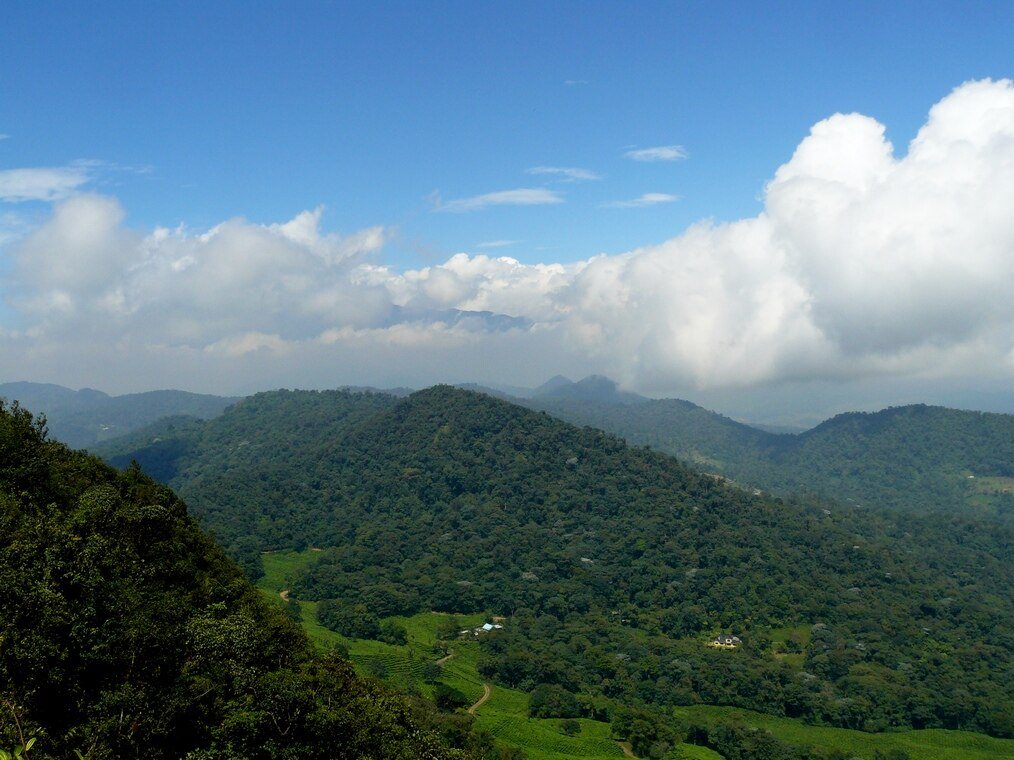
Yongchuan lies in western Chongqing in a humid mid-subtropical monsoon climate: distinct seasons, ample rain and a long frost-free period. The annual mean is about 17.9°C, rainfall about 1,034.9 mm, sunshine about 1,362.5 hours and frost-free days about 317. Some 96.8% of the district is hills and low mountains, with soil pH mostly 4.5–5.5. Spring warms early, so the gardens pick 20–25 days earlier than comparable latitudes in Zhejiang and Anhui — an “early-market” advantage.
It is a green tea, not a black tea or a scented tea. The standard defines it as a needle- or strip-shaped famous green tea made from young buds in Yongchuan, processed locally by spreading, fixing, rolling, carding and drying, with “elegant shape, green colour, clear aroma and mellow taste.” The raw material is one bud with one or two leaves, or equally tender shoots.
History
Tea in Yongchuan goes back to the Qin and Han, but Yongchuan Xiuya is a modern 20th-century famous tea. In 1959 the Chongqing Academy of Agricultural Sciences tea institute (then the Sichuan tea institute) began making handmade needle-shaped tea. After stages of creation, improvement and refinement, the tea was named “Yongchuan Xiuya” under the guidance of the tea scientist Chen Chuan. It was once called “Yinfeng”; in the early 1960s it was tasted and praised during an inspection of the Jishan tea garden. In the mid-1970s the district built more than 500 hectares of gardens and more than 50 factories, beginning industrial scale. The making process received a national invention patent in 2005; the geographical indication certification mark followed in 2010; in 2019 Yongchuan was named a national distinctive agricultural product (tea) advantage zone; in 2021 it ranked first among Chongqing tea-producing districts.
These dates come from the Yongchuan Xiuya website and the district agriculture committee. They are local brand narratives that show craft continuity, not a substitute for independent archival history.
Craft and quality
The standard flow is spreading, fixing, rolling, carding and drying. Needle shape is the core: carding straightens and tightens the strip, and drying fixes a tight, round, fine needle. The top grade is tight, straight, even and green; the aroma is clean; the liquor is yellow-green and bright; the taste is mellow; the infused leaf is yellow-green and fairly bright. It does not chase high-fire aroma or strong bitterness; “clear” and “mellow” are the key words.
The group standard requires no more than 6.5% moisture, 7.5% total ash, 1.0% powder, at least 34.5% water extract and no more than 15.5% crude fibre. These thresholds describe a clean, extract-rich, not-overly-coarse famous green tea. Brew at 80–85°C, 3 g to 150 ml in a glass, about one minute for the first infusion. The needles stand upright in the glass — a visual signature, not a grade.
Buying and boundaries
First check the GI mark and licensed producer. The Yongchuan tea association manages the mark, and licensed firms must follow the group standard; many products with “Xiuya” in the name are not GI products. Second, look at shape: tight, round, fine, straight, even and green is positive; loose, broken or grey is negative. Third, aroma: clean, tender or chestnut notes are fine; perfume or smoke is a defect. Fourth, “early” is not “better”: early picking is a regional advantage, not proof that every early lot beats a later lot.
Drink it plain; milk and sugar do not suit it, and boiling water with a long steep flattens it. The page avoids absolutes such as “Chongqing's only” or “China's earliest”; the checkable statement is “a representative of Chongqing's early-market famous tea” and “20–25 days earlier than comparable latitudes in Jiangsu and Zhejiang.”