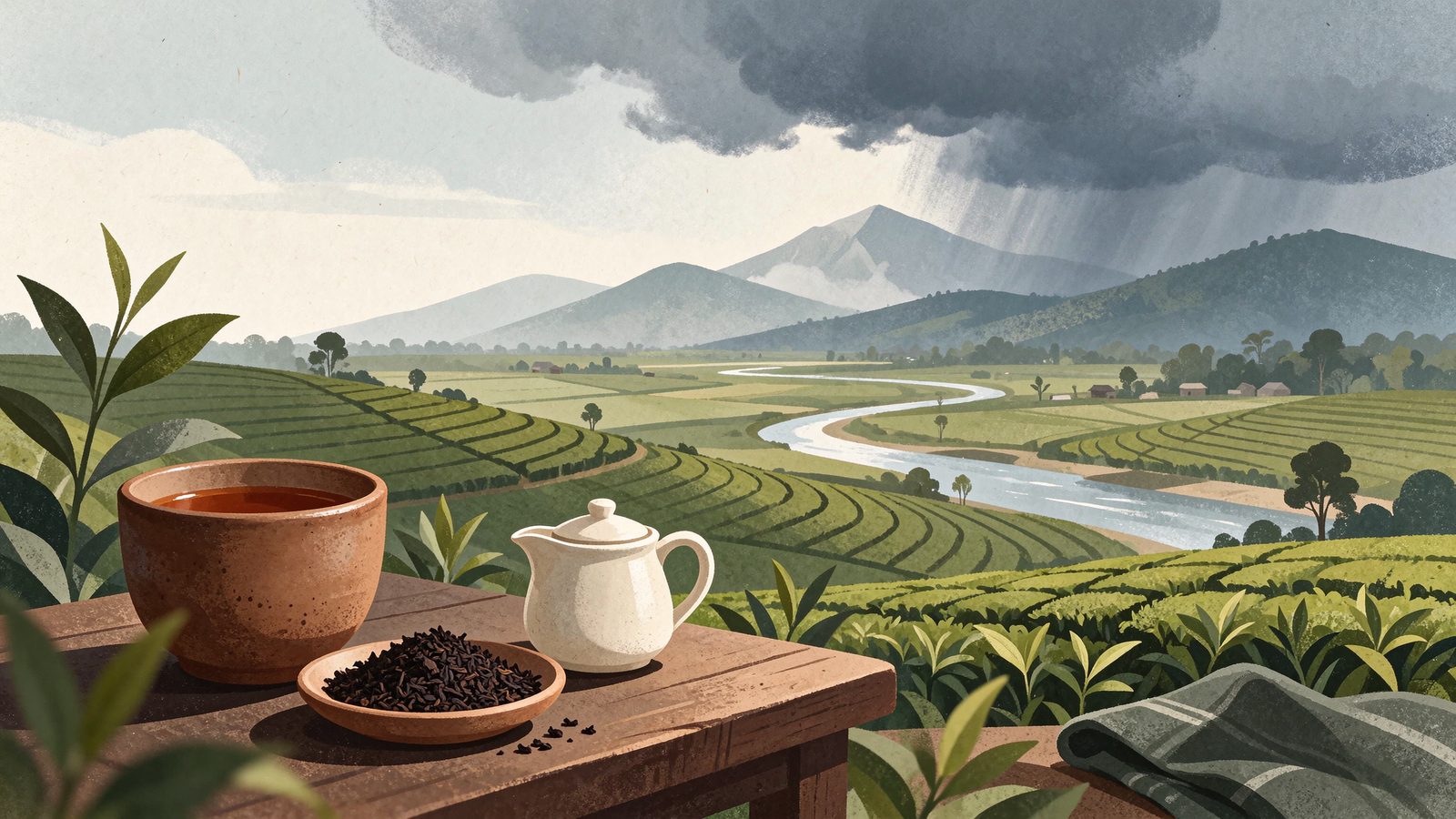
Dooars is a black-tea region in northern West Bengal, India, between the Himalayan foothills, the Bhutan border and Assam. “Dooars” means “door” in Bengali, Assamese and Nepali, because the area is the gateway to Bhutan and north-east India. It is often spelled “Duars.” It sits next to Darjeeling, but it is not the same region or the same style.
Origin and identity
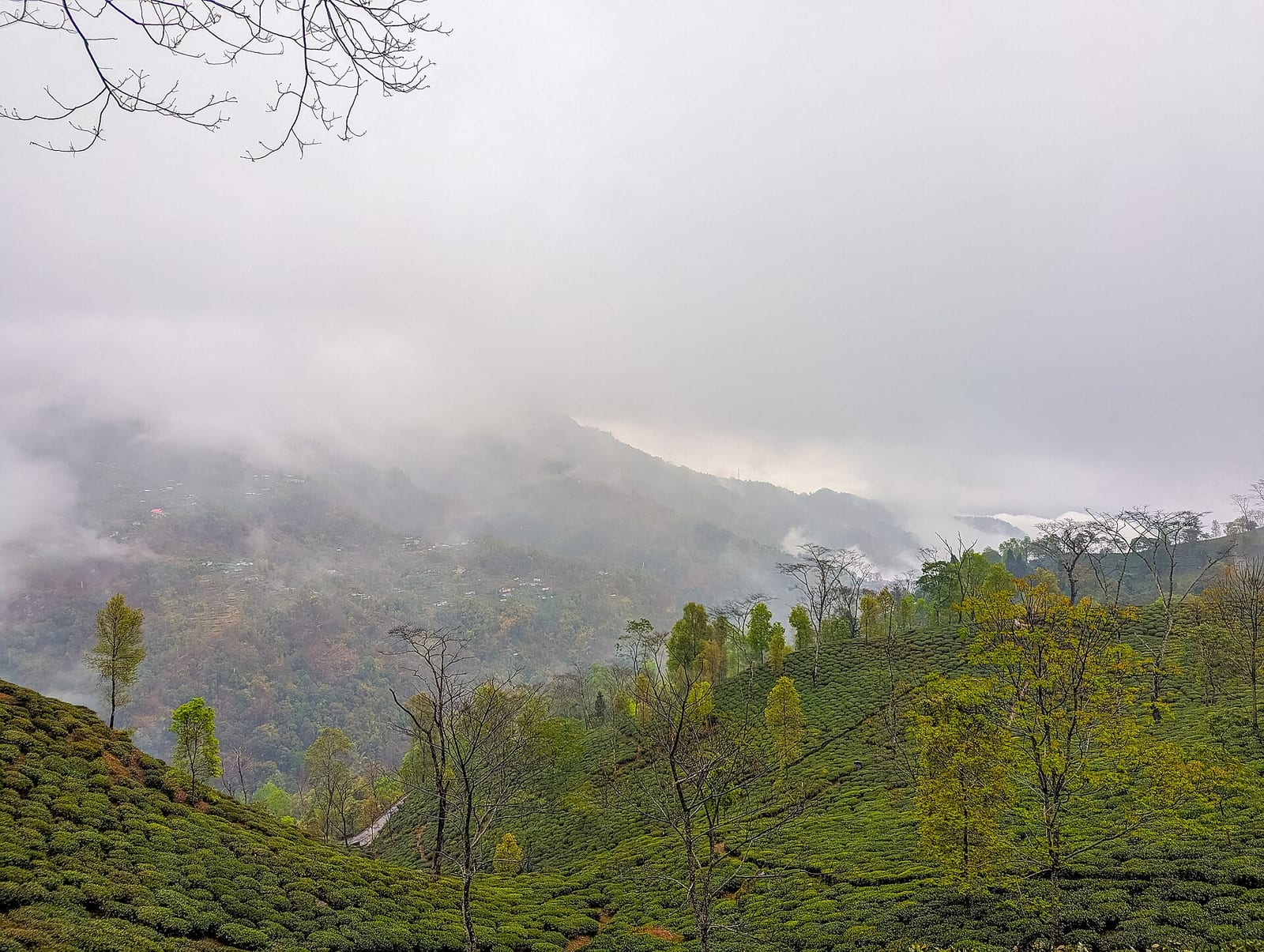
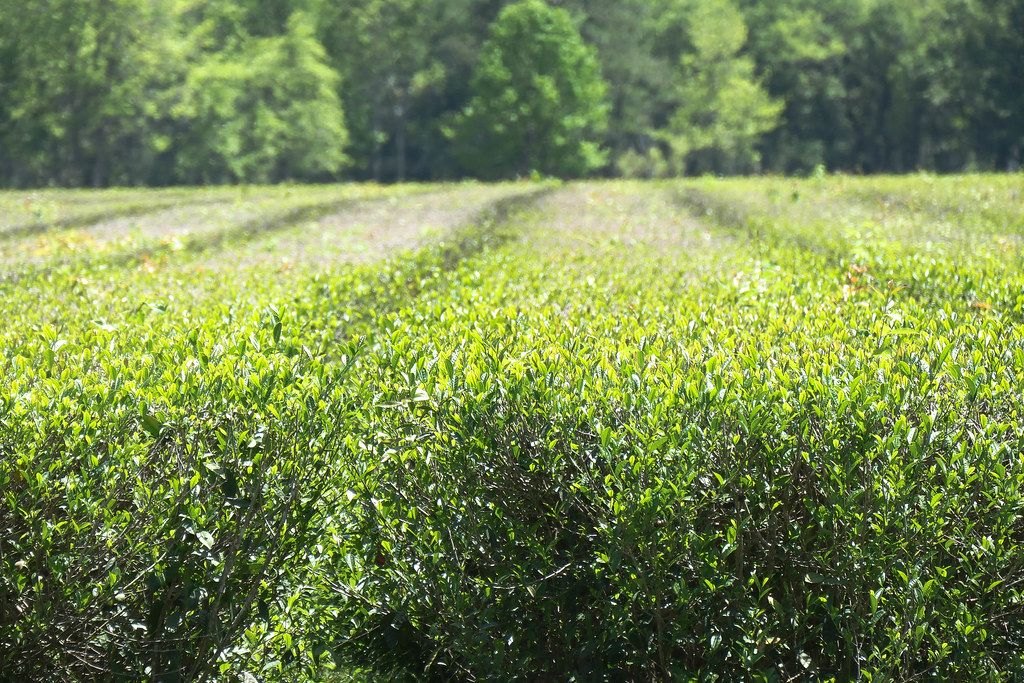
Dooars lies mainly in Jalpaiguri and Cooch Behar districts of West Bengal, bordered by Bhutan and Darjeeling to the north-west, Bangladesh to the south and Assam to the east. Tea Board India gives an elevation range of 90–1,750 m and annual rainfall around 3,500 mm. The range is wide: low alluvial plains and tropical monsoon forest at the bottom, foothills higher up, with gardens, rivers, forest and wildlife habitat interlocking.
Dooars is a black-tea region, not a synonym for “high-aroma Darjeeling.” Its output is mainly CTC, with some Orthodox. CTC means crush, tear, curl: machines cut, tear and curl the leaf into granules, giving fast extraction, strong colour and milk compatibility. Orthodox keeps the strip and gives more aroma layers. Dooars is not “the CTC region,” but CTC is its main product.
History
Dooars gardens were largely established during the British colonial period through planting agencies, but Indian entrepreneurs also opened gardens and acquired land in phases. Tea Board's regional page specifically notes the Indian contribution. The history is not a single “British cleared the jungle” story; it includes colonial capital, local capital and labour communities.
Today the structure is “large estates plus smallholders.” The Indian Tea Association white paper, citing Tea Board India, counts 449 big growers and 39,654 small growers in West Bengal. Dooars–Terai account for 98% of the state's tea output and support 35,000 workers and their dependants. In 2025 smallholders produced 68% of West Bengal's output, or 285.73 million kg; Dooars produced 229.29 million kg and Terai 186.74 million kg. Smallholders do not carry the same statutory welfare burden as estates, a dual-cost structure at the centre of the region's dispute.
Craft and quality
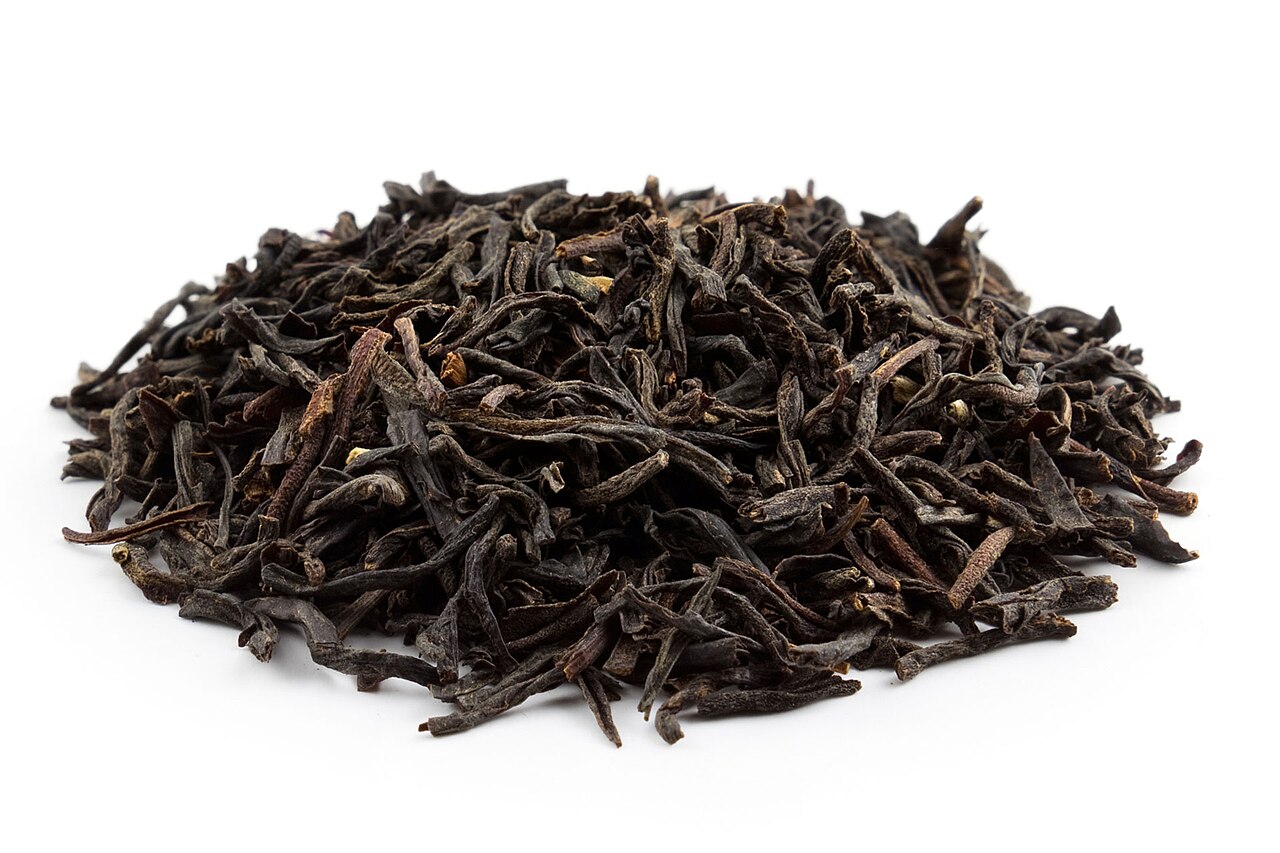
CTC follows withering, crushing/tearing/curling, fermentation, drying and sorting. The machine cuts the leaf into granules, breaks cells thoroughly and speeds oxidation, giving a strong, dark liquor; sorting separates grades such as BP, BOP and BOPSM. Orthodox follows withering, rolling, fermentation, drying and sorting, keeping the strip and more aroma. Dooars CTC is usually tight, black granules with a bright, smooth, full liquor that is lighter than Assam — well suited to everyday milk tea.
Dooars is not “the stronger the better.” Good CTC has bright red liquor, even granules, good milk integration and no smoke, char or earthiness; poor CTC is dark, bitter, astringent and dusty. Orthodox Dooars is judged more on aroma: floral, malty, woody and fruity notes can appear, though not the muscatel signature of Darjeeling. Flush and season change the body and aroma substantially, even within one garden.
Brewing and boundaries
CTC: 100°C, 5 g to 200 ml, 3–4 minutes, with milk and sugar; for a strong milk tea, 6 g and 4–5 minutes. Orthodox: 90–95°C, 4 g to 200 ml, 2–3 minutes, taste plain before adding milk. Long CTC steeping turns bitter; boiling water on Orthodox flattens the aroma.
Check origin (Dooars, not Darjeeling), craft (CTC or Orthodox) and grade (BP, BOP, BOPSM and so on). Dooars is a region, not a grade; Darjeeling is not a “premium version” of Dooars. “All Dooars tea is smoky” is inaccurate: smoke is a defect or storage problem, not a regional standard. It suits milk tea and everyday drinking, not the delicate floral plain-tea occasion.