First, the identity: a historic famous tea, not a synonym for “Ziyang Selenium-Rich Tea”
Ziyang Maojian is a traditional famous tea from Ziyang County, Shaanxi, and a product name still used in the Ziyang tea area. It is not a separate geographical-indication protected product, but it is a geographical-indication certification trademark registered with the National Intellectual Property Administration and held by the Ziyang County Tea Industry Association. The 2004 protected-product designation and the 2023 protection upgrade apply to “Ziyang Selenium-Rich Tea”; “Ziyang Maojian” is a separate certification mark. The two layers of protection should not be conflated.
During the 2000s brand consolidation, Ziyang grouped its selenium-rich tea products into two series, Ziyang Maojian and Ziyang green tea. Most Ziyang Maojian sold today also carries the regional public brand “Ziyang Selenium-Rich Tea”. More precisely, Ziyang Maojian is a historical tea name, a product series and a GI certification trademark; Ziyang Selenium-Rich Tea is the regional public brand, protected product and agricultural geographical indication covering the Ziyang tea area.
Where Ziyang is: the upper Han River, north slope of the Daba Mountains
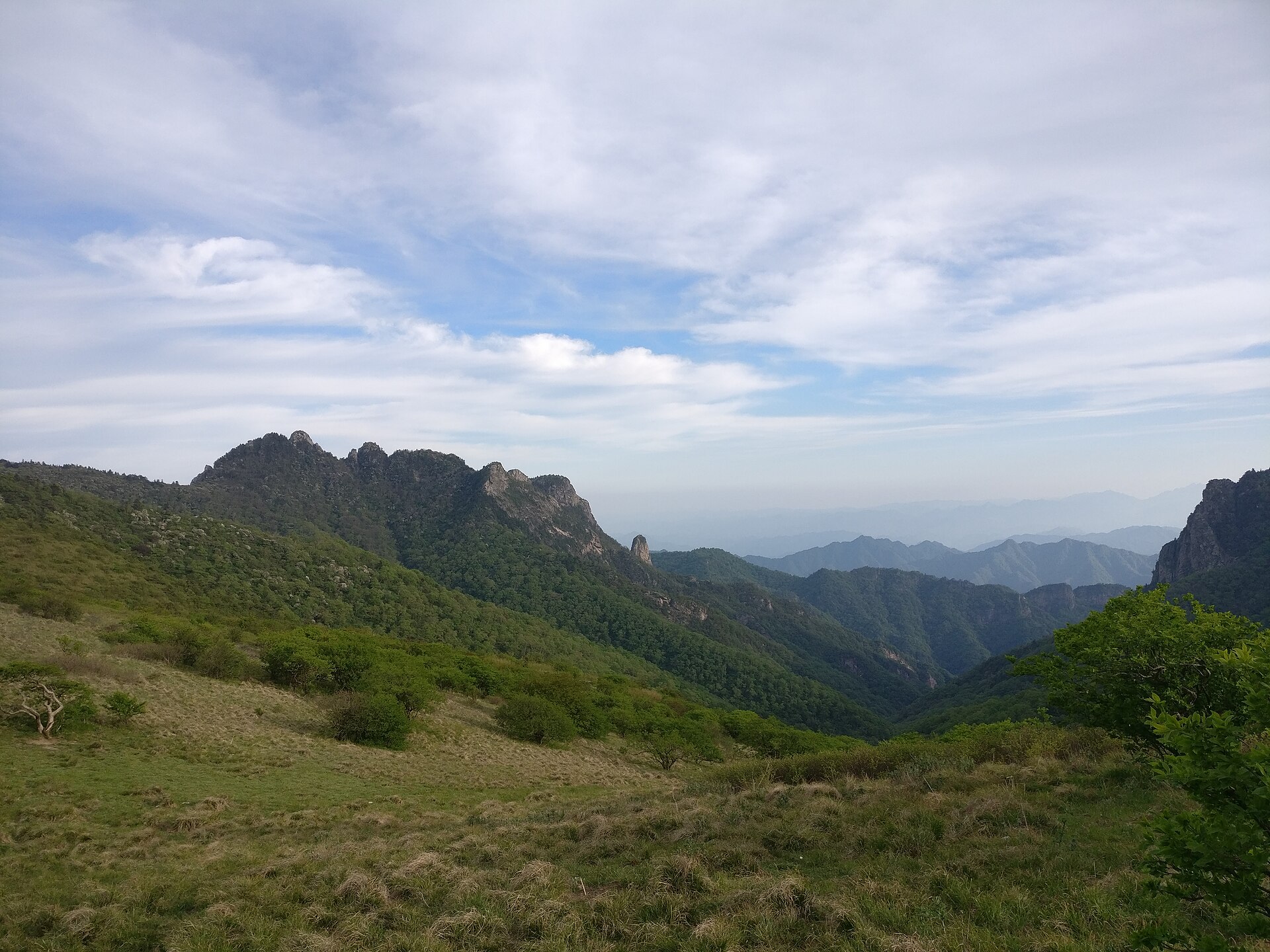
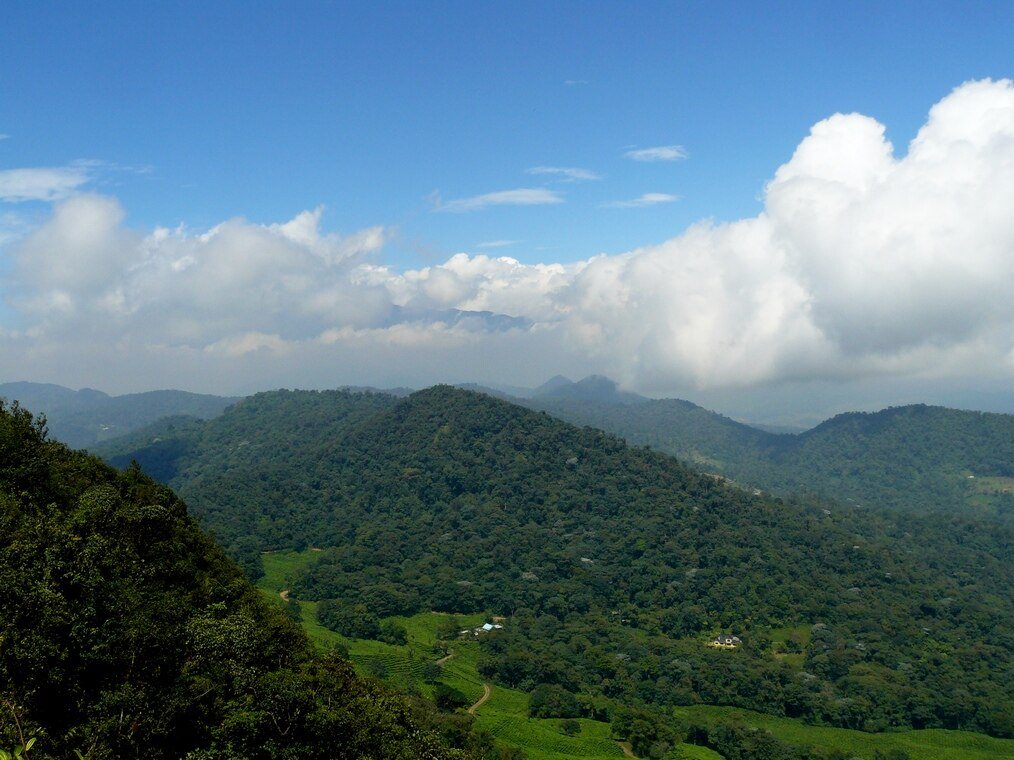
Ziyang County lies in southern Shaanxi, on the upper Han River and the north slope of the Daba Mountains, between 108°06′–108°43′E and 32°08′–32°49′N. Its total area is 2,204 km², and ground elevation runs from 277 to 2,522 m. The Han and Ren rivers cut the county into the Daba, Micang and Fenghuang mountain blocks, with gorge-like valleys; tea gardens are scattered across valley slopes rather than concentrated in one flat estate.
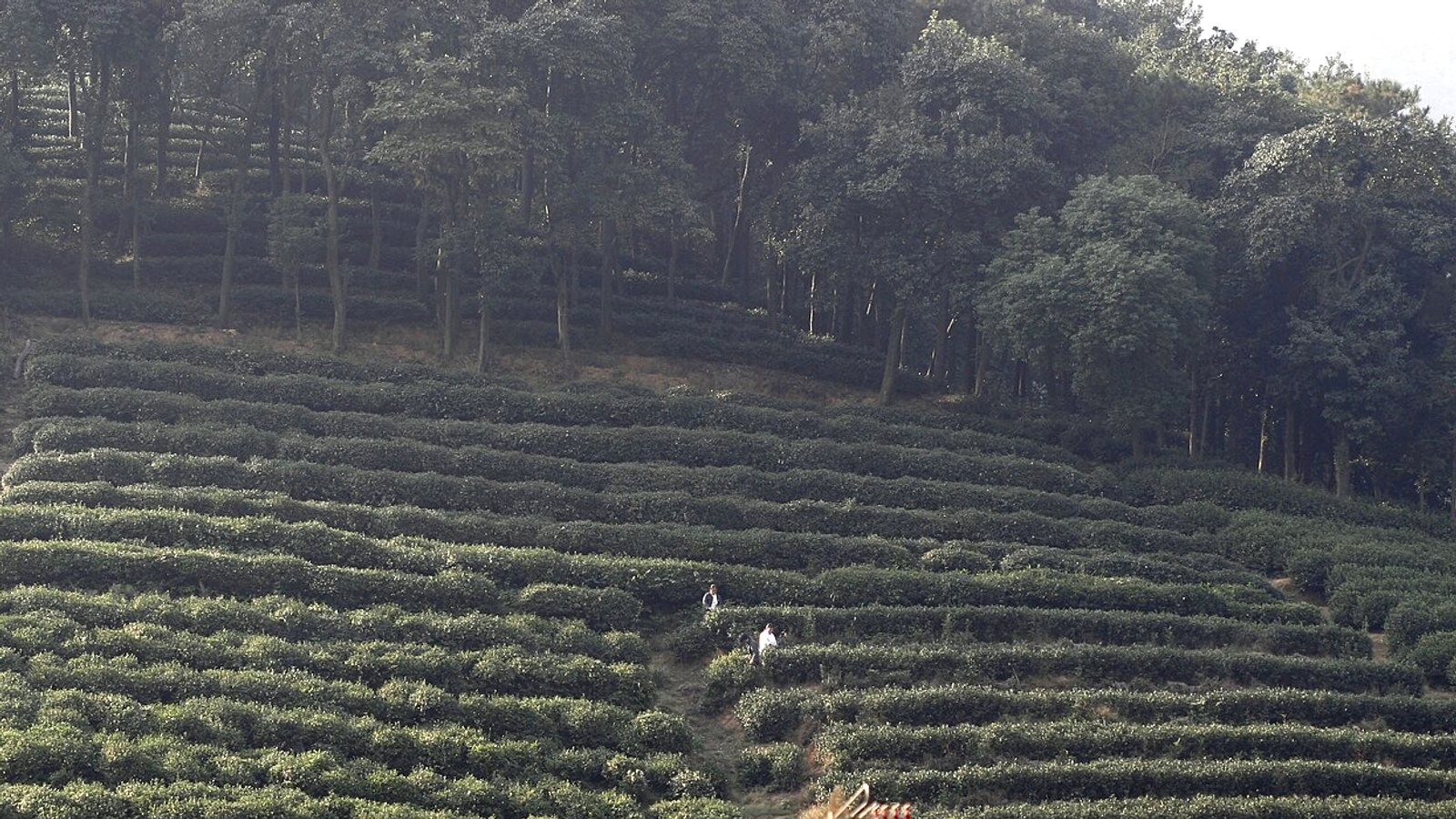
The hero photograph on this page is a Longjing tea garden in Hangzhou, used as a type reference; it is not a Ziyang tea garden or a product photograph of Ziyang Maojian. It can show the form of a terraced tea garden, but says nothing about Ziyang’s slope, cultivar or quality.
The 2004 protection notice describes tea gardens at 300–1,000 m on yellow-brown soil at pH 4.5–6.5. Today all 17 towns in Ziyang produce tea, with core areas still along the Han and Ren river valleys and on lower and mid-mountain slopes.
The county’s average soil selenium content is about 0.49 mg/kg, but it varies considerably within the county, and tea selenium also depends on cultivar, soil, season and processing. The 2004 protected-product standard requires at least 0.3 mg/kg selenium in the finished tea. That is a product standard, not a guarantee that every leaf grown in Ziyang is automatically selenium-rich.
From Jinzhou tea buds to Ziyang Maojian: how the name travelled
The name changed several times. In the Tang it was called Shannan tea buds; in the Song and Yuan, Ba tea; in the Ming and Qing, Ziyang Maojian; after 1949, Shaanxi green tea (Shaanxi Qingcha) was used as a general name. The China Co-op article therefore calls Ziyang Maojian and Shaanxi green tea the oldest tea brands in Shaanxi.
Local tea histories and the intangible-heritage filing trace the line further back to the Tang name “Jinzhou tea buds”, say it was sent as tribute, and state that in the Qing it was listed among the national top ten famous teas. These are local historical and heritage-application narratives, not a modern national ranking that can be independently re-checked today. This page keeps the “historic famous tea” identity but does not present the top-ten claim as a verified national award.
Ziyang Maojian was not invented in 1985. In the 1950s Ziyang established a tea research institute and a state demonstration tea farm and began systematic selection of local tea populations; in 2004 Ziyang Selenium-Rich Tea received protected-product status, in 2005 it was registered as a certification trademark, and the traditional handcraft of Ziyang Maojian was later listed as provincial intangible cultural heritage. Its modern product standards, certification mark and brand system took shape from the 2000s onward.
The Ziyang cultivar and plucking: local populations set the base
Ziyang Maojian is made mainly from the “Ziyang cultivar” and local populations. The Ziyang cultivar was selected from local tea populations; systematic selection began in the 1950s, large-scale clonal propagation from 2010, and by 2024 it accounted for 90% of the county’s tea-planting area. Old gardens also contain local types such as Zhuye, Daqingye and Daliuye, with different buds, aromas and resilience.
Plucking runs from one bud with one leaf just opening to one bud with two leaves just opening. The 2004 notice set the premium grade at 90% or more one-bud-one-leaf, first grade at 80% or more, and second grade at 70% or more one-bud-two-leaves. Pickers lift or snap the shoot; they should not pinch it with a fingernail, which bruises the stem and darkens the leaf.
The award sample used single buds of the local “Dayepao” type. That shows that high-grade Ziyang Maojian can be made from buds alone, but single-bud picking is low-yielding and expensive; it is not the definition of all Ziyang Maojian.
Pan-firing plus baking: traditional handwork and the modern standard
Ziyang Maojian is not simply a pan-fired green tea; its process alternates pan-firing and baking. Traditional handwork stresses shaping and “raising the hairs”; the modern standard fixes spreading, fixing, shaping, baking or pan-firing the blank, re-shaping, final baking and aroma development, and sorting into a repeatable sequence.
| Stage | Traditional handwork (provincial ICH) | Modern standard (2004 notice) |
|---|---|---|
| Plucking | One bud with one leaf just opening to one bud with two leaves just opening; lift or snap | Same range, graded as premium, first and second |
| Spreading | Thin spread to lose moisture evenly | Fresh-leaf spreading |
| Fixing | Pan at 160–180°C, 1.5–2.5 kg charge, fast fixing | Fixing |
| Rolling and shaping | Initial rolling, sun-drying, a 30–40 minute short pile, tightening strips and raising hairs | Shaping, baking or pan-firing the blank, re-shaping |
| Drying and aroma | Shade-drying and sorting; hair raising at 70–80°C | Final baking and aroma development, sorting, finished tea |
The traditional “short pile” or “sweating” is a brief rest, not the long pile fermentation of dark tea. It lets moisture redistribute through the leaf before the strips are tightened and the white hairs raised. Modern lines alternate baking and pan-firing to stabilise shape and fire. The 2025 award sample was described as going through ten steps: fixing, initial rolling, pan-firing the blank, second rolling, initial baking, strip alignment, second baking, hair raising, final drying and aroma baking.
Handwork and machine production are not a simple hierarchy. Handwork more easily gives curved strips and a pronounced white-hair cover; machine production gives greater uniformity and consistency. With the same fresh leaf, a lighter fire leans toward a clean aroma, a fuller fire toward chestnut. Judge the tea in the cup, not the word “handmade” on the packet.
Quality: chestnut aroma, white hairs and what “selenium-rich” really means
The 2004 protected-product notice describes the sensory profile as plump, tender, stout strips; green colour; strong chestnut aroma; thick but not astringent; mellow with a sweet aftertaste; and resistant to repeated infusion. The liquor should be clear and bright, the infused leaf tender green and bright. The 2025 award sample is described in finer terms: round, tight, fine and even strips; green colour; visible white hairs; persistent chestnut aroma; tender-green, clear liquor; fresh, sweet taste; and tender, complete infused leaves.
Traditional hand-made Ziyang Maojian is not always “emerald green”. The provincial intangible-heritage page describes it as finely curved, tender yellow and covered with white hairs; machine-made tea and different grades can be greener. A range from tender green to yellow-green is normal. Chestnut aroma, sweetness and staying power matter more than a single colour word.
“Selenium-rich” is a laboratory result, not a taste. The 2004 notice requires at least 0.3 mg/kg selenium in the finished tea; the county’s average soil selenium is about 0.49 mg/kg, but plots, cultivars and batches vary widely. A package claim needs a test result; origin alone is not proof. Selenium is an essential trace element, but tea is not a substitute for medical treatment. This page makes no claims about weight loss, blood lipids, cancer or other health effects.
Brand timeline: protected product, certification marks and the 2025 award
| Date | Event | Protection layer |
|---|---|---|
| October 2004 | AQSIQ approves geographical-indication protection for “Ziyang Selenium-Rich Tea”, listing 20 townships | Protected product |
| 2005 | “Ziyang Selenium-Rich Tea” registered as a GI certification trademark | Certification mark |
| Third provincial batch | Traditional handcraft of Ziyang Maojian tea listed as Shaanxi provincial intangible cultural heritage | Intangible heritage |
| 2019 | Ziyang Selenium-Rich Tea registered as an agricultural geographical indication by the Ministry of Agriculture and Rural Affairs | Agricultural GI |
| 2023 | Ziyang Selenium-Rich Tea passes a GI protection upgrade; tested indicators rise from 18 to 36 | Protected-product upgrade |
| October 2024 | “Ziyang Tea” registered as the county’s fourth tea-related GI certification trademark | Certification mark |
| 2024 entry; announced January 2025 | “Ziyang Selenium-Rich Tea (green tea · Ziyang Maojian)” wins the Special Gold Award at the 109th Panama-Pacific International Exposition | Product award |
“Ziyang Maojian” is one of four tea-related GI certification trademarks, alongside “Ziyang Selenium-Rich Tea”, “Ziyang Red” and “Ziyang Tea”. The marks are held or administered by the Ziyang County Tea Industry Association; use requires an application under each mark’s management rules, not simply printing the name on a packet.
The 2025 Panama award must be read with its exact entry name: the award went to a specific submitted product, “Ziyang Selenium-Rich Tea (green tea · Ziyang Maojian)”, not to every Ziyang Maojian ever made. The certificate and the award date are not a universal grade certificate for the category.
The 2024 industry figures: 260,000 mu, 12,800 tonnes, CNY 7 billion
The commonly cited 2024 figures for Ziyang’s tea industry are 260,000 mu of tea gardens, 12,800 tonnes of tea, CNY 3.55 billion in output value and CNY 7 billion in composite output, supporting 120,000 people. The county also reports 446 tea enterprises, 100,000 mu of standardized tea gardens, the Ziyang cultivar at 90% of planting area, and tea production in all 17 towns.
These are industry-report figures, not figures from the county statistics bureau’s annual economic and social development communiqué. CNY 3.55 billion is tea output value; CNY 7 billion is composite whole-chain output, and the two should not be added together. Nor should 260,000 mu, 12,800 tonnes, 120,000 people and 446 enterprises be compared directly with another county without checking that county’s reporting basis.
The 2004 notice lists 20 townships; Ziyang today has 17 towns. After administrative changes, the protected-area wording and certification-mark licensing must follow the current management rules, association approval and National Intellectual Property Administration announcements. The 2004 township list cannot simply be mapped onto today’s towns and villages.
Brewing, buying and the limits of the record
For brewing, use about 3 g of tea to 150 ml of water at 80–85°C. Let the first infusion run 20–30 seconds, then lengthen later infusions. A glass or a gaiwan both work. Do not pour boiling water straight onto tender buds or leave them steeping for a long time; the chestnut aroma can turn cooked and the liquor can yellow. Adjust to the grade and the packet instructions.
When buying, check three things first: the food-production licence (SC), an origin in Ziyang, and the “Ziyang Maojian” GI certification trademark plus any “Ziyang Selenium-Rich Tea” mark on the packet. Then look at grade and test information. “Premium” is a grade in the 2004 protected-product notice, not a universal national grade used by every company. Avoid cheap packets that name Ziyang Maojian but give no producer, address or SC number.
Three limits apply to this record. First, the Tang tribute-tea story and the Qing “national top ten” claim are local tea-history and heritage-application narratives, not independently verified national conclusions. Second, the 2025 Panama award belongs to a specific submitted product, not to the whole category. Third, the 2024 figures of 260,000 mu, 12,800 tonnes, CNY 3.55 billion and CNY 7 billion are industry-report figures, not statistical-communiqué figures; an audit-grade account would need the county statistical communiqué and an explicit note on its basis.