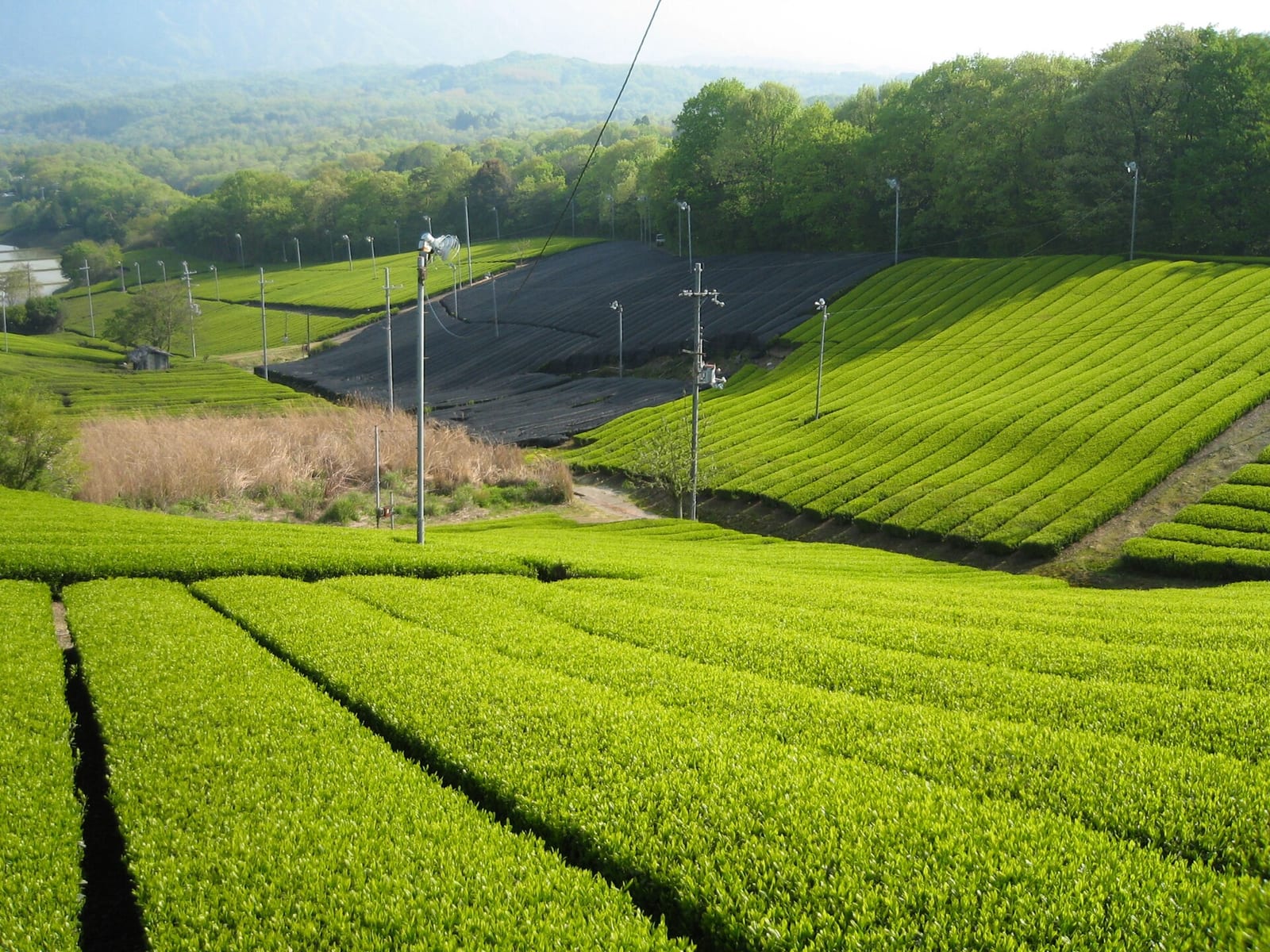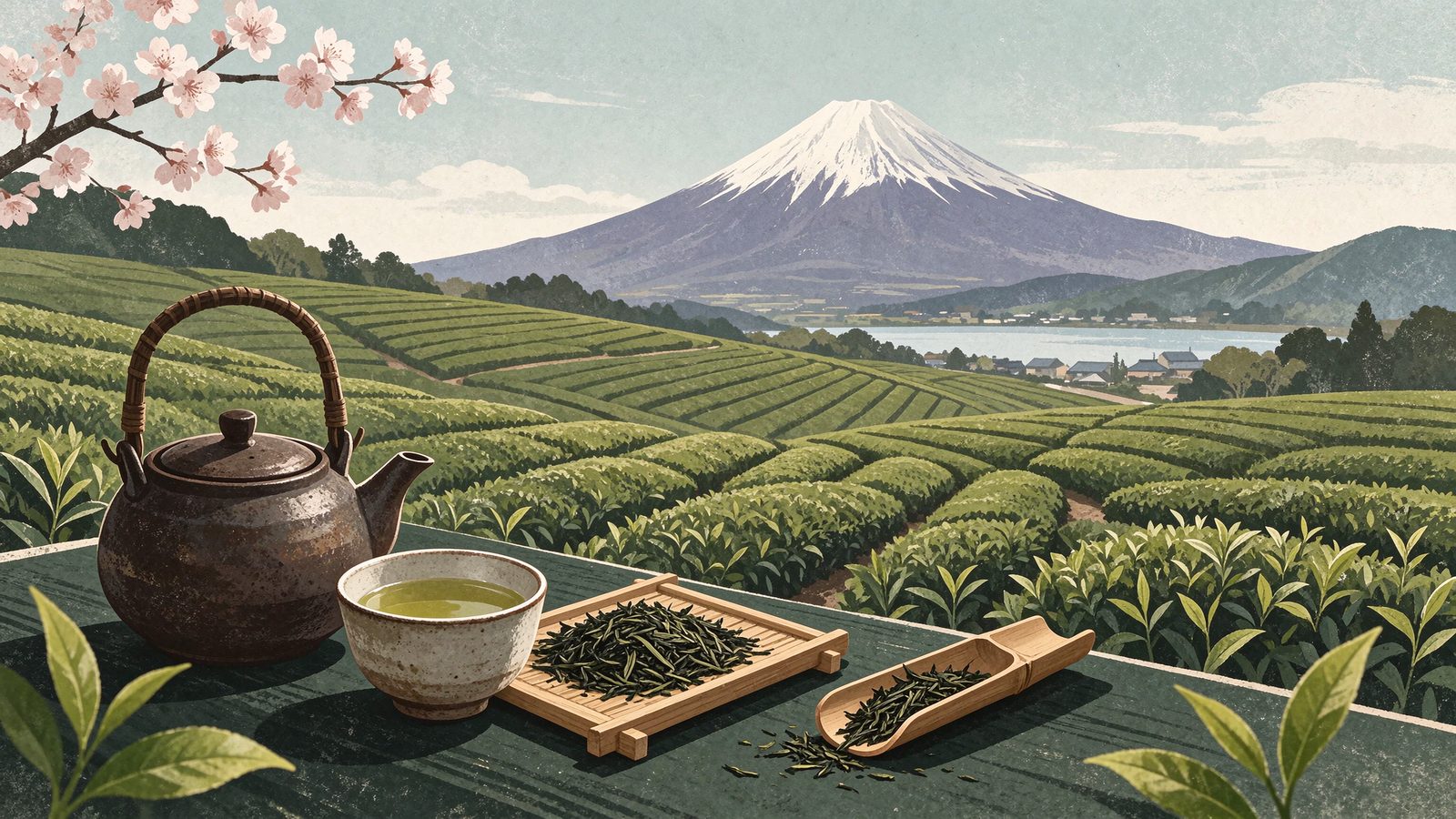
Shizuoka sencha is a regional name for sencha produced in Shizuoka Prefecture, Japan. Sencha is Japan's mainstream green tea: steamed, rolled and dried, without fermentation. Shizuoka is not Japan's only sencha region, but it has the largest tea-garden area and is the main home of deep-steamed sencha. Treating “Shizuoka sencha” as a cultivar, or “sencha” as all Japanese green tea, misses the craft distinctions.
Origin and identity
Shizuoka lies in central Honshu, facing the Pacific, with gardens on hills, foothills and coastal terraces. Japan's Ministry of Agriculture, Forestry and Fisheries data for 2025: Shizuoka has 11,600 hectares and 24,100 tonnes of crude tea; Japan has 33,400 hectares and 75,100 tonnes. Shizuoka ranks first in planted area and second in output after Kagoshima. It produces mainly sencha, especially deep-steamed sencha; its tencha (matcha material) and kabusecha outputs rank third nationally.
Sencha is a process name, not an origin. The basic flow is picking, steaming, rough rolling, rolling, middle rolling, fine rolling and drying. Steaming kills oxidase within tens of seconds, preserving green colour and umami; rolling shapes the leaf into needles; drying lowers moisture. Shizuoka sencha can be standard sencha or deep-steamed sencha; the latter steams longer, breaks the leaf more, and gives a greener, stronger, less astringent liquor.
History
Shizuoka tea history is often traced to the Kamakura period, but as a modern large region it grew with Meiji-era transport, ports and mechanisation. Proximity to Yokohama supported exports; railways and tea experiment stations brought new cultivars and methods. In the late 20th century Shizuoka developed a combined “garden + auction market + tea tourism” structure, with Kakegawa, Makinohara, Kawane and Motoyama showing different styles.
Deep-steamed sencha is a modern Shizuoka innovation. Standard sencha steams briefly, keeps leaf shape and gives a clear liquor; deep steaming extends the steam, breaks the leaf more, makes the liquor stronger and less astringent, and suits everyday pots and cold brew. The Shizuoka tea fair has a separate deep-steamed sencha division, showing it is a category rather than a marketing word. The page does not give an unsourced start year; the checkable facts are the 2025 area, output and category structure.
Craft and quality
Quality turns on four variables: steaming time, rolling pressure, drying temperature and cultivar. Standard sencha has a shorter steam, a more intact leaf, yellow-green clear liquor, grass, marine and fresh-bean aroma, and a crisp taste. Deep-steamed sencha has a longer steam, a more broken leaf, a deeper green and slightly cloudy liquor, stronger aroma, thicker taste and less astringency; it also resists turning bitter when cooled. Kabusecha is shaded before picking to raise umami; gyokuro is shaded longer and sweeter; matcha is shaded, unrolled, dried and ground — a separate process line.
Shizuoka sencha is not “the greener the better.” Standard sencha can be clear yellow-green; deep-steamed can be deep green with fine haze; colour is a process signal. Aroma can include marine, grass, fresh bean and roasted chestnut; smoke, mould or metal are defects. Good sencha has umami, sweetness and moderate astringency; astringency that locks the throat is not “strength.”
Brewing and boundaries
Brew at 70–80°C, 5 g to 150 ml in a kyusu or glass. Standard sencha: 60–90 seconds for the first infusion. Deep-steamed: 40–60 seconds, because the leaf is more broken and extracts faster. Shorten the second to 20–30 seconds and lengthen the third. Boiling water amplifies astringency; too-cool water hides umami. Cold brew: 5 g to 500 ml cold water, 4–6 hours; deep-steamed is sweeter cold.
Check origin (Shizuoka), process (standard/deep-steamed/kabusecha) and picking season (first, second, autumn/winter). Shizuoka is a region, not a grade; “deep-steamed” is a process, not “more premium.” “All Shizuoka sencha is deep-steamed” is inaccurate; Shizuoka also makes standard sencha, kabusecha and matcha. Drink it plain; milk and sugar do not suit it.