What the name covers
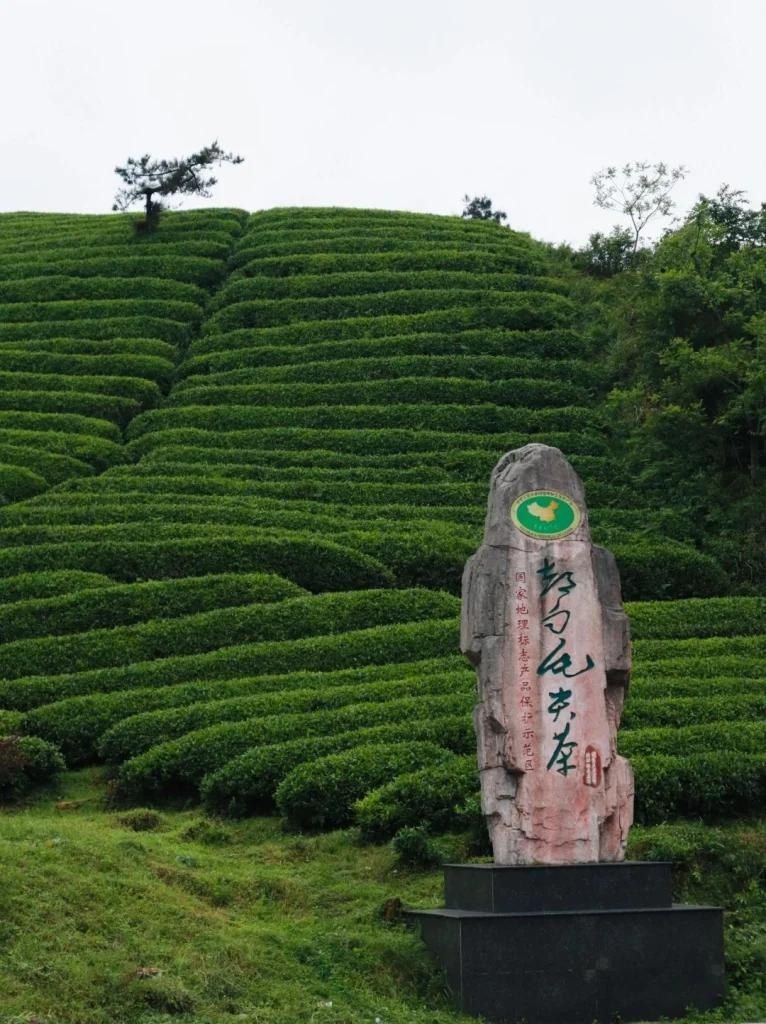
Shiqian Taicha comes from Shiqian County in Tongren, Guizhou. Official material uses the name for both a tea population and a product: the local sexually propagated tea plants on one side, and the green tea made from them on the other.
That overlap is the first thing to get right. Shiqian Taicha is not one cloned cultivar, not one company brand and not a synonym for every “taicha” in Guizhou. Packs sold under the name can come from different enterprises, grades and harvests. What they share is a protected origin and a processing tradition, not a single fixed tasting profile.
The geographical-indication status has several layers:
| Status | Date / number | Meaning |
|---|---|---|
| National GI product protection | 2009 | Protects the product name and the defined origin |
| GI certification mark | 2010 | Licensed to qualifying producers by the mark owner |
| Agricultural GI | AGI01644 | Provincial registration, applicant Shiqian County Tea Administration |
| China Well-Known Trademark | 2013 | A trademark recognition, not a grade for every product |
These are not interchangeable. GI protection applies to tea made inside the defined area under the stated rules; it does not automatically certify every package that uses the words “Shiqian Taicha.” The special mark and the authorised producer still matter at the point of sale.
“Tai” means thick leaves, not white fuzz
The official explanation of the name is thick leaves and long, tender stems, which is why locals also call it “Taizicha.” The “tai” is a plant and stem characteristic, not the white fuzz on a young bud.
The name and the appearance claim need to be kept apart. Turning “tai” into “white fuzz” and then building a “downy, honeyed” style on top of it is a guess from the name. Shiqian Taicha can show bud down, but the name does not mean down. Treating the two as the same turns a population name into a superficial appearance claim.
The local type is described as vigorous buds, thicker leaves and good tenderness retention. It suits curled or semi-curled green tea. It is not a “single bud” style, and it does not build its identity on extreme tenderness; it builds it on leaf thickness, solids and staying power.
Origin: low latitude, high altitude, little sunshine
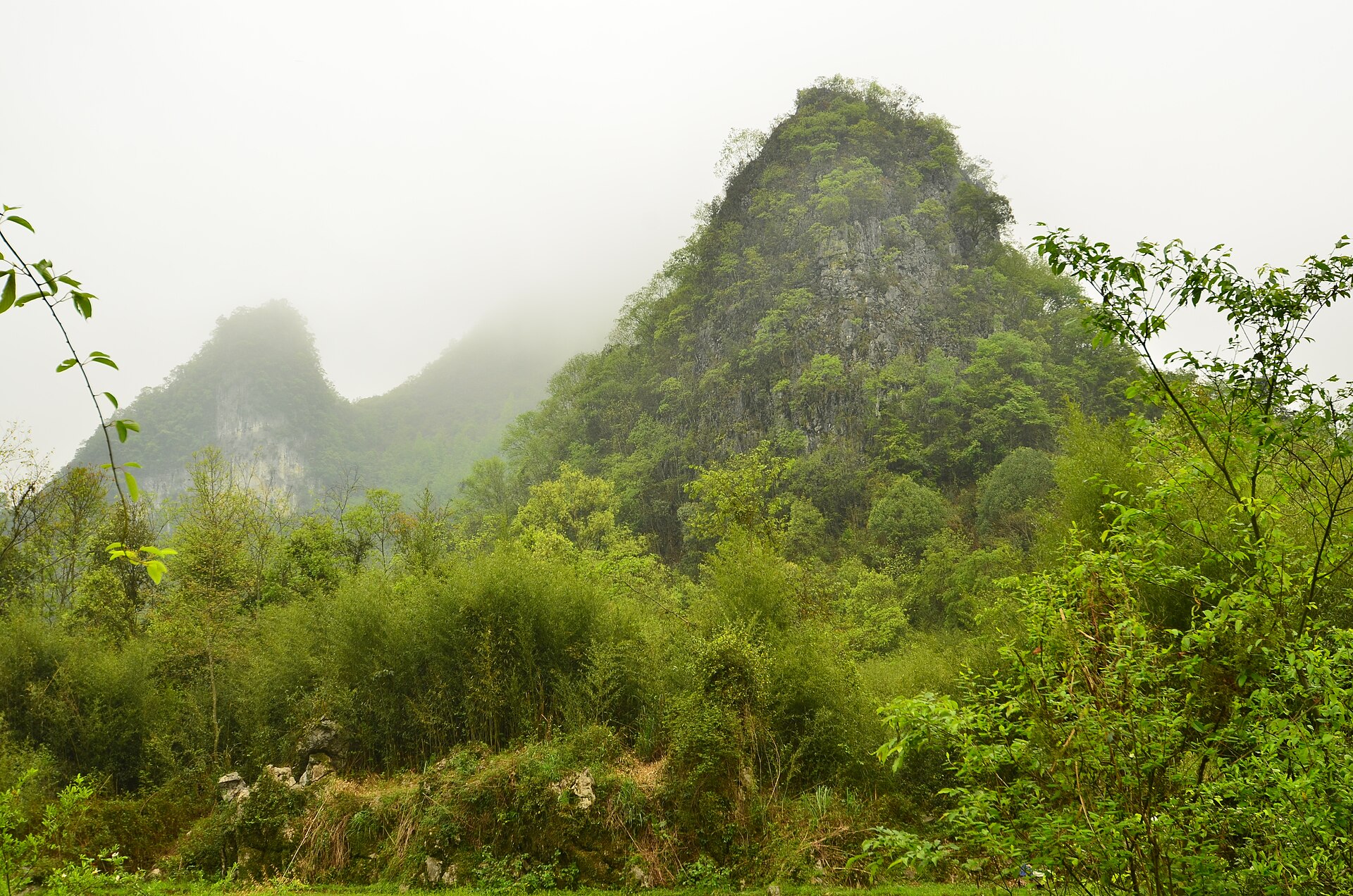
Shiqian sits in north-eastern Guizhou in a humid subtropical monsoon climate. The official shorthand is low latitude, high altitude and low sunshine, a combination that produces frequent cloud, high humidity and a noticeable day–night temperature swing.
The county also markets itself as a “hometown of hot springs” and a “hometown of longevity.” Those are county-level identities, not a description of how the tea gardens are irrigated. The step from “hometown of hot springs” to “hot-spring irrigation” has no reliable source and confuses geothermal resources with the tea garden's water system. Shiqian Taicha grows on rainfall, cloud and soil, not on spa water.
Chemistry: what the county government publishes
The county government publishes this set:
| Measure | Official figure |
|---|---|
| Amino acids | about 2.6% |
| Tea polyphenols | about 36% |
| Caffeine | about 4.69% |
| Potassium | 19,700 mg/kg |
| Water extract | about 46% |
These figures differ sharply from the commonly repeated “4.5–5.5% amino acids” and “0.1–0.3 mg/kg selenium.” The latter give no testing year, sample count or laboratory, so they cannot be treated as a county-wide standard; the county government's published set is the more reliable county-level reference.
The numbers point to a style: moderate-to-high polyphenols and caffeine, high water extract, a cup with structure and staying power. At about 2.6% amino acids, it is not in the extremely sweet, high-amino-acid green tea category represented by Anji Baicha or Huangjinya. It should not be sold as “the sweetest” green tea.
Processing: hand “three roastings, three rollings” alongside machine production
Traditional Shiqian hand-made maofeng follows three roastings and three rollings. After fixing and spreading, the leaf is rolled until it forms strips and juice reaches the surface; then it is roasted, spread and rolled again, twice more, to drive off moisture, tighten the bud-leaf structure and set the aroma and shape.
Tongren Net's feature quotes Wang Fei, a provincial intangible-cultural-heritage maker, on the pressure rhythm: light–heavy–light, hand never leaving the tea, tea never leaving the wok. Too much pressure crushes the leaf; too little leaves it shapeless. That is a useful explanation of what “three roastings and three rollings” actually controls: heat, pressure and the pause between them.
Handwork is not the whole industry. Shiqian had 185 processing enterprises in 2025, and products range from hand maofeng to large-volume green tea. “All Shiqian Taicha is handmade” is false; “only handmade is authentic” also narrows the industry into a niche.
History: the Tang tribute story needs a qualifier
There are two historical layers, and they should not be merged.
The documentary layer is Lu Yu's Classic of Tea, which says of Yizhou: “often obtained, its flavour excellent.” Yizhou was a Tang administrative region larger than today's Shiqian County; local material later connects Yizhou with the Shiqian area. The accurate sentence is “local literature connects the Yizhou tea of the Classic of Tea with Shiqian,” not “Lu Yu named Shiqian directly.”
The gazetteer layer says tea began in the Tang and was sent as tribute; a Ming gazetteer adds a figure of about 100,000 jin a year. These are local-literature claims, not modern statistics. They can be written as “the gazetteer says,” not as “Shiqian sent 100,000 jin to the court every year in the Tang.”
Claims such as “Shiqian tea surpassing eastern Guizhou in the Ming,” “hot-spring tea gardens” and “Lu Yu naming Shiqian” have no reliable source. The safer wording is “Tang-era tea records and a gazetteer tribute claim,” with the specific output and ranking kept inside the gazetteer qualifier.
Industry: 436,000 mu and 29,510 tonnes
Shiqian's 2025 figures:
| Measure | 2025 figure |
|---|---|
| Tea garden area | 436,000 mu |
| Area in production | 338,500 mu |
| Finished tea | 29,510 tonnes |
| Combined output value | CNY 3.2 billion |
| Processing enterprises | 185 |
| Households involved | 28,700 |
| People involved | 116,200 |
| Ancient tea plants | more than 50,000 |
On the brand side, the 2023 regional brand value was CNY 1.618 billion, ranked 87th among Chinese tea-region brands; the county is also “China's Taicha Hometown” and a “National Top 100 Tea County.” Those are regional-brand evaluations, not a quality ranking of individual packs.
The 50,000-plus ancient plants are important germplasm, but “many ancient plants” does not mean “every commercial pack comes from ancient trees.” Most volume comes from production gardens; ancient plants are used more for conservation, single-tree selection and small high-end lots. Buyers should read the specific product, not infer from the county's ancient-tree count.
Brewing: treat it as a green tea
Shiqian Taicha is a green tea, so the brewing logic is similar to other curled green teas:
- water: 80–85°C, not a hard boil straight onto young buds;
- leaf: 3 g to 150–200 ml;
- time: 1–2 minutes for the first steep, then about 30 seconds more each round;
- vessel: glass or a gaiwan; glass shows the leaf opening.
Its thicker leaves and high water extract usually give more staying power than a fine-bud tea. It still should not be left to stew: a long, sealed steep brings out a cooked, flat note and astringency together. If the cup is bitter, lower the temperature and shorten the time before reaching for sugar.
Common errors
| Claim | Problem | Better wording |
|---|---|---|
| “Tai means white fuzz” | Official meaning is thick leaf and long tender stem | A plant and stem trait, not bud down |
| “Amino acids 4.5–5.5%” | Conflicts with the official 2.6% and has no test basis | About 2.6%, official figure |
| “Selenium 0.1–0.3 mg/kg” | No selenium figure in the official set | Do not state selenium |
| “Lu Yu named Shiqian” | The text says Yizhou | Local literature connects Yizhou with Shiqian |
| “Hot-spring irrigation” | Hot springs are a county identity, not a water source | Low latitude, high altitude, low sunshine |
| “Ming Shiqian tea surpassed eastern Guizhou” | No verifiable source | Only the gazetteer tribute and output claims |
| “The whole county is ancient-tree tea” | Ancient plants are germplasm; volume comes from production gardens | 50,000+ ancient plants; read the specific product |
Where it sits in Chinese green tea
Shiqian Taicha is not a “famous mountain single-tree” tea and not an “ultra-tender bud” tea. Its identity comes from three things: a Guizhou GI origin, the thick-leaf taicha population, and a curled green tea tradition built on three roastings and three rollings.
Set beside Duyun Maojian and Meitan Cuiya, it reads thicker, more durable and more structured. Beside Anji Baicha, it is not the high-amino-acid sweet type. Beside Biluochun, its buds and leaves are coarser, not the tiny curled-bud style. That positioning is more useful than repeating “one of Guizhou's three famous teas.”
Source boundary
Confirmed here: the GI status, the cultivar/product overlap, the meaning of “tai,” the official chemistry, the 2025 industry figures, the ancient-plant count, the three-roasting-three-rolling tradition, and the gazetteer claims about Tang tribute and Ming output.
Not confirmed here: the cultivar composition of each lot, batch-specific amino acid or polyphenol values, selenium content, a county-wide sensory standard, or the authorisation status of every producer. For a specific pack, read the GI mark, the producer and the test information.