A protected name, not a brand
Rize Çayı is a geographical indication for black tea from Rize province, Türkiye. On 26 March 2021, the Turkish Patent and Trademark Office registered it as a menşe adı (designation of origin), no. 707, on the application of the Rize Commodity Exchange (Rize Ticaret Borsası). The geographic boundary is Rize province.
Three layers need separating:
- Rize Çayı is the protected origin name, not a company trademark.
- Çaykur Rize Turist is a specific product from Çaykur, a brand layer.
- Turkish black tea is the wider national category; not all of it comes from Rize, and not all of it may use the Rize Çayı name.
A geographical indication protects a compliance system: origin, raw material, processing and sensory result. Tea grown or processed in Rize does not automatically become Rize Çayı. Only product that meets the registered standard may use the name and logo.
The 707 registration
| Item | Official record |
|---|---|
| Name | Rize Çayı |
| Protection type | Menşe adı (designation of origin) |
| Application | C2017/110, filed 15 August 2017 |
| Registration | No. 707, dated 26 March 2021 |
| Applicant | Rize Ticaret Borsası |
| Geographic boundary | Rize province |
| Product group | Tea / processed and unprocessed fruit, vegetables and fungi |
“Menşe adı” is stronger than a simple “made in” label: the product's essential characteristics must be attributable to the natural and human factors of the defined area, not merely to final packing there. Rize tea qualifies through the combination of Rize's climate, soil, tea population, cultivation and local processing tradition.
Geography: rain, mist and slopes on the eastern Black Sea
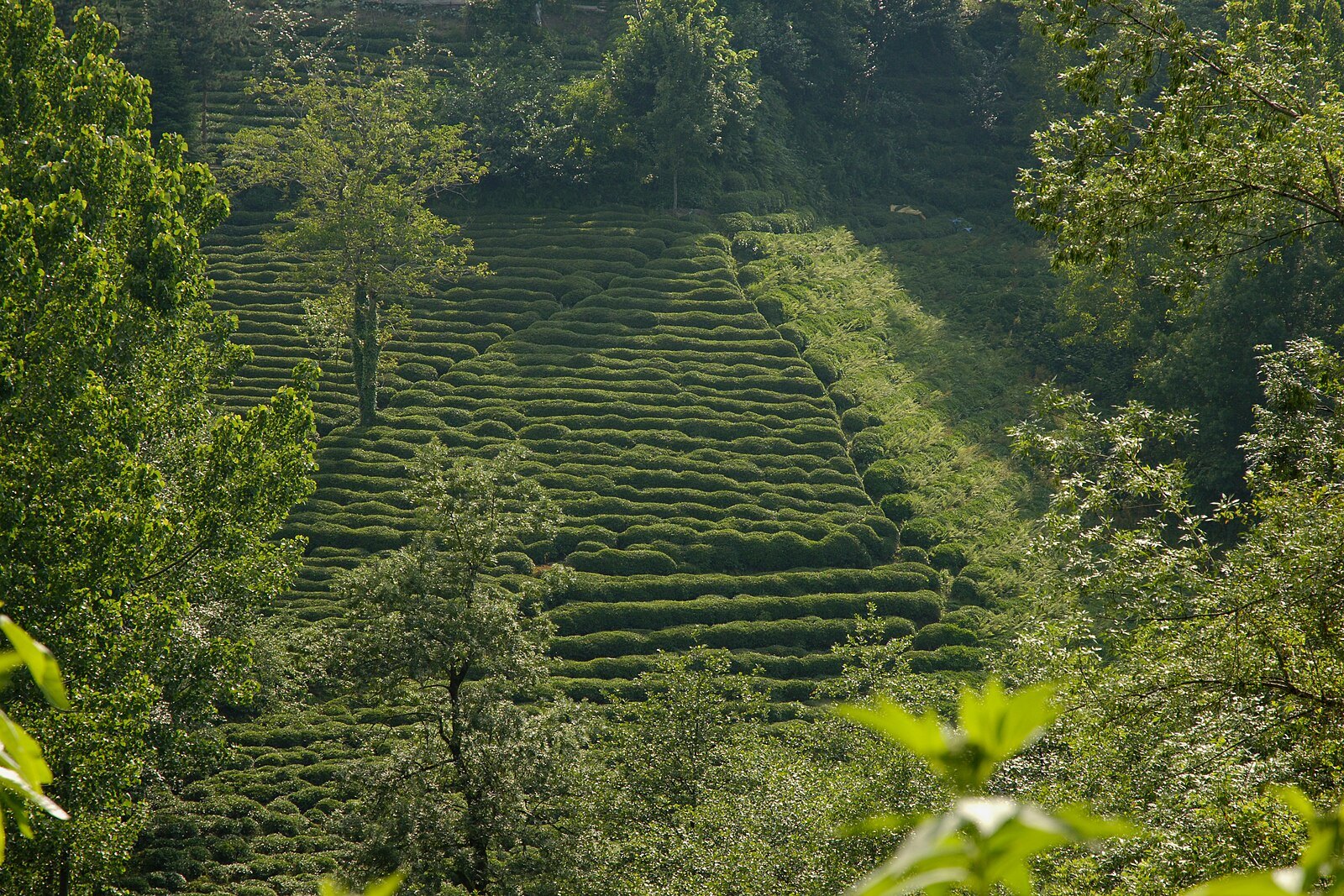
Rize sits on the eastern Black Sea coast of north-eastern Türkiye. The tea belt is not a flat plateau; it climbs from the coast into the hills, with gardens mainly below about 1,000 m. The PGI dossier gives these averages:
| Indicator | Figure |
|---|---|
| Annual rainfall | About 2,300 mm (24-year average) |
| Mean annual temperature | About 14°C |
| Mean relative humidity | About 78.8% |
| Upper tea-garden limit | About 1,000 m |
| Rize's share of Türkiye's fresh tea | 67% |
| Share of Rize agricultural land under tea | About 90% |
These numbers explain why Rize is the centre of Turkish tea, not just one production area among many. The national tea belt runs along the eastern Black Sea from the Georgian border to Fatsa in Ordu, covering Rize, Trabzon, Artvin, Giresun and Ordu. Rize is the most concentrated and highest-output province within that belt.
“Centre” is not “all.” The Ministry of Trade describes a multi-province belt. Writing “Turkish tea = Rize tea” erases Trabzon, Artvin and the other provinces, and misuses a protected origin name as a national category.
How Turkish tea took root in Rize
Tea cultivation was identified as possible around Rize in 1917 and began by law in 1924. The agricultural engineer Zihni Derin brought seeds from Batum (now in Georgia) and helped establish the nursery and trial system in Rize. In the 1940s, Rize opened Türkiye's first tea-processing factory, and the crop moved from experiment to commercial production.
From there, the tea belt expanded along the eastern Black Sea: Rize, Trabzon, Artvin, Giresun and Ordu. Rize became the shorthand for Turkish tea because it started first, has the densest gardens and produces the largest share.
This is industry history, not the geographical indication itself. History explains why Rize became a tea region; the PGI defines what kind of Rize tea may carry the name. The two are related but not interchangeable.
The plant population: diversity from seed
Rize's gardens are not a single-clone plantation. The official PGI material says the first gardens were established from hybrid seed of Chinese and Assam varieties introduced from Georgia, and the population continued to be propagated by seed. Over time, that produced a genetically diverse local population adapted to Rize's conditions.
Two corrections follow:
- It is not one named cultivar. Rize tea is a local population, not “Yabukita” or another single clone.
- It is not an ancient-tree product. The gardens are production gardens, not a handful of old trees. Age and plot variation exist, but the region is not marketed as “ancient-tree tea.”
Rize's local character comes from the combination of population, climate, soil and processing tradition, not from one legendary bush.
Processing: Orthodox and CTC coexist
Rize tea is fully oxidised black tea. The official PGI page describes the main flow:
- Plucking — mainly the bud and the next two leaves (“two and a half leaves”), by hand or scissors, delivered to the factory quickly.
- Withering — natural or artificial, reducing leaf moisture so the leaf can be rolled.
- Rolling — Orthodox or CTC (Cut-Tear-Curl) equipment, or a combination; rolling ruptures cells and starts oxidation.
- Oxidation — polyphenols change into theaflavins and thearubigins, building colour, aroma and astringency.
- Drying — high heat stops oxidation and brings moisture down to about 3%.
- Sorting, blending and packing — leaf grades are sorted and blended into stable products.
The critical correction: Turkish tea is not Orthodox-only. The official material says Orthodox, CTC and combinations are all used in Rize. CTC gives a broken, fast-extracting, high-strength style; Orthodox keeps more whole-leaf structure and layering. Either can appear in Rize tea, and a specific product's method depends on the factory, not on the origin name alone.
The sensory standard: dark red, bright, astringent
Rize Çayı's registration also defines what the tea should look and taste like:
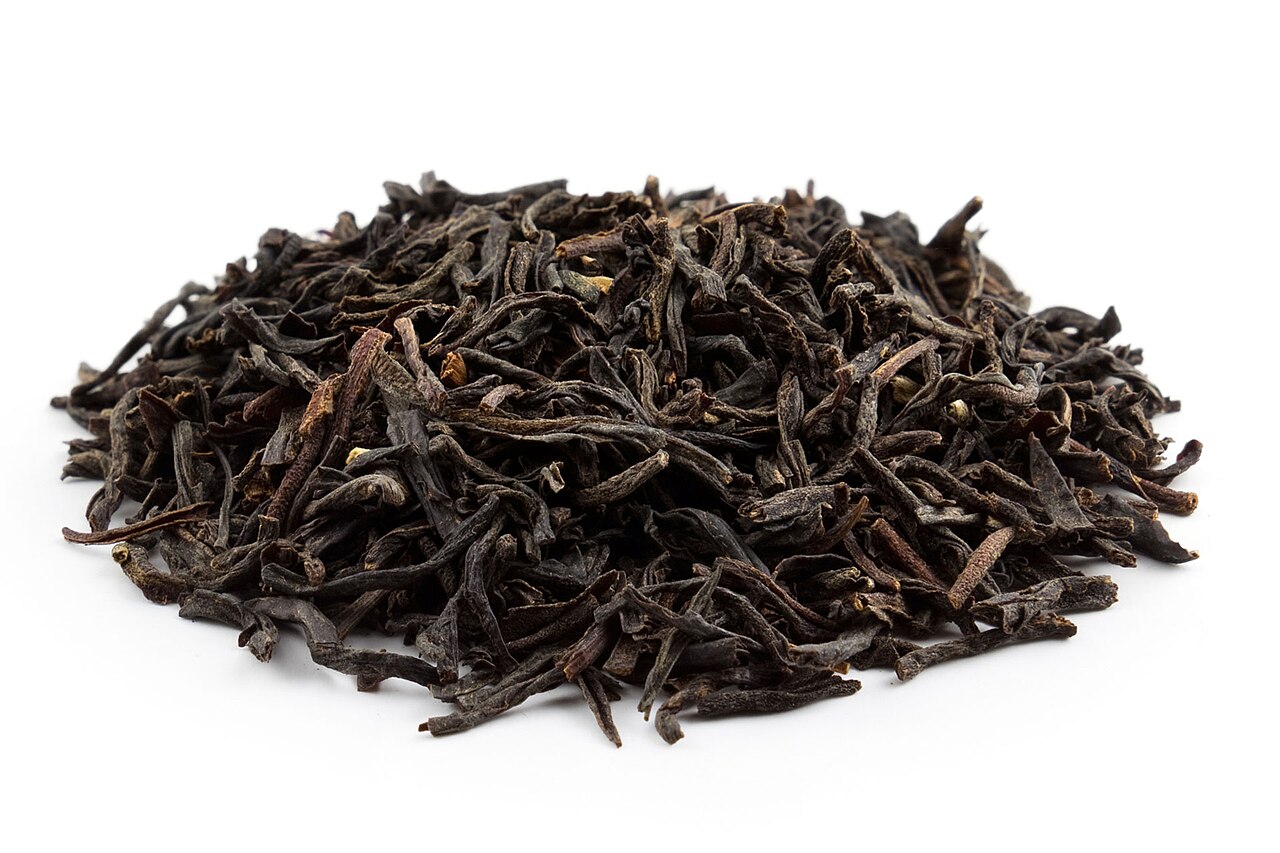
- Dry leaf — black or dark copper, free of fibre and stem.
- Liquor — dark red with a reddish cast, bright; not dull, cloudy or sedimented.
- Astringency — a “gripping” mouthfeel, the backbone of Turkish strong tea.
- Infused leaf — even copper-red colour, as little green leaf as possible, glossy rather than dark.
- Aroma — the characteristic Rize tea aroma.
- Overall score — at least 70 points in the sensory evaluation.
The dossier also gives a chemical marker: the ratio of theaflavins (TF) to thearubigins (TR) should not fall below 1/25, with TF kept high. TF drives brightness, liveliness and astringency; TR drives colour depth. That is the technical basis of “bright dark red,” not a home test.
For a drinker, the short version is: good Rize tea is not dull black; it is deep red, bright and astringent, with a clear aroma.
Brewing: the double pot and the thin-waisted glass
The traditional method is not a single-pot steep. It uses çaydanlık, the stacked Turkish teapot:
- Fill the lower pot with water and bring it to a boil.
- Put tea in the smaller upper pot, about one teaspoon per glass.
- Pour boiling water over the leaf, set the upper pot on the lower pot and let it steep for 15–20 minutes, making a concentrated dem.
- Pour the dem into a thin-waisted ince belli glass, then dilute with hot water from the lower pot to açık (light) or koyu (strong).
The logic is concentrate-then-dilute, not a pre-brewed mild pot. Leaf amount, steep time and dilution are adjustable; the official page gives the traditional method, not a universal rule.
A small pot or gaiwan also works: start with 5 g per 150 ml at 95–100°C for 1–2 minutes, then extend. Rize tea is fully oxidised and tolerates boiling water, but a long sealed steep will amplify astringency.
Claims to avoid
| Old claim | Treatment |
|---|---|
| “100% of Turkish tea comes from Rize” | The PGI dossier gives Rize a 67% share of fresh tea; the belt also includes Trabzon, Artvin and other provinces |
| “3.5 kg per capita, world number one” | Not verified in the official sources used here; omitted |
| “Orthodox only” | The official page says Orthodox and CTC coexist |
| “Z-shaped re-aroma process” | No official source; omitted |
| “1924 seed introduction from Georgia” | 1924 is the legal starting point; the introduction story is more layered, not a single-year event |
| “Martyrs' tea-tree legend” | No official source; omitted |
| “2,300–2,500 mm rainfall” | The official 24-year average is about 2,300 mm; do not turn it into a range with an upper bound |
| “Rize Çayı is a brand” | It is a geographical indication; brand products are a different layer |
The defensible version is: the protected black-tea origin of Rize province, registered as PGI no. 707 in 2021; a rainy, humid, sloping tea belt with a seed-propagated local population; Orthodox and CTC processing; a deep-red, bright, astringent liquor brewed in a double pot. That is enough for an origin page without “world's best” decoration.
Rize Çayı and Çaykur products
Çaykur is Türkiye's largest state tea enterprise, headquartered in Rize, with 47 wet-tea factories and 6,600 tonnes/day of wet-tea processing capacity. Its range includes Rize Turist, Altınbaş, Filiz, organic tea and gift packs. Rize Turist is one of its everyday Rize-style black teas.
But Rize Çayı is an origin name, while Çaykur Rize Turist is a brand product. A Çaykur product may use Rize tea as material and meet the PGI standard, or it may not carry the Rize Çayı logo; another producer's compliant tea may also qualify. Keeping those layers separate prevents “Rize tea” from becoming just another name for one company's product.
If you buy a pack with the Rize Çayı logo, read the producer, origin and compliance information, then brew it in the double pot. If you buy Çaykur Rize Turist, you are tasting a specific brand product with its own blend and price position. Related, but not the same thing.