First, the correction
“Jinshan green tea” is a name used by more than one Chinese product. The traceable tea behind this entry is Jinshan Shiyu, a historical green tea from Jinshan village, Shangzhuang township, Jixi county, in Anhui’s southern highlands. The core garden sits at roughly 500–900 metres.
The old machine draft placed this tea in a “Jinshan village” near Pai in Thailand and invented a story about a Chinese veteran, “Duan,” bringing tea from Fujian. No public record supports that. Jixi County Government, the national GI announcement and the county’s spring-tea advisory all place Jinshan Shiyu in Jixi, Anhui. This page follows the traceable record and drops the Thai setting.
| Item | Detail |
|---|---|
| Name | Jinshan Green Tea / Jinshan Shiyu |
| Type | Green tea; historical famous tea; national GI product |
| Origin | Jinshan village, Shangzhuang, Jixi, Xuancheng, Anhui |
| Altitude | Core garden about 500–900 m |
| Plant | Mainly the local “Jinshan cultivar” |
| Picking | Mingqian (late March–4 April) and Yuqian (5–19 April) |
| Processing | Fixing, rolling, drying; traditional “three firings and three rollings” |
| Flavor | Fat buds, visible white hairs, bright green liquor, fresh-sweet aftertaste |
The name
According to Jixi’s local tea history, the area has produced green tea since the Tang dynasty, though that claim is local lore rather than an independently dated record. In the Daoguang era of the Qing, a tea called “Jinshan Mingwu” was created; in 1868 it was renamed Jinshan Shiyu.
The name works on two levels:
- Jinshan — Jinshan village and its high-mountain mist.
- Shiyu — “seasonal rain,” referring to picking around Guyu, the grain-rain solar term in mid-April; the tightly rolled strips are also said to look like threads of rain.
Local accounts add tribute tea and a 1915 Panama-Pacific gold medal. Those are cultural history, not independently verified facts. What is solid: Jinshan Shiyu is a long-established Jixi green tea, modernized and branded in the twentieth century, and recognized as a national GI product in 2025.
The garden
Jixi lies in southern Anhui, in the same broad tea landscape as Huangshan, Shexian and Jingde. The core Jinshan village gardens are around 500–900 metres, with mist, cool nights and slow growth. The local “Jinshan cultivar” is a place-based population, not a nationally registered clonal cultivar. It is adapted to the area and gives thick buds with a high content of soluble solids.
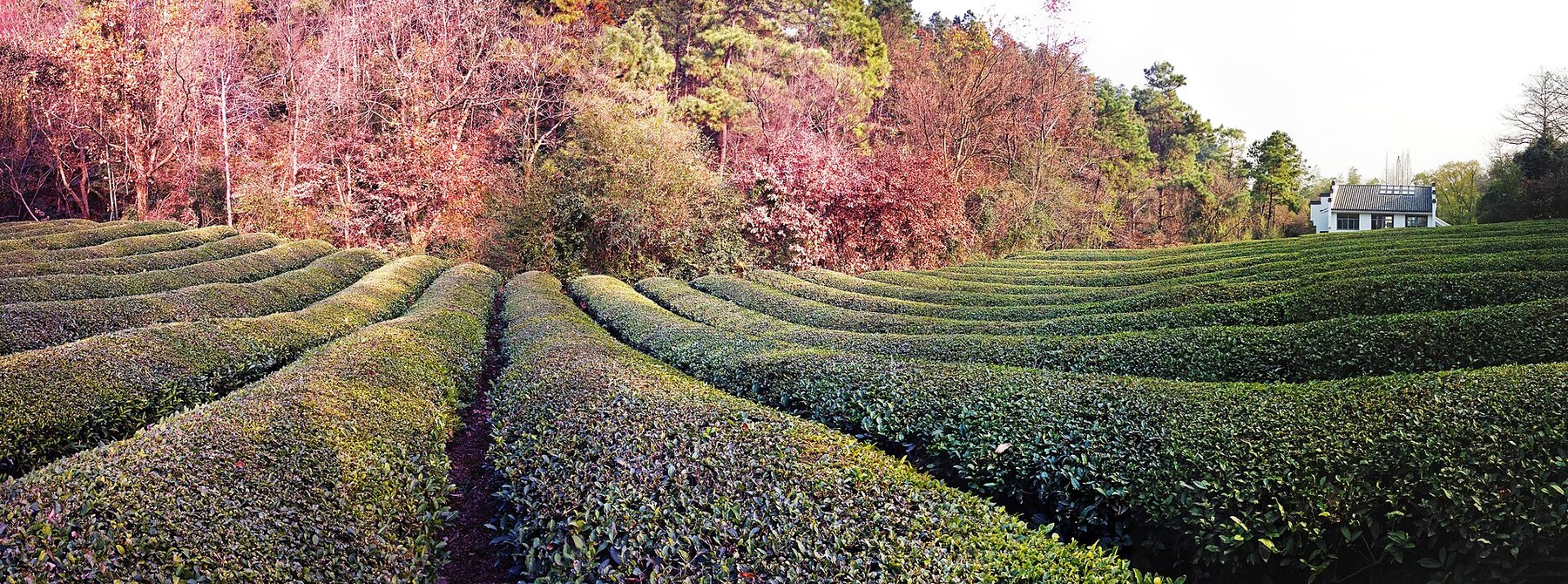
The photo used here shows tea rows below Jingting Mountain in Xuancheng, also in Anhui. It is a regional image, not a photograph of Jinshan village. It is used to show the terraced tea landscape of southern Anhui, not to claim a specific garden.
Processing
The traditional core is three steps:
- Fixing (shāqīng): high heat stops oxidation and preserves the green, fresh character.
- Rolling: tightens the strip and puts sap on the leaf surface.
- Drying: staged drying fixes the shape and aroma.
Local tea makers describe a “three firings and three rollings” rhythm, with repeated pan-firing and rolling to build the tight, downy strip. Modern production mixes hand work with small machines, but the critical points remain the same: enough heat to stop oxidation, enough pressure to shape without crushing, and a drying curve that preserves freshness.
Flavor
The county’s official description is precise: fat buds, visible white hairs, bright green liquor and a fresh, sweet aftertaste.
This is not a chestnut-heavy Longjing, nor a sharp orchid-scented Dan Cong. Jinshan Shiyu is closer to a clean, soft, slightly toasty green tea: a light chestnut or fresh soybean note, a soft body, and a slow sweetness in the throat. Top lots have clarity and a lingering finish; poor lots taste flat, grassy or astringent.
Brewing
The official advisory gives a practical baseline:
- Water: 85–90°C, not a rolling boil.
- Leaf: about 3 g to 150 ml.
- First steep: about 10 seconds, then lengthen.
- Re-steep: five to six times.
If the leaf is broken, shorten the first steep. If the strip is whole and tight, give it a few more seconds. Do not leave it sitting in hot water; the buds and white hairs turn bitter quickly.
Buying
- Look for the GI mark and the Jinshan Shiyu collective trademark. Ask for the GI-use authorization or a test report if needed.
- Check the picking date. Mingqian is scarce and expensive; Yuqian is often better value. Do not chase “first pick” or “special supply” labels.
- Check the leaf. Tight strips, visible white hairs and a fresh green color are positives. Broken leaf, dull yellow-brown color and a flat smell suggest stale or rough tea.
- Smell the dry leaf. Fresh tea has a clear, persistent aroma; old tea smells flat or closed.
- Ignore the mystique. The county’s own advisory warns against “wild ancient tree” and “master-made” marketing. Jinshan Shiyu is a fine green tea, not an ancient-tree pu’er.
Common misreadings
“Jinshan green tea is Thai.”
The old draft’s Pai setting has no reliable source. The core origin is Jinshan village, Jixi, Anhui.
“Jinshan Shiyu is a single clonal cultivar.”
“Jinshan cultivar” is a local population name, not a national registered clone.
“Greener or earlier is always better.”
Color and picking date are only two variables. Fixing, rolling, drying and storage decide the cup.
“All teas called Jinshan green tea are the same.”
The name is used in several places. This page is about the Jixi Jinshan Shiyu. Check origin, trademark and standard.
One line
Jinshan green tea is Anhui Jixi’s Jinshan Shiyu: a rain-thread green tea from a 500–900 m village garden, named for Guyu, and recognized as a national GI product in 2025. It has a real local history; it does not need a Thai plantation story.