First, the definition: a curled green tea, not a Duyun-only Maojian
Duyun Maojian is a curled green tea from Qiannan, Guizhou. One of its older names is “Yugou tea” (fish-hook tea). The leaf is tight and curly with visible white hairs; the aroma is mainly tender and chestnut-like; the liquor is yellow-green and bright; the taste is fresh, mellow and sweet. Under Guizhou provincial standard DB52/T 433—2018, it is defined as “a curled green tea with specific quality characteristics, made from tender buds and leaves of the local small-and-medium-leaf tea population or suitable cultivars grown in Qiannan Prefecture and processed according to DB52/T 995”.
The most common confusion is between “Duyun Maojian” and “Duyun City”. The core gardens are around Luosike hill, Tuanshan and Maojian Town in Duyun City. But the geographical-indication protected product “Duyun Maojian tea”, approved in 2010, covers Duyun City, Fuquan City, Weng'an County, Longli County, Huishui County, Changshun County, Dushan County, Sandu County, Libo County, Pingtang County, Luodian County and the Duyun Economic Development Zone. It is a regional brand centred on Duyun and extending across several Qiannan counties, not a product made only within Duyun City.
“Duyun Maojian” also has a certification-trademark area. The 2023 “Duyun Maojian” brand-use standard lists Duyun City, Guiding County, Weng'an County, Pingtang County, Huishui County, Sandu County, Fuquan County, Luodian County, Dushan County, Changshun County, Longli County and Libo County. Both lists contain 12 names, but one includes the Duyun Economic Development Zone and excludes Guiding, while the other includes Guiding and writes Fuquan as “Fuquan County”. The protected-product area and the certification-trademark area therefore cannot be treated as the same list. Buyers should check which mark is actually on the pack.
There is another boundary: Duyun Maojian is a green tea, not a white tea, black tea or Kuding tea. Qiannan also produces Guiding Yunwu, Weng'an white tea and Pu'an black tea; a product is not Duyun Maojian merely because it comes from Qiannan.
Where Duyun is: Miaoling mountains, Luosike and “high altitude, low latitude”
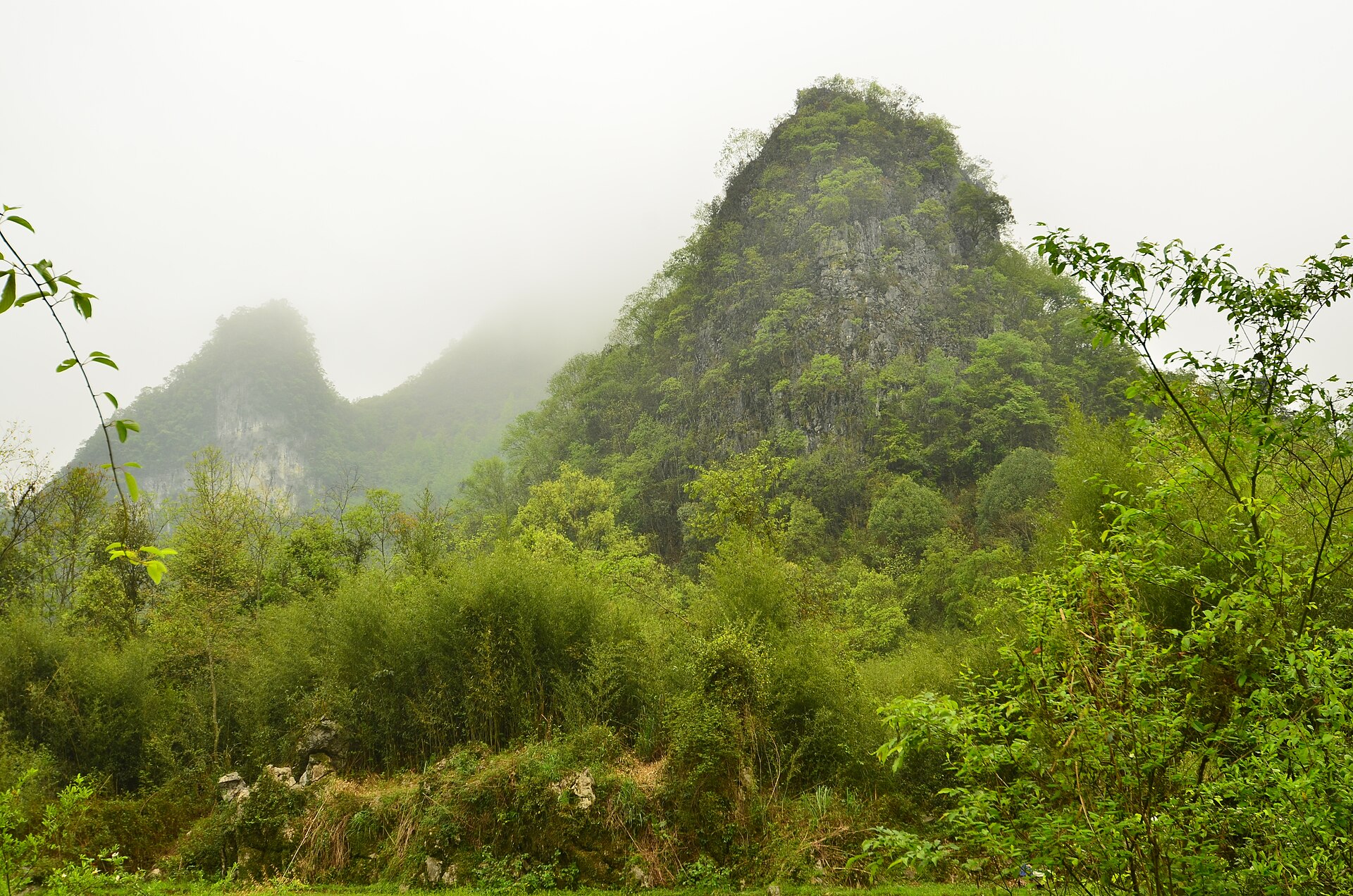
Duyun is the seat of Qiannan Bouyei and Miao Autonomous Prefecture, in southern Guizhou on the southern side of the Miaoling mountains, with the Jian River running through the city. The core tea hills lie west of the city around Luosike, Tuanshan and Maojian Town. Maojian Town is about 48 km from the city centre, with forest cover around 74%, an average elevation of about 1,240 m and a maximum of about 1,720 m; ridges above 1,700 m are common in the Luosike range. Low latitude, relatively high elevation, frequent cloud and limited sunshine are the usual regional description.
That description is only background; it does not replace site data. DB52/T 433—2018 requires the Zunpin-grade geographical-indication product to come from 600–1,500 m, on yellow or yellow-brown soil at least 1 m deep, with at least 1.5% organic matter and pH 4.0–6.5. Some gardens in the core township rise above 1,500 m. The standard defines the protected product’s site conditions, not the exact elevation of every garden. Aspect, shade, parent material, drainage and picking weather still create large differences.
Spring warms early in Duyun, but late frost remains possible. Higher gardens flush later than low basins, so “before Qingming” is not the same day on every hill. Treating “early” as automatically better can ignore cultivar, elevation and picking standard.
From “Yugou tea” to “Duyun Maojian”: a name built in layers
The history of Duyun Maojian is usually told from the Ming and Qing. Local tea histories say that “Yugou tea” and “Queshe tea” were sent as tribute in the Ming. A Qing Qianlong-era stele, the “Record of Rebuilding the Xiyue Temple”, notes an official tea garden in Duyun. The Republican-era Duyun county gazetteer records an award at the 1915 Panama exposition. Some local promotional texts call that award a gold medal; others use the broader “award of merit”. The sources do not agree on the grade, so this page uses the wider wording “an award at the 1915 Panama exposition” and does not treat “gold medal” as the only historical fact.
The name “Duyun Maojian” is commonly traced to 1956. Farmers in Tuanshan Township sent carefully pan-fired “Yugou tea” to Beijing. A reply from the General Office of the CPC Central Committee carried Mao Zedong’s note to the effect that the tea was good, that more tea should be planted on the hills, and that the tea could be called “Maojian”. The name gradually replaced “Yugou tea”. This is a well-documented local naming story, but it does not mean the generic word “Maojian” did not exist before 1956.
In 1982 Duyun Maojian entered a national famous-green-tea evaluation; local sources say it placed second and thereafter describe it as one of “China’s ten famous teas”. “China’s ten famous teas” is not a permanently valid title issued by one national authority; lists from different periods and organisers differ. This page treats it as a historical honour, not a current quality grade.
The brand timeline reads as follows:
| Time | Event | Level |
|---|---|---|
| Ming | Local tea histories say “Yugou tea” and “Queshe tea” were sent as tribute | Local tea-history narrative |
| Qianlong reign, Qing | The “Record of Rebuilding the Xiyue Temple” notes an official tea garden in Duyun | Local gazetteer |
| 1915 | Duyun county gazetteer records an award at the Panama exposition; local promotion often calls it a gold medal | Historical award, wording differs |
| 1956 | Tuanshan farmers sent tea; Mao Zedong’s reply used the name “Maojian tea” | Origin of the name |
| 1982 | Second place in a national famous-green-tea evaluation; local sources call it one of China’s ten famous teas | Historical evaluation |
| 2010 | AQSIQ announcement No. 133 approves GI protection for “Duyun Maojian tea” | Protected product |
| 2014 | Green-tea processing (Duyun Maojian technique) enters the fourth national ICH list | National ICH |
| 2022 | The broader “traditional Chinese tea processing techniques and related practices” enters the UNESCO Representative List | World heritage |
| 2024 | Duyun Maojian receives “China Time-honoured Brand” status (Duyun government work report) | Brand title |
| 2025 | Regional public brand value reaches RMB 5.588 billion (Qiannan industry bureau) | Brand value |
The 2022 UNESCO entry must be read with its full project name: the inscription covers “traditional Chinese tea processing techniques and related practices” as a whole. Duyun Maojian tea processing is one component, not a product that was separately inscribed.
Cultivar and picking: the local population is the base, not the only option
Duyun Maojian mainly uses local small-and-medium-leaf tea populations from Qiannan, often described locally as “Duyun Taicha” or “Guiding Niaowang”. DB52/T 433—2018 permits the traditional local population or suitable introduced cultivars; in practice, Fuding Daba, Longjing 43 and other cultivars are also used. Premium products emphasise the fine buds of the local population and a regional style, but “local cultivar” does not automatically make every batch better. Cultivar, tree age, management, picking and processing must be read together.
The picking standard is one bud with one leaf just opening around Qingming, no longer than 2 cm, dark or light green and shaped like a sparrow’s tongue. For Zunpin grade, DB52/T 433—2018 gives a picking season from early March to early May and requires hand picking that keeps the bud and leaf intact, with light-green or dark-green leaf and tender texture. Pickers hold the base of the shoot between thumb and forefinger and lift; they should not pinch it off with a fingernail. A pinched stem bruises and darkens, affecting appearance and increasing the risk of unwanted fermentation.
“One bud with one leaf” does not mean younger is always better. A pure-bud tea can look finer but taste thinner and yield less. One bud with one leaf just opening balances aroma, freshness and appearance. Different grades specify different bud-leaf proportions; Teji, first grade and second grade are not the same picking standard. A pack that says only “pre-Qingming Teji” without a standard, origin or SC licence should be treated cautiously.
Processing: “taking treasure from fire” in one pot
The traditional handmade sequence is picking, spreading, kill-green, rolling, shaping (ball-rubbing), hair-lifting, baking and finally “shouqing” or dry-leaf sorting. The whole sequence is completed in one iron pan, hence the saying “taking treasure from fire, in one continuous breath”. The pan temperature falls stage by stage from the high heat of kill-green. The maker judges water content and leaf condition by hand, eye and nose rather than following one fixed temperature curve.
| Stage | Main purpose | What the maker looks for |
|---|---|---|
| Spreading | Lose surface water and soften the leaf | Thin layers for 4–8 hours, no deeper than 5 cm, about 15% water loss; soft but not sticky |
| Kill-green | Deactivate enzymes and remove the raw green note | Leaf turns dark green, loses surface sheen, bends without breaking, tea aroma appears |
| Rolling | Start the strip and press out juice | Light pressure first, then heavier; strips form and white hairs begin to show |
| Shaping (ball-rubbing) | Fix the curl and fish-hook shape | Rub the leaf in one direction like a rice dumpling; strips curl as moisture falls to 20–40% |
| Hair-lifting | Expose white hairs and tighten the strip | Rub the ball lightly between the palms until hairs show evenly and strips harden |
| Baking | Finish drying and fix the aroma | Spread and turn the leaf until moisture is below 6% and it crushes to powder |
| Shouqing | Stabilise dryness and aroma | At about 80% dry, wrap in white paper and store over charcoal in a ceramic jar for about half a month |
Public manuals do not fully agree on parameters. A 2025 group-standard draft gives kill-green at 250–300°C, 0.5–1 kg leaf and 7–10 minutes. The Qiannan Academy of Agricultural Sciences’ 2024 manual gives kill-green at 300–400°C, 0.5–0.8 kg and 4–6 minutes; rolling at 150–200°C; shaping at 120–170°C; hair-lifting at 100–150°C; baking at 100–120°C. The differences reflect pan type, where temperature is measured, leaf load and moisture. No single table should be treated as the only valid curve. This page keeps the stage order and the sensory checkpoints; the numbers are references.
Modern mechanised lines separate spreading, kill-green, rolling, shaping and drying, with more controllable temperature, time and airflow and better batch consistency. Handmade tea can show more individual curl and hair; machine-made tea can be more even but sometimes flatter in aroma. Neither is inherently better. Judge the sample, not the word “handmade”.
Quality: curl, white hairs, tender and chestnut aromas
DB52/T 433—2018 divides Duyun Maojian into five grades: Zunpin, Zhenpin, Teji, first grade and second grade. Zunpin applies to the geographical-indication product. Its sensory requirement is tight, fine and curly strips, fully covered with white hairs, even, tender green and clean; tender and chestnut aroma; fresh and mellow taste; tender yellow-green bright liquor; tender green, lively and even infused leaf. Zhenpin is tight, fine and fairly curly with visible white hairs, even and green-lustrous; tender, chestnut and clean aroma; fresh and sweet with a returning sweetness; tender yellow-green bright liquor. Teji is fairly tight and fine, curved with visible hairs, even and green-lustrous; clean and chestnut aroma; mellow taste; yellow-green fairly bright liquor.
Local promotion often sums up Duyun Maojian as “three greens with a yellow tone”: dry leaf green with yellow, liquor green with yellow, infused leaf green with yellow. This is a summary of a common style, not a physical or chemical requirement that every grade and batch must meet. Early high-mountain leaf picked young with light firing can look more tender-green; rainy weather, later picking or heavier firing can push the colour toward yellow-green. Colour is a clue; aroma, taste and infused-leaf liveliness matter more.
White hairs are a characteristic, not a “more is better” score. Hair density depends on cultivar, tenderness, shaping and hair-lifting. Some machine-made teas look more evenly haired; some handmade teas look looser. When judging dry leaf, also check whether the strips are tight and curly, even, free from scorched edges and broken pieces. Looking only at “hair” can mislead.
The aroma is mainly tender and chestnut-like, not a uniformly high, perfumed fragrance. Tender aroma comes from early spring buds and proper kill-green; chestnut aroma from firing and drying. Lighter firing tends toward clean freshness, heavier firing toward chestnut. Liquor colour ranges from tender yellow-green to yellow-green bright; the key is clarity, no reddening and no cooked-off note. The infused leaf should be tender, even and lively, not heavily broken or dark brown.
Brand and industry: keep Duyun City and Qiannan Prefecture apart
For 2024, Duyun City reported 378,300 mu of tea gardens covering 103 villages in eight townships/subdistricts; tea output of 12,600 tonnes; output value of RMB 3.305 billion; a regional public brand value of RMB 5.223 billion, eighth nationally among green teas and first in Guizhou; and more than 40,000 tea workers with 125,000 beneficiary farmers. In 2024 the city also completed 35,300 mu of geographical-indication certified area, 27,300 mu of export-registered base, three digital tea gardens, 96 upgraded processing lines and 32,000 tonnes of processing capacity.
Maojian Town’s 2024 figures are 125,000 mu of tea gardens, 80,200 mu in production, 79 tea enterprises and cooperatives, 18 with SC certification, three above-scale enterprises, 3,581 tonnes of tea and RMB 952 million in output value. It is one township within Duyun City and cannot stand in for the whole city.
In 2025 the Qiannan Prefectural Bureau of Industry and Information Technology put the Duyun Maojian brand value at RMB 5.588 billion, with 104 licensed enterprises. In the same review, Qiannan Prefecture as a whole had 1.38 million mu of tea gardens, 1.24 million mu in production and 67,000 tonnes of output. The 1.38 million mu and 67,000 tonnes are prefecture-wide, not Duyun City. The RMB 5.223 billion is the 2024 brand value; RMB 5.588 billion is the 2025 value. They should not be added together or presented as the same year.
These figures come mainly from government news, departmental reviews and industry reports, not a line-by-line statistical communiqué for Duyun City. They are useful for trend reading. For audit or investment calculations, use the statistical communiqué and industry statistics, and state the year and administrative level. Brand value, tea-garden area, output, output value and composite output value are different measures and cannot substitute for one another.
Market and buying: check the mark, then the grade
The first step in buying Duyun Maojian is not to look for “pre-Qingming”, but to check the mark and the responsible producer. A geographical-indication protected product should carry the appropriate special mark; a certification-trademark product should be licensed to use “Duyun Maojian”. The pack should name the producer, address, SC licence number, execution standard, grade, net weight, production date and contact details. A pack that says only “Duyun Maojian” without these details cannot be verified as licensed.
The second step is origin and grade. The 2010 protected-product area covers several Qiannan counties, not only Duyun City. The certification-trademark area under the 2023 standard is a different list: it includes Guiding and excludes the Duyun Economic Development Zone. A pack that names “core area, Luosike, Duyun City” is making a specific origin claim; a pack that says only “Qiannan” is using the wider regional scope. The grade should be one of Zunpin, Zhenpin, Teji, first grade or second grade, not merely the word “Teji” in advertising.
The third step is the sample. Dry leaf should be tight, fine and curly, with visible white hairs, even, tender green or green-lustrous, and free from a large amount of broken pieces, scorched edges, yellow flakes or off-odours. The aroma should be tender and chestnut-like, not smoky, burnt, mouldy or stale. The liquor should be yellow-green and bright, not cloudy or red. The infused leaf should be tender, even and lively, not largely dark brown or broken. A price far below the market for the stated grade, with no licence or test information, is a warning sign.
“Handmade” is not a quality guarantee. Handmade tea can have more individual shape but also scorched edges if the pan temperature is unstable; machine-made tea can be more even but sometimes flatter in aroma. Judge the sample and grade, not the label. Duyun Maojian is a green tea and freshness matters; old “cellar Maojian” should not be sold at new-tea prices.
Brewing, storage and source boundaries
For Duyun Maojian, use about 3 g of leaf in 150 ml of water at 80–85°C, in a glass or a covered bowl. Give the first infusion 20–30 seconds, then lengthen subsequent infusions. Do not pour boiling water directly onto young buds or leave them steeping for a long time; the tender aroma can cook off and the liquor can turn yellow. The exact ratio, temperature and timing depend on grade and personal taste; one set of numbers does not fit every sample.
Store the tea sealed, away from light, moisture and strong odours. Keep a small amount in a cool place for short-term use; keep the rest at 0–5°C in a refrigerator or freezer. After opening, expel as much air as possible and finish the tea soon. Do not store it beside coffee, spices or leftover food. Green tea is not suited to long open storage at room temperature, nor to repeated removal from and return to the refrigerator.
There are three source boundaries. First, the Ming tribute story, the Qing official tea garden, the 1915 Panama award, the 1956 naming and the 1982 evaluation belong to local gazetteers, local tea history and brand narrative; this page does not present them as a modern national evaluation that can be independently re-run. Second, the 2022 UNESCO inscription covers “traditional Chinese tea processing techniques and related practices” as a whole; Duyun Maojian processing is a component, not a separately inscribed product. Third, the 2024 Duyun figures of 378,300 mu, 12,600 tonnes, RMB 3.305 billion and RMB 5.223 billion, and the 2025 figure of RMB 5.588 billion, are government-news and departmental figures, not statistical-communiqué figures. Cite the year and administrative level.
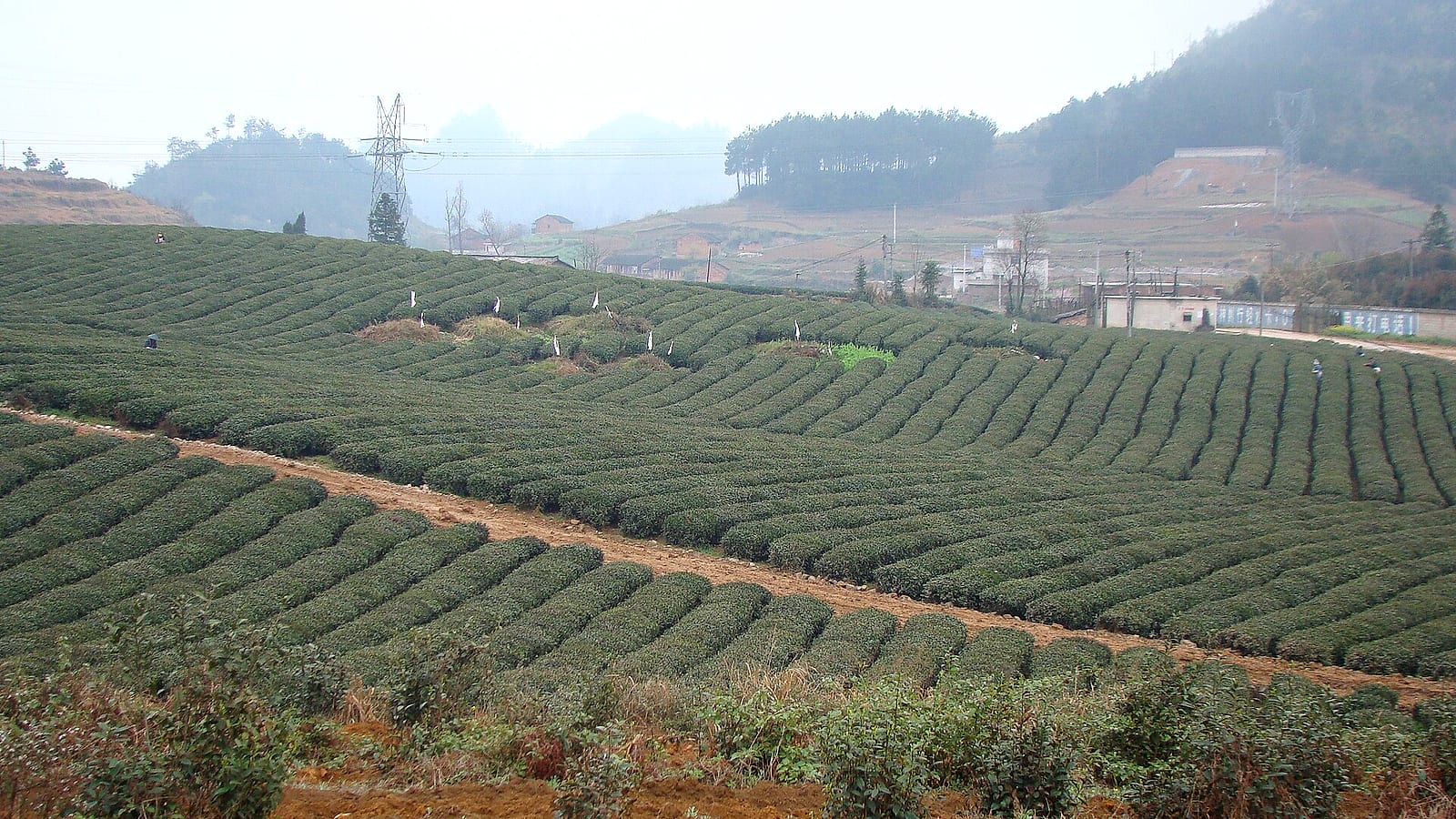
The main image is a real photograph of Niuchang tea farm in Duyun, used as a production-area reference. It is not a photograph of Duyun Maojian dry leaf, liquor or a graded sample, and cannot be used to judge leaf shape, white hairs, liquor colour, infused leaf or quality.