Water is over 99% of a cup, yet it is often ignored. Pure water is not automatically good; mineral water is not automatically suitable. Total dissolved solids (TDS), hardness, pH and residual chlorine each change extraction, liquor colour, aroma and taste. Set the water into a reasonable range first; then adjust temperature and time.
Four measures
| Measure | What it is | Effect on tea | Practical direction |
|---|---|---|---|
| TDS | Total dissolved solids | Too low may under-extract and taste hollow; too high suppresses aroma and extraction | Start around 50–150 mg/L |
| Hardness | Calcium + magnesium, as CaCO₃ | Binds polyphenols, increases sediment, lowers some catechins | Low to moderate, about 50–100 mg/L |
| pH | Acidity / alkalinity | Alkaline water accelerates catechin oxidation and darkens liquor; acidic may sharpen taste | About 6–7 |
| Residual chlorine | Disinfection residue | Reacts with polyphenols and aroma compounds; gives a chemical off-flavour | As close to 0 as possible |
These are starting ranges, not universal standards. Tea type, processing and personal preference move you within them.
TDS: not the purer the better
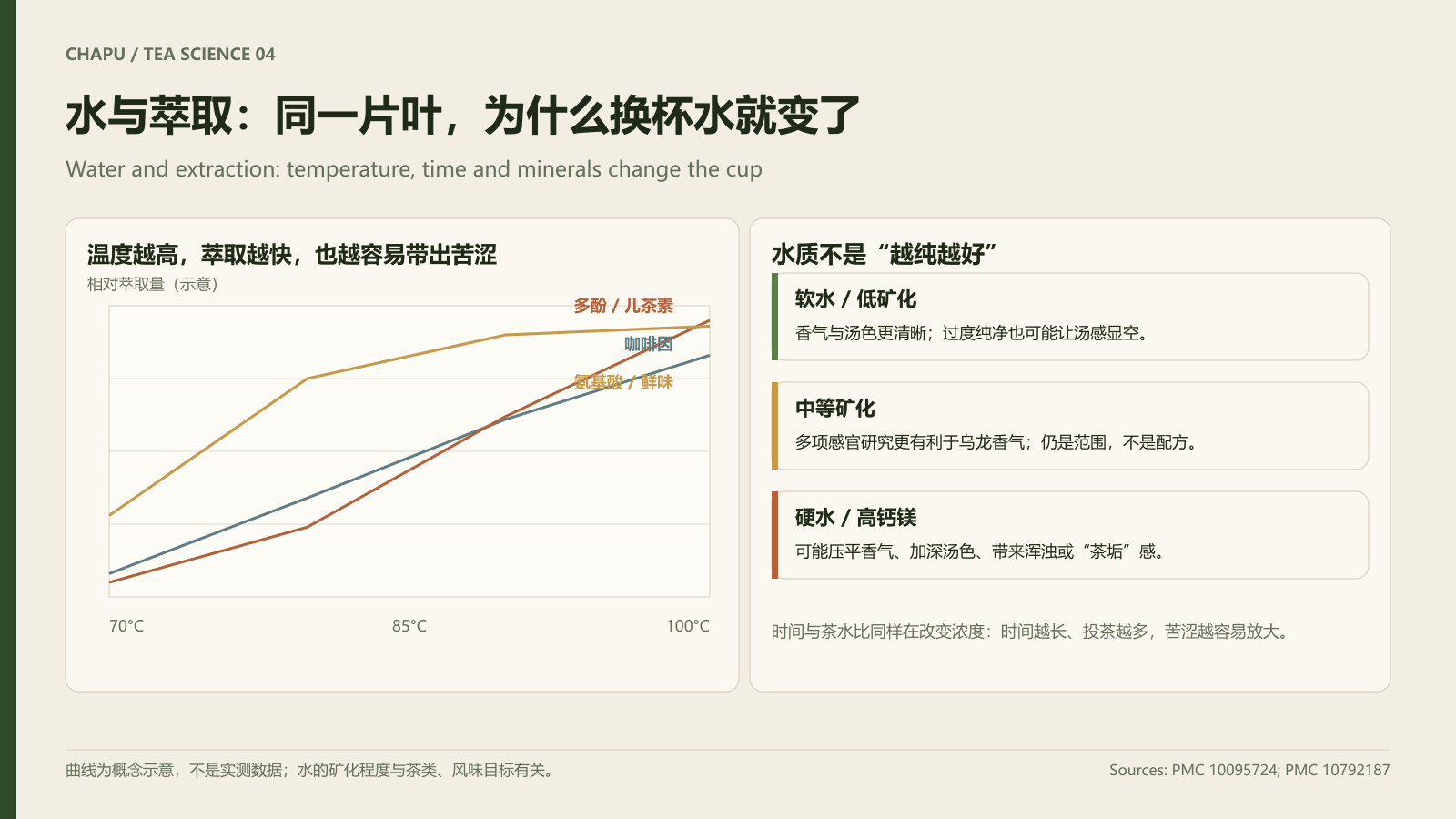
The 2017 green tea study found higher soluble solids, catechins and L-theanine with low TDS (0.59–13.0 ppm), low conductivity and pH 6.04–6.90. With high TDS (315–338 ppm), high conductivity and pH 7.65–8.05, major catechins fell by about 84–93% and the liquor colour deteriorated.
But too low TDS also has problems: fully deionised water can taste hollow and flatten aroma and taste. Practical guides often recommend 50–150 ppm; below 50 may under-extract, above 150 minerals suppress delicate aroma. Many city tap waters are 150–400 ppm, some above 500, and may need filtration or a different source.
Hardness: a trade-off
Hardness is calcium plus magnesium. Japanese trials show harder water reduces green tea catechins (especially EGC and EGCG), increases white sediment (tea cream) and darkens the liquor; above 200 mg/L hardness, vitamin C almost disappears. Yet the same tasters preferred tea brewed with 225.6 mg/L hard water because astringency and bitterness were lower and sweetness higher.
“Optimal hardness” depends on what you want: for clarity, freshness and high catechins, choose low hardness; for softer, less astringent tea, slightly harder water may please. In a separate magnesium test, 16 mg/L reduced black tea sweetness and umami and increased astringency; 4 mg/L was better.
pH and chlorine
Alkaline pH accelerates catechin oxidation, darkens liquor and reduces freshness; acidic pH can sharpen taste. Near neutral, slightly acidic (about 6–7) is a stable range.
Residual chlorine is the most common tap-water issue. Even 0.2–0.3 mg/L can react with polyphenols and floral volatiles, producing a chemical off-flavour or extra bitterness. Boiling does not remove all chlorine; standing, activated carbon filtration or a low-chlorine source works better.
Temperature: tea first, then water
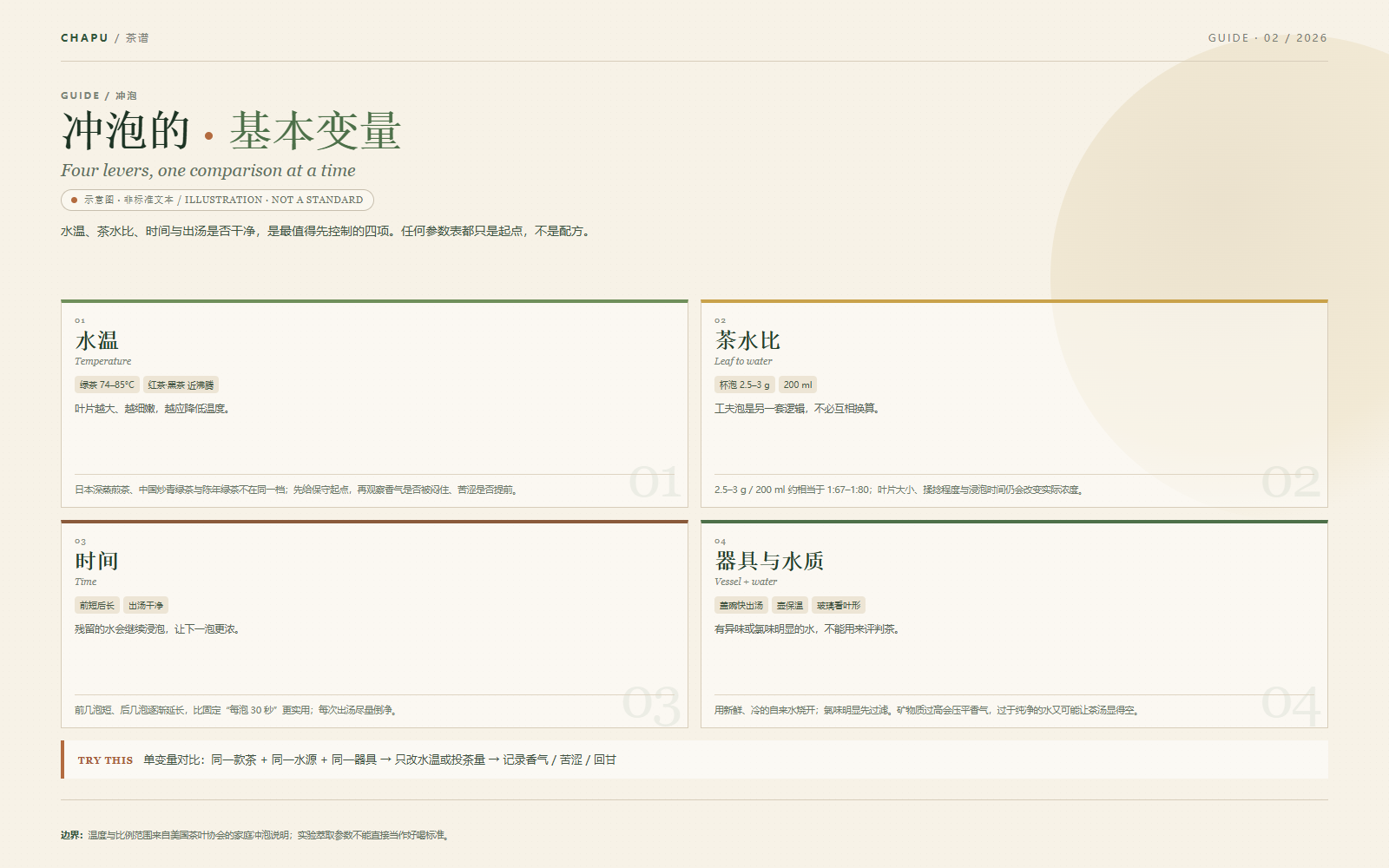
Once water quality is set, temperature matters:
- green and white tea: about 75–85°C to avoid cooking the leaf;
- light oolong: about 90–95°C;
- roasted oolong and black tea: about 95–100°C;
- post-fermented tea: boiling water, or simmer when appropriate.
Temperature is not a fixed table. Young, broken or heavily dosed leaf may need cooler water or a shorter time.
Household options
- Measure first. A TDS pen and pH paper tell you the starting point; without tools, start low-hardness and chlorine-free.
- Filter. Activated carbon removes chlorine and some organics; reverse osmosis removes too much mineral, so remineralise slightly.
- Read mineral-water labels. “Natural” does not mean suitable; check TDS, calcium, magnesium and bicarbonate.
- Do not brew with distilled water directly. It can taste hollow; add a little mineral water or use low-TDS tap water.
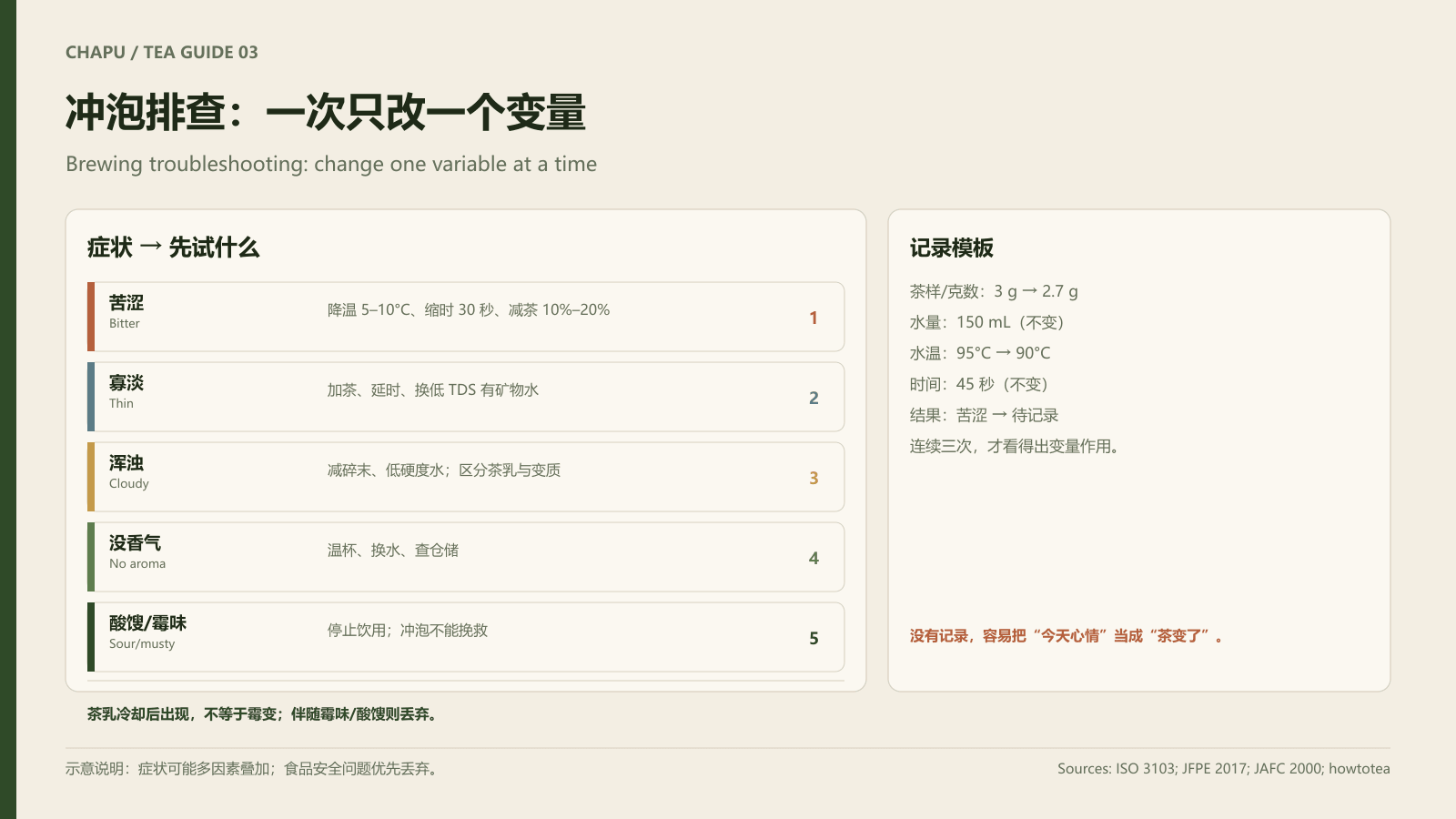
- Run an A/B test. Same tea and parameters, different water; record colour, aroma and astringency.
- Avoid repeated boiling. Heat fresh water in small batches to limit concentration and off-flavour.
Common misreadings
| Claim | Problem | More defensible reading |
|---|---|---|
| “Pure water is cleanest and best for tea” | Deionisation may under-extract and taste hollow | Low TDS with some minerals is more stable |
| “The more expensive the mineral water, the better” | High TDS/hardness can suppress aroma | Read the label, not the price |
| “Harder water tastes sweeter” | Hardness affects astringency, extraction and sediment | A trade-off; adjust by tea type |
| “Boiling removes chlorine” | A short boil does not remove all chlorine | Stand, filter or change source |
| “pH does not matter” | Alkaline water accelerates oxidation and changes colour | Keep close to neutral |
Source boundary
This page can establish: TDS, hardness, pH and residual chlorine change extraction, aroma, liquor colour and taste; low TDS, low hardness, near-neutral and chlorine-free is a stable starting point; high TDS and hardness can reduce catechin extraction and increase sediment; hardness has a trade-off in astringency.
This page cannot establish: that one bottled water suits every tea; that TDS/pH numbers fully predict flavour; that a filter always reaches a target. Judge by labels, measurements and trial brews; when in doubt, choose a checkable low-chlorine, low-hardness source.