“Tea gets better with age” is true only for a few post-fermented teas under specific aging conditions. For most green teas, light oolongs and black teas, time usually means lost aroma, darker liquor and less freshness. Storage is not folklore; it is a set of measurable processes: moisture migration, lipid and polyphenol oxidation, pigment degradation, residual enzyme activity, volatile loss and microbial risk.
Four pivot variables
| Variable | Main action | Typical consequence |
|---|---|---|
| Moisture | Reaction solvent and microbial growth condition | Higher moisture accelerates oxidation and mould |
| Oxygen | Oxidises polyphenols, lipids and vitamin C | Darker liquor, less freshness, stale notes |
| Temperature | Speeds up reactions | Faster aroma loss and pigment degradation |
| Light | Triggers photo-oxidation and pigment breakdown | Greener tea browns; “sun-baked” off-flavour |
These variables interact. High humidity raises moisture content; oxidation releases heat and raises temperature, creating a feedback loop. The goal is not a magic jar but reducing all four at once.
Moisture: from crisp to mouldy
Dry tea is usually kept at 3–5% moisture. That range helps limit contact between air and lipids and slows oxidation. Near 10%, mould risk rises sharply. When relative humidity stays above 60%, tea absorbs moisture and both enzymes and microbes can wake up.
Two kinds of “wet” matter:
- The leaf was not dried properly: a processing or storage defect, risky from day one.
- The storage environment is humid: repeated opening, rainy season, or fridge removal without sealing.
“No visible mould” is not proof of safety. Mould growth and toxin accumulation do not always appear together. Musty odour, clumping, cloudy and irritating liquor: discard. Do not try to rescue it by rinsing.
Oxygen and residual enzymes: black tea keeps changing
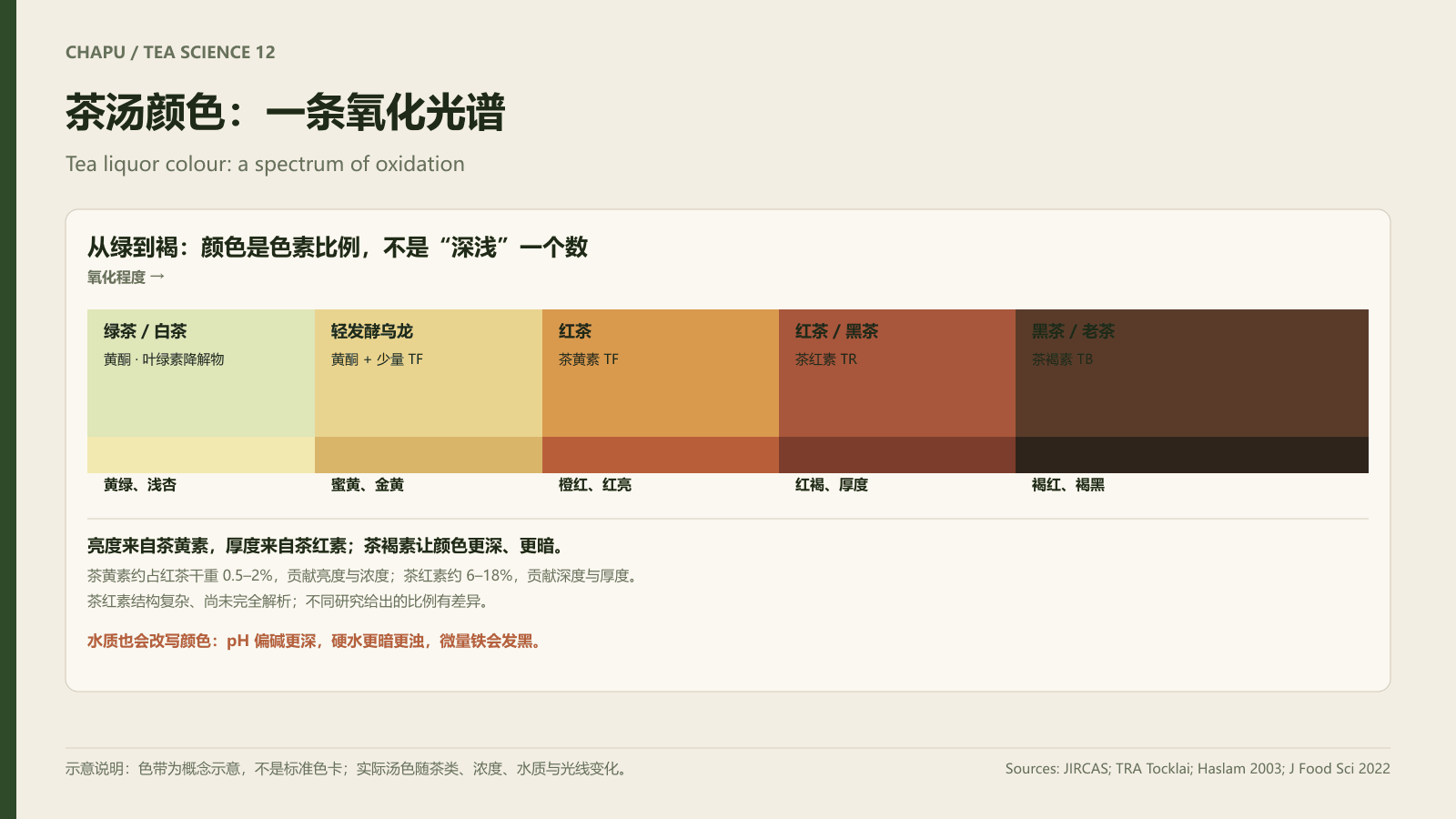
Green tea staleness is easy to picture: chlorophyll degrades, vitamin C falls, fresh aroma volatilises. Black tea changes too, by a different route. Classic storage work shows theaflavins decline, thearubigins and extractable caffeine rise, and aroma and astringency are lost. Residual polyphenol oxidase and peroxidase activity continue to degrade theaflavins. High moisture and temperature accelerate this.
This explains a common puzzle: a well-sealed black tea one year later may retain “body” but lose brightness and freshness. It is not a new aged note; theaflavins and aroma compounds are declining.
Temperature and light
Temperature speeds most chemistry, but “every 10°C doubles the rate” does not apply to every tea reaction. Published acceleration differs with moisture, oxygen and packaging barrier. Keep long-term storage cool, away from stoves, balconies and hot cars.
Light, especially sunlight through clear packaging, triggers photo-oxidation and pigment breakdown. Green tea in a glass jar on a sunny shelf can develop off-flavour and browning within days. “Dark” means an opaque package, not merely a dark corner.
Paths by tea type
| Tea | Main deterioration | Storage focus |
|---|---|---|
| Green tea | Chlorophyll loss, vitamin C decline, aroma loss | Cool, sealed, dark, limited opening |
| Light oolong | Volatile loss, colour darkening | Sealed, dark, short-term refrigeration |
| Roasted oolong | Roast note fades, aroma transforms | Sealed, cool, avoid moisture cycling |
| Black tea | Theaflavin loss, aroma and brightness decline | Sealed, dark, avoid heat and humidity |
| White tea | Slow transformation, but humid mould risk | Dry, dark, moderate airflow |
| Post-fermented tea | Microbial and enzymatic activity continues | Stable temperature and humidity, clean, odour-free |
“Older and better” needs raw material, processing, stable humidity, cleanliness and time. Putting ordinary green tea in a damp basement does not create aged tea; it creates mouldy tea.
Home storage sequence
- Confirm the tea is dry. Do not store damp, clumped or musty tea.
- Split into small packages. Reduce repeated opening and oxygen exposure; reseal promptly.
- Seal, dark, odour-free. Foil laminate or a sealed tin; keep away from coffee, spices and cleaning products.
- Match temperature to tea type. Green and light oolong can be refrigerated, but must be sealed and warmed before opening to avoid condensation.
- Do not “wake” tea repeatedly. Take only what you will drink; leave long-term stores closed.
- Record batch and date. Not every tea is made for long storage; drink first, store selectively, check periodically.
Source boundary
This page can establish: moisture, oxygen, temperature, light and residual enzymes drive storage change; black tea loses theaflavins and gains thearubigins; high humidity raises mould and toxin risk; tea types deteriorate differently.
This page cannot establish: how long a specific batch will last; the exact rate in a particular home; that all “aged” tea is safe or better. Judge by raw material, processing, moisture, packaging and storage records. Discard musty, clumped or visibly mouldy tea on food-safety grounds.