Hold a cup to the light and colour comes first: green-tea yellow-green, white-tea pale apricot, oolong honey to amber, black-tea orange-red, dark-tea brown-red. Colour is not decoration. It is the chemical result of leaf pigments, oxidation products, concentration and water chemistry.
"Dark means strong means good" is the most common misreading. Dark can come from concentration, over-oxidation, old leaf, hard water or ageing; brightness can come from theaflavins or simply from a naturally pale tea type. To read liquor colour, start with what pigments are actually in the cup.
Four pigment families in the cup
| Pigment/class | Typical colour | Mainly found in | Note |
|---|---|---|---|
| Chlorophyll and pheophytin | Green, olive, dark brown | Green tea, matcha; aged or overheated tea | Chlorophyll itself is poorly soluble in water; green in the cup comes more from other pigments and suspended matter; pheophytin turns dull |
| Flavones and flavonols | Yellow, yellow-green | Green tea, white tea, lightly oxidised oolong | Water-soluble flavonoids contribute the yellow-green of green tea; some glycosides add soft astringency |
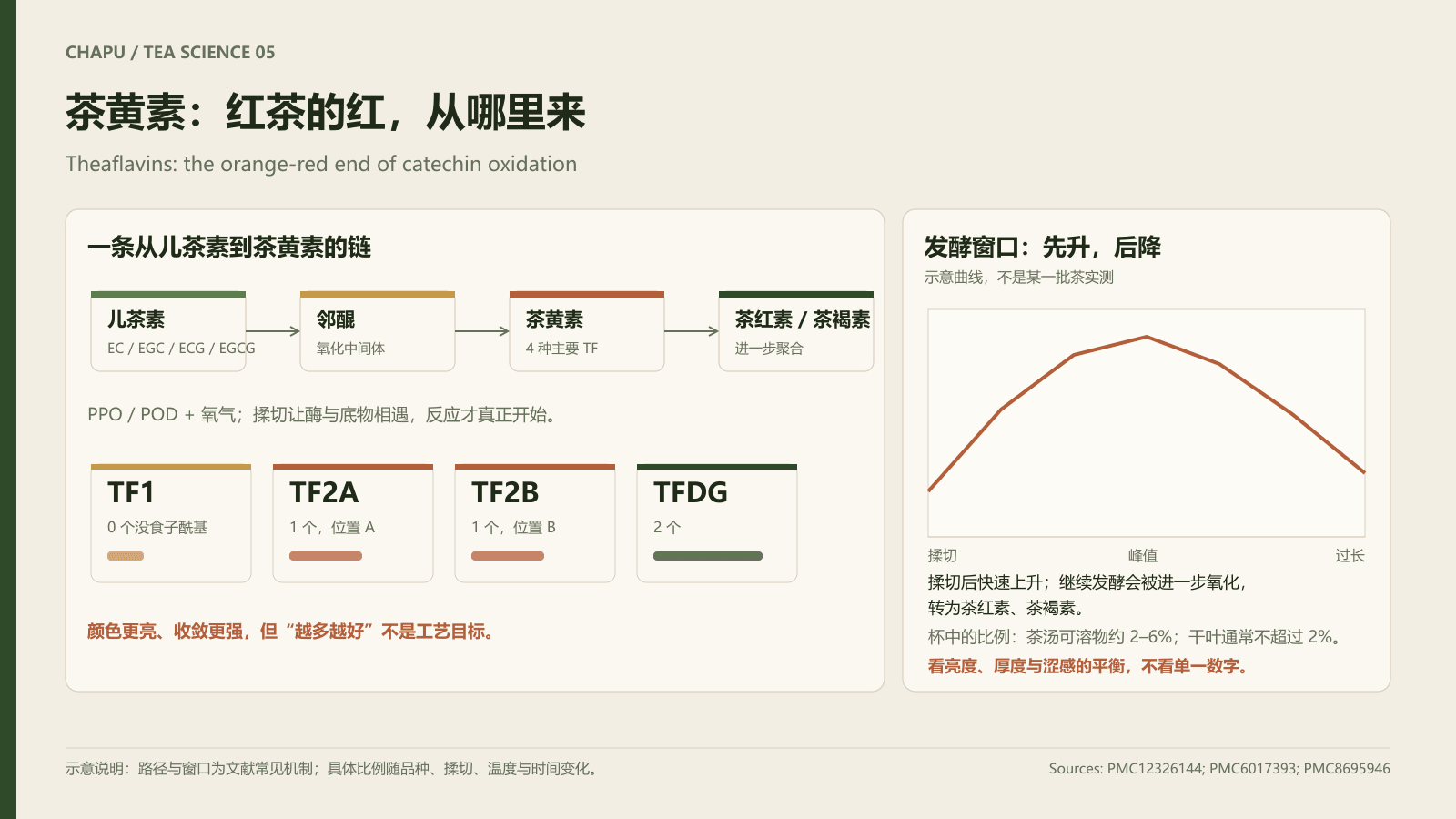
| Theaflavins (TF) | Orange-red, golden | Black tea, some oolong | Oxidised catechin dimers; contribute brightness, colour and briskness; usually 0.5–2% of dry weight |
| Thearubigins (TR) | Red-brown, dark red | Black tea, dark tea | Complex mixtures formed by further oxidation and polymerisation of theaflavins; contribute body and depth; 6–18% of dry weight or more |
| Theabrownins (TB) | Dark brown, brown-black | Dark tea, ripe Pu'er, aged tea | Further polymerisation and oxidation; deep, low-brightness liquor, often with aged and mellow notes |
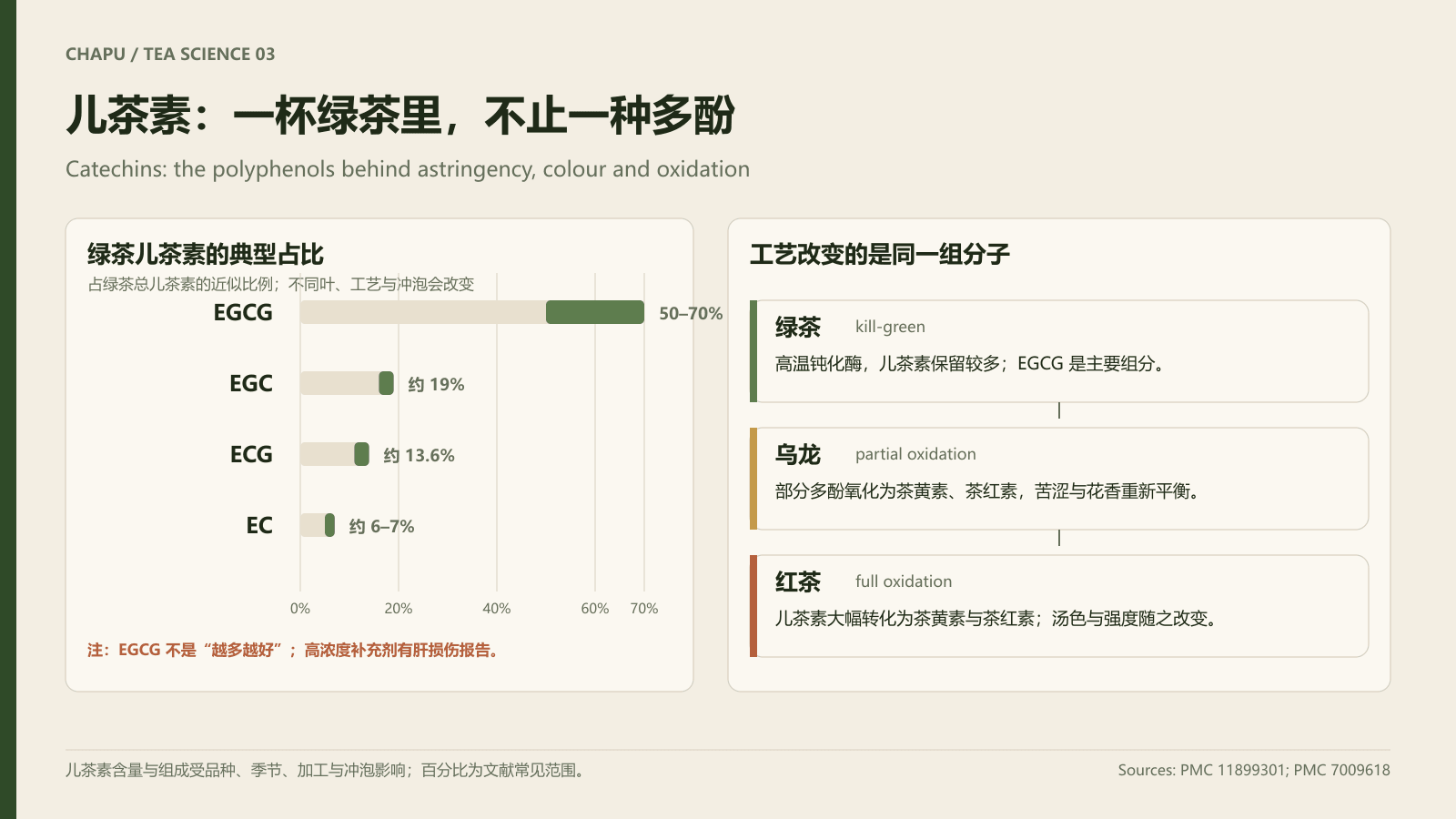
Green tea kills the enzyme early, so little theaflavin or thearubigin forms; colour comes mainly from flavonoids, chlorophyll degradation products and minor oxidation. Black tea oxidises fully, and theaflavins and thearubigins take over. Dark tea, through pile fermentation or long ageing, pushes thearubigins further into theabrownins, and the liquor turns brown-red or brown-black.
Processing writes the oxidation level into the liquor
| Process | Oxidation | Liquor direction | Key control |
|---|---|---|---|
| Green tea | Near zero | Yellow-green, clear | Kill-green fast and thorough; avoid enzymatic oxidation and stewing |
| White tea | Very low | Pale apricot, apricot yellow | Gentle withering and drying; preserve bud and leaf colour |
| Yellow tea | Very low, plus sealed yellowing | Yellow, bright | Yellowing time sets the yellow tone and sweetness |
| Oolong | Partial | Honey yellow, golden, amber | Shaking level and roasting set depth and brightness |
| Black tea | Full | Orange-red, red-bright | Fermentation window balances theaflavins and thearubigins |
| Dark tea | Post-fermented | Orange-red, brown-red, brown-black | Pile fermentation microbes and time, then ageing |
Within one tea type, process details still move colour a long way. Under-fermented black tea is pale, greenish and astringent; over-fermented tea has oxidised more theaflavins, giving a dark, dull liquor with less briskness. Heavier roasting darkens oolong, but dark is not automatically better; the roast must not smother the cultivar aroma.
Theaflavins and thearubigins: brightness and body
Two words matter in black-tea liquor: bright and full. Theaflavins contribute brightness and colour; thearubigins contribute depth and body. When the ratio is off, the liquor shows it:
- High TF, low TR: bright but pale; the palate may feel sharp and astringent, lacking body.
- High TR, low TF: deep but dull; full but possibly heavy, without freshness.
- Both low: pale, watery liquor, common with coarse leaf, poor fermentation or over-dilute brewing.
- Both high but unbalanced: dark, dense liquor, possibly over-fermented or over-extracted at high temperature.
Thearubigins are not one molecule. They are a highly complex, incompletely resolved mixture; estimates of their share of dry weight range from about 6% to 20%, while theaflavins usually stay below 2%. That is why "darker liquor" cannot be converted directly into "more thearubigins", let alone "better quality".
Brewing and water: the same tea changes colour
Liquor colour is the concentration of dissolved pigments, so brewing parameters act directly:
- Leaf quantity: more leaf means darker liquor; too much also masks brightness.
- Temperature: heat accelerates pigment and polyphenol extraction, and oxidation; green tea at high heat stews yellow, black tea at high heat can turn dull.
- Time: longer steeping extracts more theaflavins and thearubigins and darkens the liquor; prolonged high heat reduces brightness.
- Water pH: thearubigin colour depends on pH; more alkaline water tends to darken, more acid can brighten.
- Hardness: calcium and magnesium bind polyphenols, darkening and clouding the liquor, sometimes producing a surface film.
- Iron: traces of iron form dark complexes with polyphenols, turning the liquor dull or black.
- Light and oxygen: tea left in air and light oxidises and polymerises pigments, deepening and dulling the colour.
To compare two teas fairly, fix the vessel, leaf quantity, water temperature, time and water source. The same white porcelain cup, same light and same camera angle is far more reliable than colour from memory.
How to evaluate liquor colour
Professional tasting usually reads four dimensions:
- Hue: green, yellow, orange, red or brown, and whether it fits the tea type.
- Depth: intensity, reflecting concentration and oxidation.
- Brightness: surface reflection and transparency; bright usually reads fresh and clean.
- Clarity: clear or cloudy, suspended matter, sediment or surface film.
Use a white porcelain cup or a white-bottomed tasting bowl; avoid coloured glass and warm light. Colour can also change from freshly poured to cooled. Black tea may develop "cream down" on cooling, a natural complex of theaflavins, thearubigins and caffeine, not automatically a defect. But cloudiness with off-flavour or heavy sediment should raise questions about leaf, storage or water.
Colour is not the whole of quality
Liquor colour offers many clues, but cannot judge quality alone:
- Aged tea: ageing darkens the liquor and lowers brightness, while aged aroma and mellow body may improve.
- Roasted tea: heavier roast darkens the liquor; if roast flavour overwhelms the cultivar, dark is not a plus.
- Purple buds: anthocyanins give a purple-red liquor; that is a cultivar trait, not over-fermentation.
- Cream down: clouding as black tea cools can be a concentration feature, not a defect.
- Photography bias: phone white balance, warm light and cup colour all change what you see; one photo cannot judge liquor.
The reliable method is: identify tea type and process first, fix brewing conditions, then record hue, depth, brightness and clarity separately. Colour is one piece of evidence, not the verdict.
Four common misunderstandings
| Claim | Problem | A more careful reading |
|---|---|---|
| "Darker liquor means stronger and better tea" | Dark can come from over-strong brewing, over-fermentation, old leaf, hard water or ageing | Depth is only a clue to concentration and oxidation; brightness, clarity, aroma and taste still matter |
| "Greener green-tea liquor is better" | Over-green can come from insufficient kill-green, additives or camera bias | Natural yellow-green, clear and fresh-aroma is safer; fluorescent green is not a standard |
| "Cream down means black tea has spoiled" | Cream down is a complex of theaflavins, thearubigins and caffeine | Without off-flavour, natural sediment is often a sign of concentration; judge again if there is an off-note |
| "Liquor colour alone can judge quality" | Colour depends on water, light, cup and brewing | Fix conditions and combine aroma, taste, leaf and origin |
Source boundaries
This page can confirm: green-tea colour comes mainly from flavonoids and minor oxidation products; black-tea colour is led by theaflavins and thearubigins; theaflavins are about 0.5–2% of black-tea dry weight, while thearubigins can reach 6–18% or more; thearubigin structures are complex and unresolved; pH, hardness, iron, light and brewing all change liquor colour.
This page does not confirm: the exact pigment content of a particular cup; quality or origin from a photo or colour alone; or a direct conversion from "dark liquor" to "high thearubigins". Those require spectrophotometric or chromatographic data, and fixed brewing and imaging conditions.