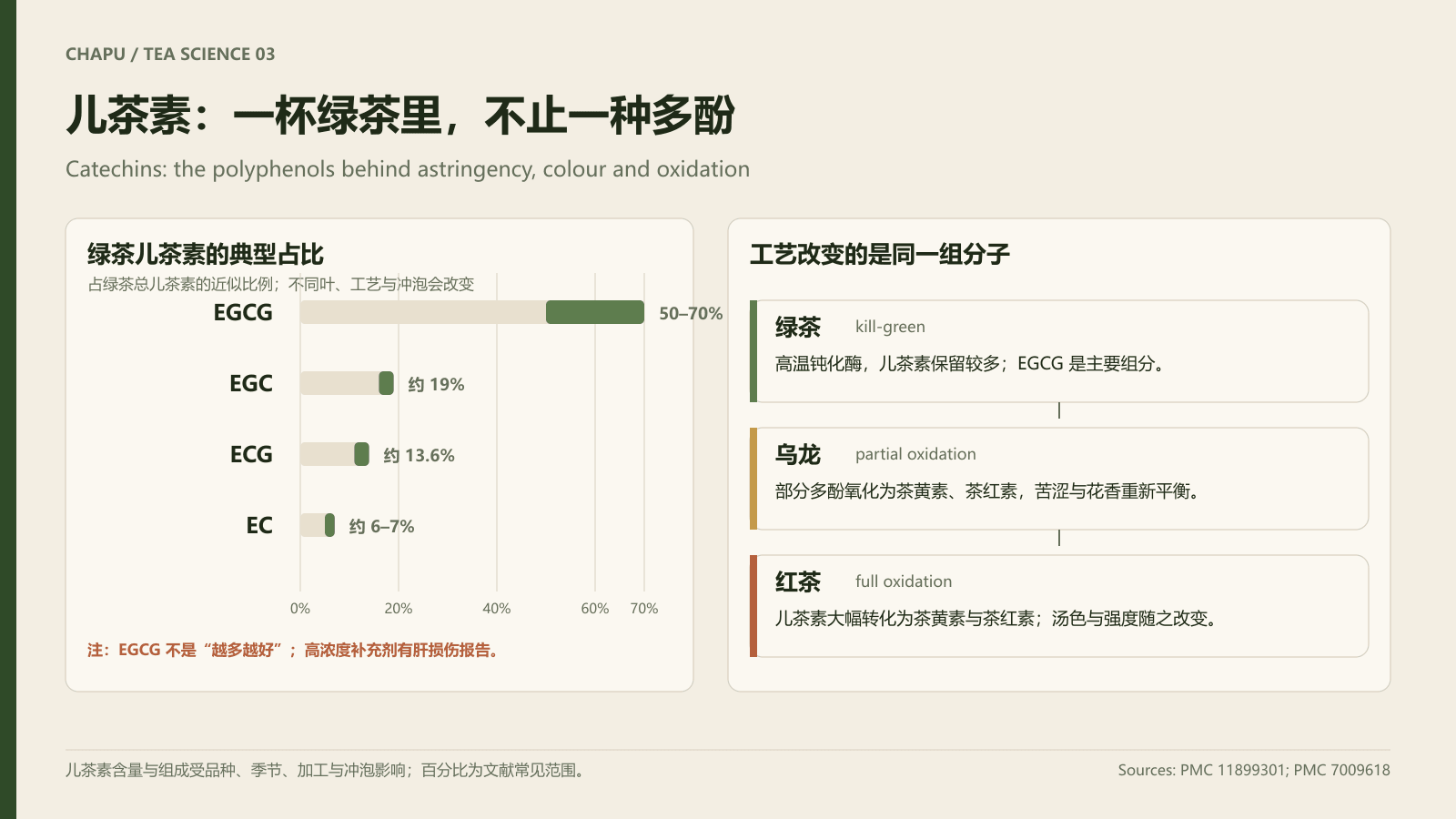
Green tea usually pours a clear yellow-green; black tea pours amber-red. That colour change is not the leaf “getting older”. It is the same family of catechins being rebuilt after rolling, oxidation and drying. Theaflavins are the most visible link in that chain: they give black tea its brightness and part of its tightening astringency.
They are not the whole story. Theaflavins sit alongside thearubigins and theabrownins, which also shape colour and body. Their concentration is low, yet marketing often isolates them as “black-tea essence” or a metabolic ingredient. It is more useful to understand how they form and where the evidence stops than to memorise a health claim.
Why black tea turns red
The first step is not colour but cell rupture. In fresh leaf, catechins sit mainly in the vacuole while polyphenol oxidase (PPO) is separated from them. Rolling, or CTC maceration, breaks the cell structure, brings enzyme and substrate together, and lets oxygen in. Catechins are oxidised to quinones.
These quinones are unstable. They react with another catechin and condense into an orange-red product with a benzotropolone skeleton. Four common pairings produce the four main theaflavins:
| Common name | Structural difference | What it does in the cup |
|---|---|---|
| TF1 (theaflavin) | No galloyl group | Orange-yellow, brightness, comparatively softer astringency |
| TF2A / TF2B | One galloyl group, at different positions | Deeper colour, stronger tightening sensation |
| TFDG (TF3) | Two galloyl groups | The most pronounced colour and astringency of the group |
These are not a ranking. They reflect which catechins were available and how the enzyme reaction proceeded. The proportions of EC, EGC, ECG and EGCG in the leaf, enzyme activity, oxygen and temperature all shift the final mix.
Fermentation is a window, not a race to red
Theaflavins rise quickly after maceration. In CTC black tea, cell disruption exposes catechins to PPO and theaflavin content climbs rapidly. If fermentation continues, some theaflavins are oxidised further into thearubigins and theabrownins, and total theaflavin content falls from its peak.
So “longer fermentation makes a redder tea” is only half true. Colour does deepen, but brightness may drop and the liquor can move from orange-red toward a duller red-brown. The aim is a balance of theaflavins, thearubigins and theabrownins, not a maximum on one line of a lab report.
What controls the window:
- Oxygen and humidity. Oxidation needs oxygen and high humidity; a closed, wet mass can stall.
- Temperature. Many black-tea fermentations sit around 24–29°C. Too hot accelerates enzyme loss and aroma loss.
- Time. It varies from under an hour to several hours depending on leaf and process. Read the leaf, not only the clock.
- Degree of maceration. CTC cuts the leaf thoroughly and reacts fast; orthodox rolled leaf has a slower, more uneven pace.
- Cultivar and season. Leaf with more catechin substrate often reaches a higher peak, but can also oxidise past it more quickly.
What actually reaches the cup
Theaflavins are water-soluble and enter the infusion during brewing. The literature gives a range of roughly 2–6% of the soluble solids in a black-tea infusion; in dry leaf the total is usually no more than 2% and can be as low as 0.3%. “More” is not automatically better, because brightness, body and astringency come from several polyphenols at once.
A red-looking cup may owe its colour to theaflavins, thearubigins, theabrownins, concentration, or simply the light. Colour depth alone cannot tell you the theaflavin level. A high-theaflavin tea can also be unpleasant if the tightening sensation overwhelms the aroma and sweetness.
Brewing changes the amount you actually drink:
- Hotter water and a longer steep extract more theaflavins along with other polyphenols: deeper colour, more astringency.
- More leaf increases the total dissolved solids, but not necessarily the theaflavin fraction.
- Hard water can make the liquor darker and rougher; that is a water effect, not a theaflavin measurement.
- Milk proteins bind some polyphenols and soften astringency, but the theaflavins are still in the cup.
Where the health research stands
Theaflavins have shown several effects in cell and animal studies, and reviews list metabolic, inflammatory and gut-microbiome directions. Those results do not add up to “drinking black tea treats a disease”. The reasons are practical: the concentration in a cup, human absorption, metabolites and the purified doses used in experiments are not the same.
What can be said safely: theaflavins are real black-tea polyphenols that participate in colour and mouthfeel. Their health effects remain a research question, with limited human evidence. Treat black tea as a drink, not a medicine or a substitute for prescribed treatment.
Four common misunderstandings
| Claim | What is wrong | A more careful reading |
|---|---|---|
| “More theaflavins means better black tea” | Theaflavins are only one part of the polyphenol mix | Aroma, sweetness, thearubigins and theabrownins also matter |
| “The redder the tea, the more theaflavins” | Colour comes from several pigments and concentration | A dark cup may be theabrownin-rich or simply over-brewed |
| “Theaflavins can replace medication” | Cup doses and purified study doses differ | Cell and animal findings are not clinical proof |
| “Longer fermentation is always more valuable” | Over-fermentation oxidises past the peak | Judge the process by its target and aroma, not time alone |
Source boundary
This page can confirm: during black-tea fermentation, catechins are oxidised by PPO/POD with oxygen into quinones and then condensed into theaflavins; the four main theaflavins differ in the number and position of galloyl groups; theaflavins rise quickly after maceration and decline when fermentation runs too long; and theaflavins make up roughly 2–6% of brewed black-tea solids, usually no more than 2% of dry leaf.
This page does not confirm: the exact theaflavin content of a particular tea; a health effect from one cup; a therapeutic role for theaflavin supplements; or the claim that a higher theaflavin number always means better quality. Anyone taking medication or managing a medical condition should put their clinician’s advice above this page.