Tea tasting falls into two traps: treating “I like it” as “it is good”, or reciting “orchid, rock rhyme, throat rhyme” without explaining what was perceived. Sensory science does not score the tea for you. It offers a repeatable method: control the brew, separate aroma, taste, mouthfeel and finish, then describe differences with words that can be checked.
Four things happen at once
| Channel | What you perceive | Main sources |
|---|---|---|
| Aroma | Dry leaf, wet leaf, liquor, empty cup | Volatile terpenes, aldehydes, alcohols, esters, pyrazines, lactones |
| Taste | Sweet, bitter, umami, sour, salty | Sugars, caffeine, catechins, amino acids, organic acids, salts |
| Mouthfeel | Thick, thin, silky, astringent, drying, grainy | Polyphenol–protein binding, pectin, fibre, suspended particles |
| Finish | Sweet aftertaste, lingering aroma, dryness, bitter tail | Saliva and oral proteins, retained volatiles, post-swallow receptors |
Aroma and taste are often conflated because smell has two routes: orthonasal (sniffing) and retronasal (aroma travelling from the mouth to the nasal cavity during swallowing). A tea that “tastes floral” may be giving a floral impression through retronasal olfaction, not the tongue.
Taste: astringency is not bitterness
Tea taste research separates the channels:
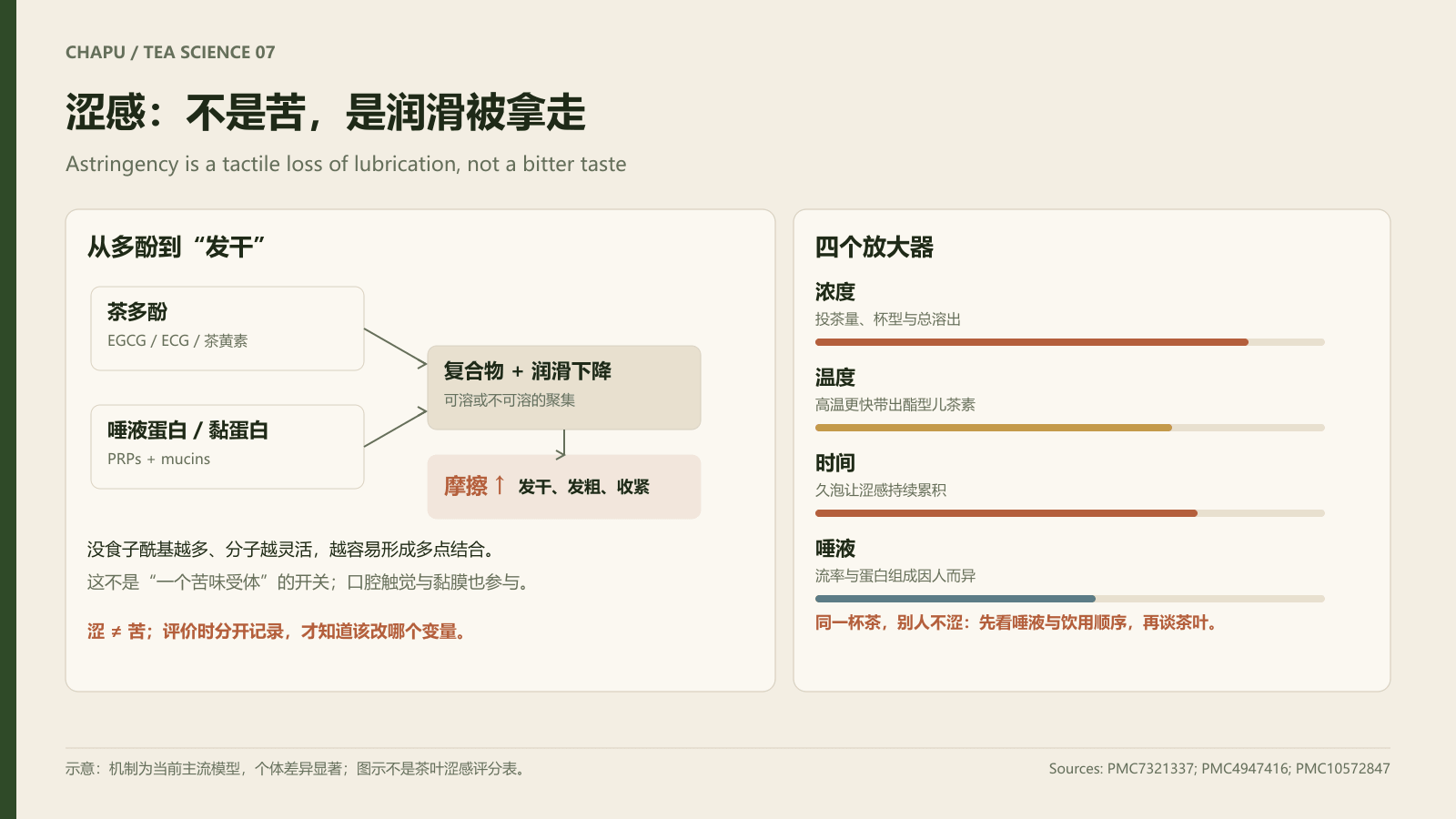
- Astringency: flavonol-O-glycosides, tannins and galloylated catechins bind salivary proteins, producing drying, tightening and roughness.
- Bitterness: caffeine and non-galloylated catechins activate T2R bitter receptors.
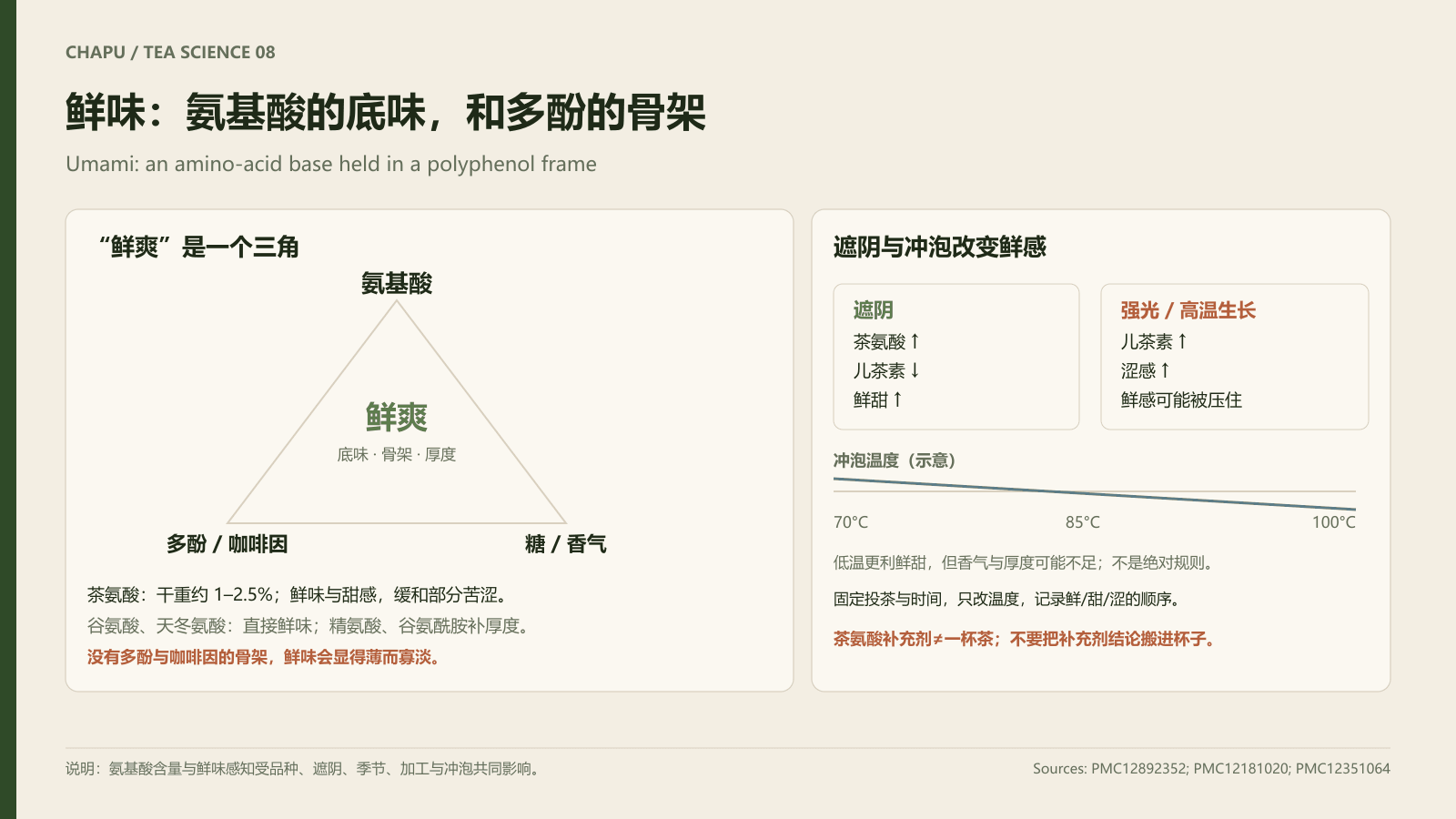
- Umami: L-theanine, succinic acid, gallic acid and theogallin contribute umami and a sweet-savoury impression.
- Sweet aftertaste: in green tea, linked to hydrolysis of galloylated catechins and changes in saliva and the oral environment.
This is why “bitter and astringent” is too coarse: bitterness is a receptor signal; astringency is tactile and protein-binding. A tea can be bitter without being astringent, or astringent without being bitter.
Mouthfeel: the structure of the liquid
Mouthfeel is not taste intensity. Light, thin, silky, thick, creamy, coating, astringent and grainy describe physical and chemical contact with the mouth. Thickness may come from pectin, soluble sugars, amino acids and some oxidation products; astringency comes from polyphenol–protein binding.
Roasting changes this structure. In Wuyi Rougui, deeper roasting increased thickness and intensity, but excessive roasting raised bitterness and sourness; sweet aftertaste, umami and briskness peaked at different stages. Processing is not “more is better”; it balances several sensory dimensions.
Turn impressions into comparable notes
- Fix the brew. Same water, temperature, leaf-to-water ratio, time and vessel. Follow the logic of ISO 3103: control variables before comparing.
- Evaluate in order. Dry aroma → wet aroma → liquor colour → taste → mouthfeel → finish. Do not conclude on the first sip.
- Use a reference. Comparing two teas on the same day reveals differences better than a single tea alone.
- Separate intensity from liking. “Strong aroma” and “I like this aroma” are two judgments.
- Record reproducible words. Floral, roasted, woody, fruity acidity, umami, astringent, sweet aftertaste; avoid unverifiable “energy” or “qi”.
Common biases
| Bias | Manifestation | Correction |
|---|---|---|
| Order effect | The first tea shapes the next | Randomise order, rinse with water, rest between |
| Expectation | Price or origin label makes it taste better | Blind tasting; reveal the label after |
| Temperature | Hot and warm tea differ in aroma and bitterness | Fix tasting temperature; note changes as it cools |
| Vocabulary inflation | Terms replace observation | Add “what I smelled / where I felt it” after each term |
| Concentration as quality | “Stronger” equals “better” | Separate intensity, complexity, balance and finish |
Source boundary
This page can establish: tea taste involves multiple molecules and receptors; astringency and bitterness have different mechanisms; aroma includes orthonasal and retronasal routes; mouthfeel relates to pectin and polyphenols; standardised brewing and blind tasting reduce bias.
This page cannot establish: that a specific tea must show a specific aroma or taste; that one term maps to one fixed molecule; that personal preference can be replaced by “science”. Sensory evaluation remains a human judgment; method only makes it more repeatable and discussable.