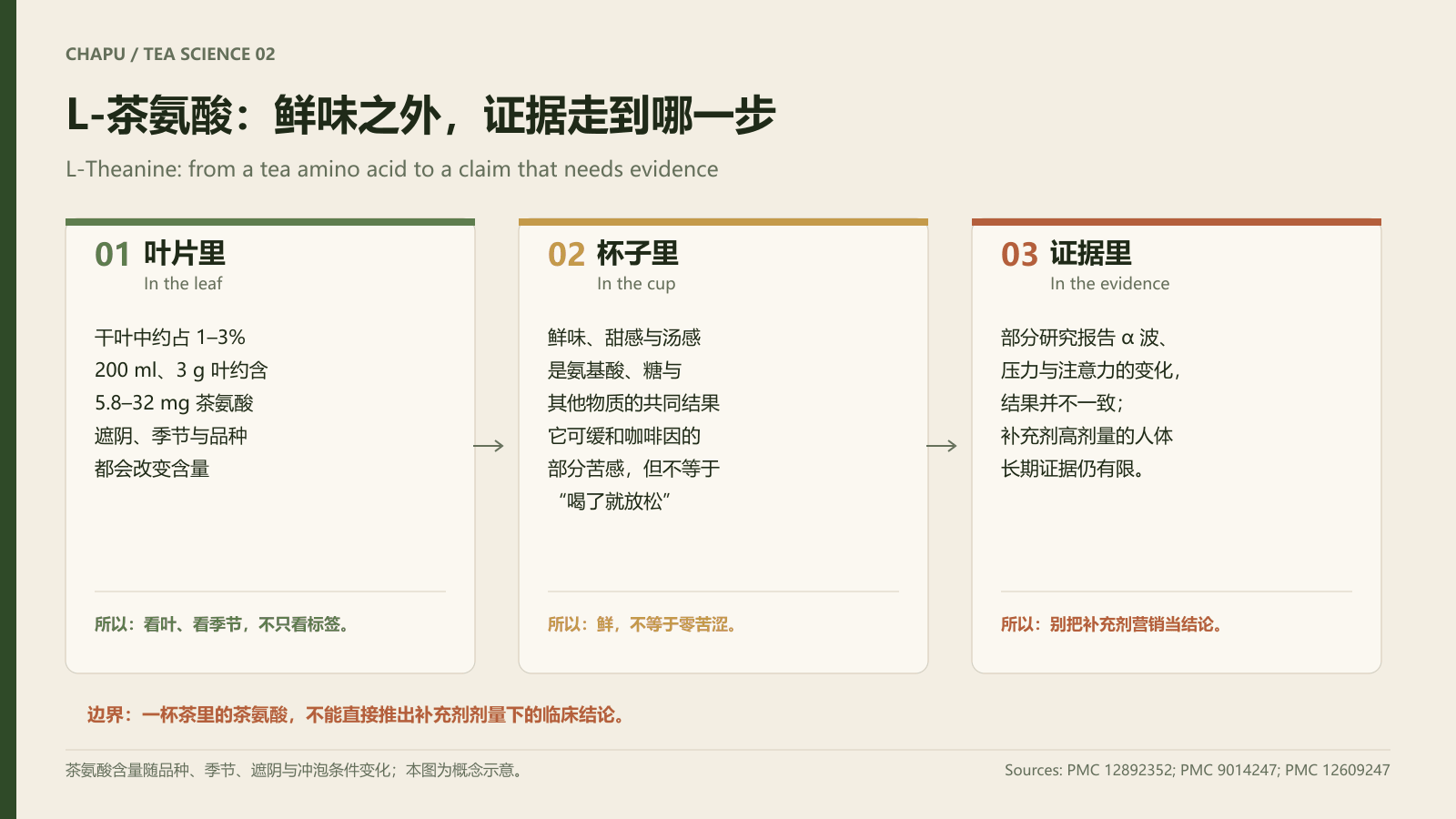
“This tea tastes fresh.” It sounds like one flavour, but it describes a balance: free amino acids supply umami and sweetness, catechins bring firmness, caffeine brings bitterness, and sugars and aroma compounds add body. If any one element dominates, freshness disappears. Equating “fresh” with “MSG” or with “more amino acids is better” misses the structure of the cup.
L-theanine is the most famous tea amino acid and an important part of freshness, but it is not a solo act. Glutamate, aspartate, arginine, glutamine, along with cultivar, shading, harvest season and brewing temperature, decide whether you taste clean freshness, sweet freshness, or freshness with an astringent edge.
Umami is not the taste of MSG
Umami is a taste separate from sweet, sour, bitter and salty, often described as broth-like, seaweed-like or mushroom-like. Glutamate and aspartate are representative umami amino acids. When they meet certain nucleotides, the umami sensation is amplified; this is the umami synergy effect.
Tea umami is more complex:
- L-theanine. A characteristic non-protein amino acid in tea, carrying umami and sweetness, and softening some bitterness and astringency.
- Glutamate and aspartate. Direct umami base notes, influenced by cultivar and metabolism.
- Arginine, glutamine and others. Add umami-sweetness body and participate in plant nitrogen metabolism.
- Polyphenols and caffeine. Provide firmness and bitterness, the frame that makes freshness taste like tea rather than broth. Without them, the liquor feels thin.
A “fresh” tea is therefore not necessarily sweet, and not necessarily light. Good freshness has a base and body, and leaves the mouth clean after swallowing. An MSG-like flatness lacks layers.
Free amino acids in tea
Theanine makes up roughly 1–2.5% of tea dry weight and accounts for a large share of free amino acids; it is often described as a main contributor to tea umami. Published proportions vary because cultivar, tissue, season and analysis method all change the result.
The free amino acid pool is not fixed. It shifts with growth and processing:
- Tissue. Buds and first two leaves usually exceed old leaves; stems and coarse leaves have a different profile.
- Cultivar. Some cultivars are naturally high in amino acids and low in catechins, giving a rounder freshness; others are more polyphenol-driven.
- Season. Spring shoots often have a higher amino acid proportion; summer and autumn shoots build more catechins, changing the fresh/astringent balance.
- Shading. Covering the plants raises theanine and some amino acids while reducing catechin accumulation; this is part of the sweetness of matcha and gyokuro.
- Altitude and temperature. High altitude or slow cool growth is often linked to finer freshness, but cultivar, management and processing matter just as much. Altitude alone is not a quality number.
Why shading changes taste
Shading is not a trick that “makes tea sweet”. It changes photosynthesis and nitrogen metabolism. With less light, the leaf allocates more nitrogen to amino acid synthesis, and theanine and chlorophyll-related compounds accumulate; carbon-based polyphenols such as catechins decline. The amino-acid-to-polyphenol ratio rises, so the liquor tastes fresher, sweeter and less astringent.
There are costs: yield falls, leaves can become thinner, and the aroma profile changes. Too much shade, or shading for too long, can turn freshness into a closed, seaweed-like note rather than a more refined one. Matcha’s sweetness comes from shade, steaming, drying and stone-milling together, not from one intervention.
Processing: retain or transform
- Green tea. High-heat kill-green quickly deactivates enzymes, retaining more free amino acids and low-boiling aroma. Steamed, pan-fired and baked styles express freshness differently.
- White tea. Slow withering lets amino acids and sugars participate in aroma formation; freshness is softer and sweeter.
- Oolong. Shaking and oxidation shift the amino acid/polyphenol balance; freshness falls while floral and fruity notes rise.
- Black tea. Fermentation consumes or transforms theanine; umami weakens and sweet, floral, malty body increases.
- Dark tea. Post-fermentation and microbial action further change the amino acid profile; freshness is low, while aged, woody and mellow notes dominate.
Freshness is not limited to green tea. Lightly oxidised tea, low-temperature drying and leaf that retains tenderness can all taste fresh. The question is whether the process kept the amino acids in the cup.
Brewing temperature: the ceiling and the floor of freshness
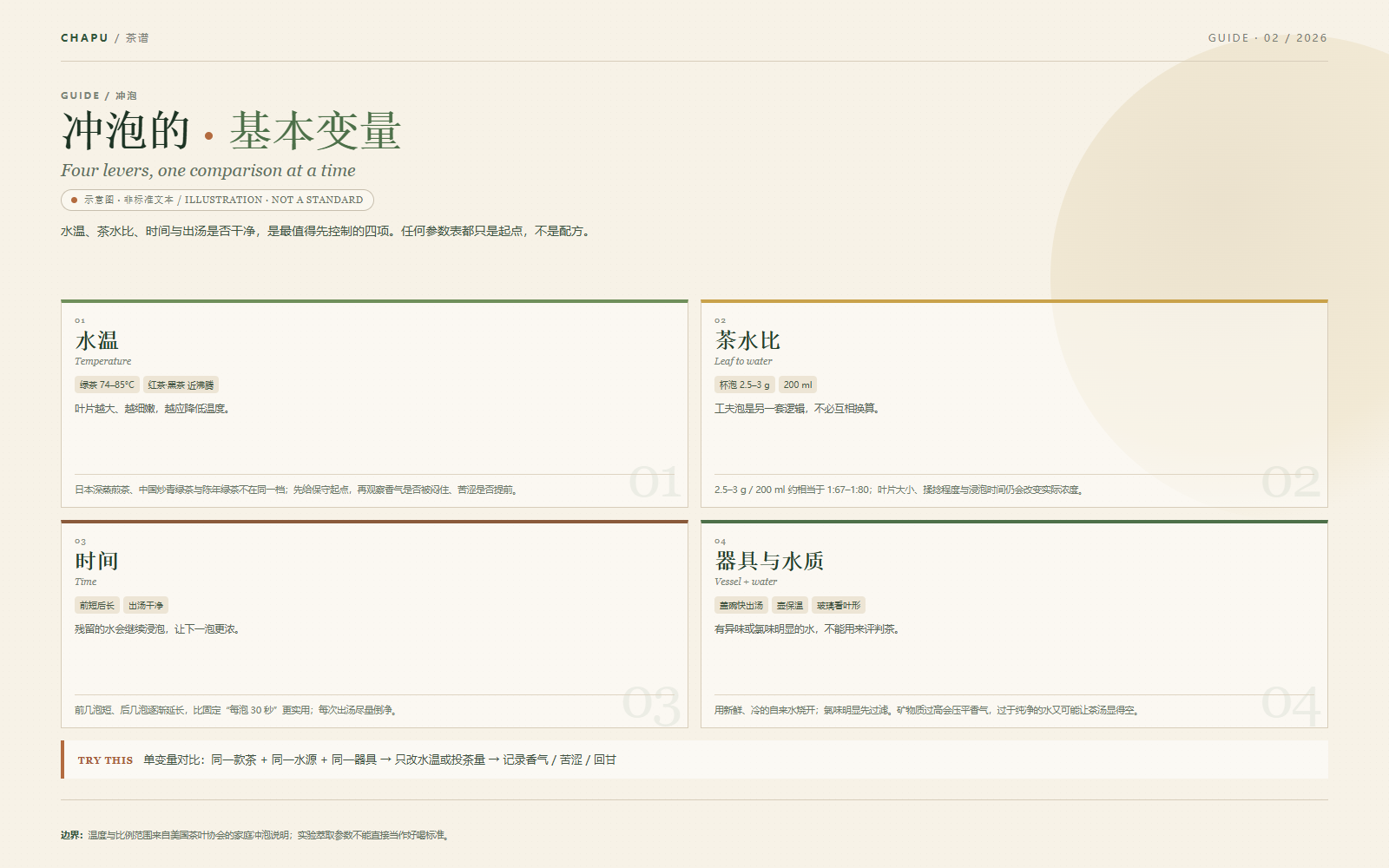
Amino acids dissolve easily, but heat also changes their retention and perception. In Longjing experiments, as brewing temperature rose from 70°C to 100°C, L-theanine, L-aspartic acid and L-arginine — compounds associated with umami — declined. That does not prove cooler is always fresher; it shows that “hotter extracts more” is not true for every target.
A practical trade-off:
- For fresh sweetness. Use cooler water (often 70–85°C for green tea), keep the first steeps short, and reduce bitterness that would mask freshness.
- For aroma. Raise the temperature, but accept that freshness may be pushed back and astringency may rise.
- For body. Increasing leaf amount is more controllable than raising temperature; too much heat pulls polyphenols and caffeine up together.
- Water. Low-mineral water usually keeps umami clearer; very hard water can roughen the liquor and hide freshness.
There is no universal formula. Brew the same tea at 75°C and 90°C, then record the order of fresh, sweet, astringent and bitter. That is more useful than memorising a temperature table.
The balance of freshness and astringency
“Fresh and brisk” is not a race to maximise umami. It is a balance of umami, sweetness, firmness and bitterness. A tea high in amino acids and low in catechins can taste sweet but thin; one low in amino acids and high in gallated catechins can taste flat and drying; high caffeine can bury freshness under a bitter base.
Ask:
- What is the first impression: fresh, sweet, bitter or astringent?
- Does the freshness have a base, or does it flash on the tip of the tongue?
- After swallowing, is the mouth moist or dry?
- Across the second and third steeps, does freshness rise, hold or collapse?
Those answers are closer to the cup than an amino acid number.
Four common misunderstandings
| Claim | What is wrong | A more careful reading |
|---|---|---|
| “Fresh means MSG was added” | Tea naturally contains glutamate, aspartate and theanine | Natural umami has a base and layers; it is not automatically an additive |
| “More amino acids means better tea” | Freshness also depends on polyphenols, caffeine and aroma | A high-amino-acid tea with a thin structure can still taste empty |
| “The tenderer the leaf, the fresher the tea” | Tenderness is only one variable | Cultivar, shading, season and processing also matter |
| “Cooler water is always fresher” | Cooler extraction is slower and may lack aroma and body | Adjust to the tea and the goal; do not turn temperature into dogma |
Source boundary
This page can confirm: tea umami is built from free amino acids together with polyphenols, caffeine and sugars; L-theanine is a characteristic tea amino acid that contributes umami and sweetness; shading usually raises amino acids and lowers catechins; oxidation changes theanine and freshness; and brewing temperature affects the retention and perception of umami-related compounds.
This page does not confirm: the exact amino acid content of a particular tea; that freshness alone can judge origin, cultivar or quality; or that theanine supplements treat disease. Anyone taking medication or managing a medical condition should put their clinician’s advice above this page.