"Is this a tea plant?" Leaf shape alone is a poor test. Ornamental camellias, oil camellias and tea all carry thick evergreen leaves. The tea plant is Camellia sinensis, one species in the genus Camellia, family Theaceae. Thousands of years of cultivation have selected leaf size, habit and flushing time, but the basic plant body has not changed.
Start with the plant, not with "green tea bush" or "black tea bush". Green, black and oolong tea are products of the same species processed differently. Keeping botany and processing separate makes the later questions — cultivar, plucking, soil and flavour — much easier to answer.
The five organs of a tea plant
An adult tea plant can be read as roots, stem, leaves, flowers and fruit. Each part affects the cup, not just the field.
| Organ | Basic features | What it means for tea |
|---|---|---|
| Root | Seedlings form a taproot; cuttings lack a strong taproot, with roots mostly below 50 cm and feeding roots at 5–30 cm | Takes up water and nutrients; hates waterlogging, needs acid, well-drained soil |
| Stem | Shrub or small tree; cultivated bushes are pruned to a plucking table around 1 m | Strong apical dominance; without pruning the table rises and thins |
| Leaf | Alternate, leathery, elliptic to oblong, serrulate margin, 7–9 pairs of side veins; underside often pubescent | Photosynthesis and storage; the bud and young leaves are the raw material |
| Flower | White, axillary, solitary or in clusters of 2–4; 6–8 petals and many stamens | Usually autumn-flowering; flowering and fruiting consume reserves |
| Fruit and seed | Capsule with 1–4 round or flattened seeds | The vehicle for sexual reproduction; seed-grown plants vary |
A useful field character is the vein pattern: side veins curve before reaching the margin, and the marginal teeth are fine and forward-pointing. Cultivars differ greatly in leaf length, width, colour and surface texture. One leaf cannot identify a cultivar, but it can place the plant in the tea group of Camellia.
The two main botanical varieties
The two varieties most often discussed are the China type, Camellia sinensis var. sinensis, and the Assam type, C. sinensis var. assamica. They are not "green tea species" and "black tea species"; they are morphological types shaped by long geographic separation.
| Trait | China type var. sinensis | Assam type var. assamica |
|---|---|---|
| Habit | Usually a dense shrub, tolerant of pruning | Can become a small tree, up to 20 m in the wild |
| Leaf | Smaller, commonly 4–8 cm, relatively flat | Larger, commonly 10–25 cm, thicker |
| Climate | Often more cold-hardy; suits subtropical and temperate gardens | Prefers heat and humidity; suits tropical and subtropical lowlands |
| Typical use | Green, white, some black and oolong | Black tea, raw Pu'er and some large-leaf green teas |
"Large leaf means strong, small leaf means light" is another over-simplification. Cup strength depends on leaf quantity, leaf form, water temperature and time. The variety sets a ceiling and a baseline, not the final result. Assam-type leaf can make a gentle Yunnan green tea; a small-leaf China-type leaf can make a full-bodied black tea.
Plucking: one bud and two leaves is not the only standard
The most quoted standard is "one bud and two leaves": the apical bud plus two opened young leaves. The logic is tenderness. The bud and young leaves carry a favourable balance of amino acids, caffeine and aroma precursors for a fine green tea. Older leaves have more fibre and polyphenols, giving a coarser taste.
Different tea types ask for different maturity:
- Famous green teas: often one bud and one leaf, or one bud and two leaves, for tenderness, fresh aroma and appearance.
- Oolong: often one bud and two to three leaves, or "open-face" plucking, because some maturity is needed for shaking and aroma development.
- Dark tea and some black teas: one bud and three to four leaves, or mature leaves, for strength and infusibility.
- White tea: Silver Needle uses buds only; White Peony uses one bud and one to two leaves; Shou Mei is more mature.
"Tender is better" therefore holds only within certain tea types and grades. One bud and one leaf may be too young for a tea that needs rolling and oxidation; mature leaf may be too coarse for a famous green tea. Plucking standard is part of processing, not an absolute quality line.
Roots and soil: why tea likes acid and hates waterlogging
Tea evolved in acid, well-drained forest soil. The Chinese Academy of Agricultural Sciences soil explainer gives a suitable pH range of 4.0–6.5, with 4.5–5.5 best. Above 6.5, or below 4.0 for long periods, root function and nutrient uptake suffer. Tea is also a calcifuge: limestone soils with high free calcium carbonate are unsuitable.
"Acid-loving" does not mean "the more acid the better". Strong acidity suppresses roots, and long-term nitrogen-heavy fertilisation can acidify a garden further. Three things matter more than a pH number:
- Drainage: tea roots need oxygen. Waterlogging causes root rot; slope, beds and drainage ditches are more fundamental than another bag of fertiliser.
- Soil depth: effective depth should exceed 80 cm, with feeding roots concentrated at 5–30 cm. Shallow soil or a hardpan limits yield.
- Organic matter and pH: organic matter buffers acidification but cannot replace drainage or depth. Do not spread lime blindly; test pH first.
The same applies to a pot on a balcony. Ordinary potting mix plus daily watering quickly produces yellow leaves. An acid, open, free-draining mix is closer to the plant's native habitat.
The annual rhythm
Tea is evergreen but not evenly productive all year. Most regions have spring, summer and autumn flushes, with a slower winter. The first spring flush gets the most attention because amino acids are high and pest pressure is usually lower. Summer grows fast, with more polyphenols, suiting black tea or some oolong. Autumn brings cooler nights and a wider day–night range, often building the aroma precursors behind high-fragrance teas.
Pruning is the other key. Tea has strong apical dominance: unpruned bushes grow upward, produce fewer side branches and offer a small plucking surface. Tea gardens use formative, light and deep pruning to build a flat, dense, accessible "table". Pruning is not destruction; it controls height and branching. Cut too hard and the bush suffers; cut too lightly and the table ages quickly.
Seed versus cutting
Tea can be raised from seed or propagated vegetatively by cuttings and layering.
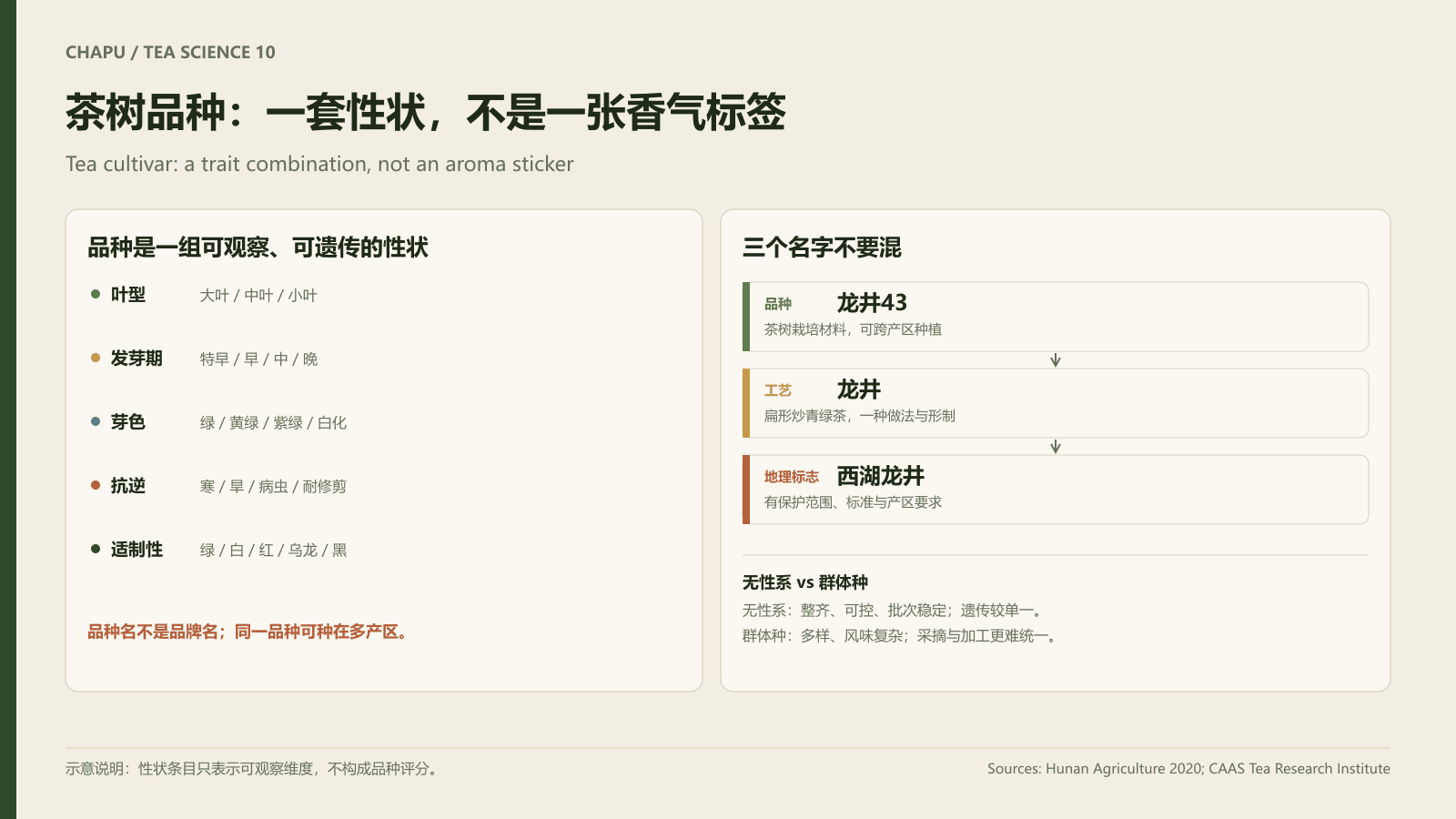
- Seed: recombination produces variation in height, leaf shape and flushing time. Seedlings often have a stronger taproot and may show better stress tolerance.
- Cutting: offspring are clones of the mother bush, uniform and concentrated in flushing, which suits mechanisation and consistent processing. Roots are shallower and demand better soil and water management.
Commercial gardens rely mainly on clones not because clones are "superior", but because they are controllable. A famous tea that must hit a narrow spring window and repeat a batch profile is easier with clonal material. Landraces and seed populations carry diversity: early and late buds, different aroma types in one garden, more complex cups but far harder standardisation.
Four common misunderstandings
| Claim | Problem | A more careful reading |
|---|---|---|
| "The tea tree is the tea tree oil tree" | Tea tree oil comes from Melaleuca alternifolia, not from Camellia sinensis | The tea plant is Camellia sinensis; tea tree oil is a different species |
| "Black tea and green tea come from different trees" | Tea type is decided by processing, not by species | The same leaf can be made into green, black or oolong; cultivar affects suitability, not a fixed category |
| "Bigger leaves always make better tea" | Large and small-leaf types have different strengths | Large-leaf types tend to be polyphenol-rich for strong teas; small-leaf types often bring finer amino-acid and aroma profiles |
| "Tea likes acid, so the acider the better" | Strong acidity suppresses roots | Aim for roughly pH 4.5–5.5; drainage, depth and organic matter matter just as much |
Source boundaries
This page can confirm: the tea plant is Camellia sinensis in Theaceae; the two main cultivated varieties are China type and Assam type; leaves are alternate, leathery and serrulate; root distribution and a suitable pH around 4.5–5.5 are documented in cultivation literature; one bud and two leaves is one common standard, not a universal rule.
This page does not confirm: the cultivar of a particular bush; the altitude, age or plucking standard of a particular bag; or that leaf shape alone can judge quality. Cultivar identification needs buds, habit, flushing time and biochemical data. Quality still returns to processing, origin and the cup.