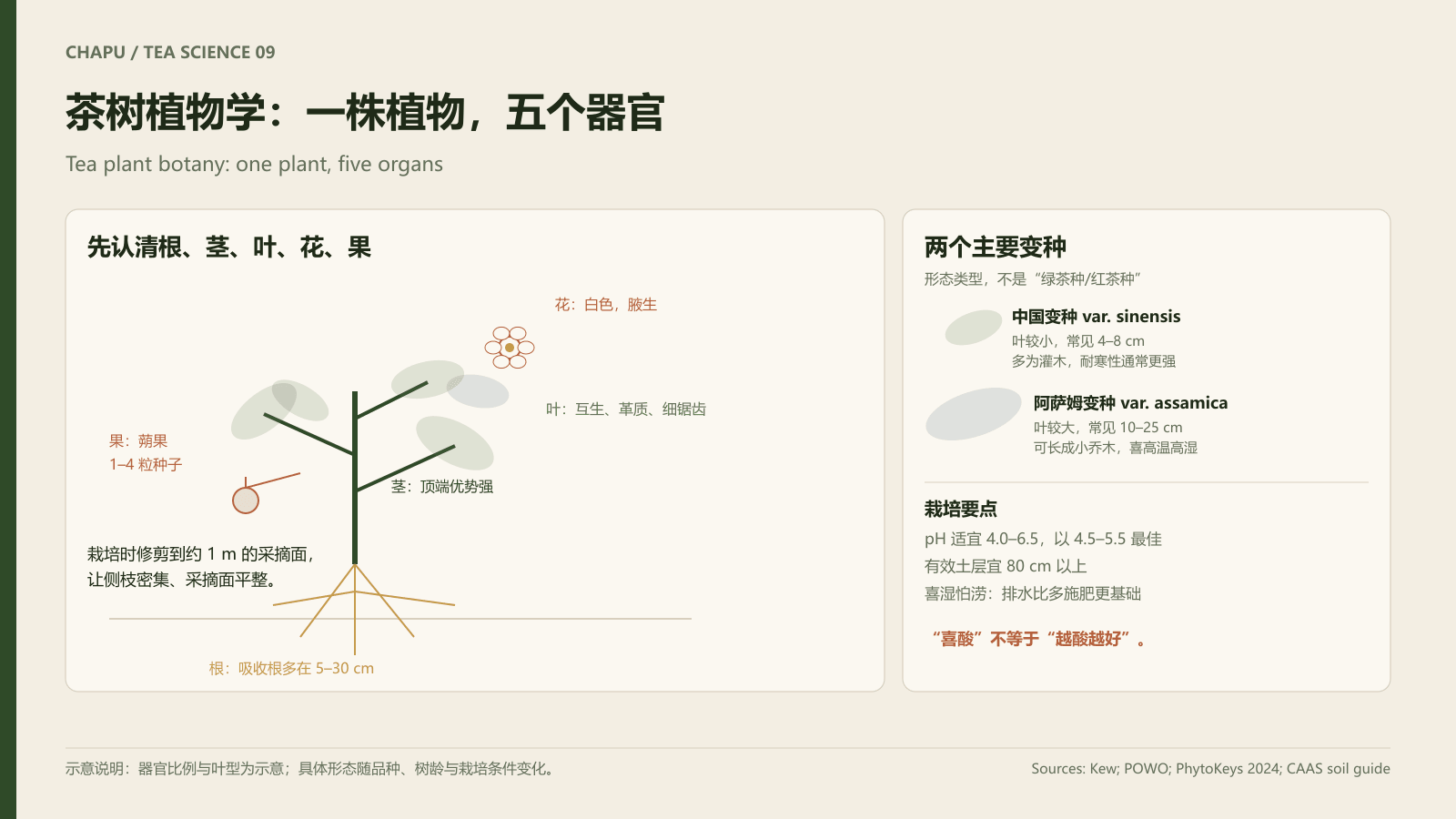
"What cultivar is this?" is one of the easiest questions to ask in the wrong way. A cultivar is not the brand on the packet, and not a tea name such as "Longjing" or "Tieguanyin". It is a biological suite: leaf size and shape, flushing time, bud colour, branching angle, cold and drought tolerance, pest resistance, and which tea types the leaf can support.
One cultivar can be planted in several regions and made into several tea types. One tea name can draw on several cultivars. Separate cultivar, processing style and geographical indication, then add the distinction between clonal and seed populations, and much of the market language loses its spell.
Cultivar, selection line and landrace population
Three terms are often used interchangeably, but they describe different stages and reproductive systems:
| Concept | What it is | Key point |
|---|---|---|
| Cultivar | A cultivated material that has been selected, evaluated and stably used in production, usually with an approved or registered name and number | Stable, propagable and comparable; not a brand name |
| Selection line | Material still under selection and regional trials, not yet fully stable | Must not be sold as a finished cultivar; may be discarded |
| Landrace population | A mixed population raised from seed, with variation in bud colour, leaf shape and flushing time | High diversity, lower batch consistency; not a synonym for "low grade" |
Landrace populations are marketed heavily in places such as West Lake Longjing and Wuyi rock tea. Their value is genetic diversity within one garden, which can give more layered aroma and taste. The cost is a drawn-out picking window, uneven leaf and harder process control. Clonal gardens are the opposite: uniform, controllable and scalable, but genetically narrow, with less buffering against pests and weather extremes.
Clonal versus seed propagation
| Dimension | Clonal (cutting, layering) | Sexual (seed) |
|---|---|---|
| Genetics | Clone of the mother bush; highly uniform offspring | Recombination; clear segregation in the progeny |
| Roots | No strong taproot; shallower system, more dependent on soil management | Stronger taproot; often better deep-water access |
| Picking | Concentrated flush, easier to schedule and mechanise | Early and late buds coexist; a longer window |
| Flavour | Stable batches, reproducible style | Large individual variation; possible basis for complex blends |
| Risk | Genetic uniformity; narrower buffer against stress | Uneven traits; weaker standardisation and commercial consistency |
This is not a hierarchy of "clone good, population bad". It is two production logics. For a famous tea with a narrow spring window and a repeatable batch profile, clones are more suitable. For flavour complexity, local germplasm and long-term adaptation, seed populations have value. Longjing 43 and Tieguanyin are both clonal; "clonal" is not a low-end label.
A cultivar is a trait combination, not an aroma sticker
Identifying a cultivar normally means reading a combination:
- Habit and branching: shrub, small tree or tree; upright, semi-spreading or spreading; branch density.
- Leaf: large, medium or small; shape, colour, surface relief, inward fold, tip and margin teeth.
- Bud and shoot: bud colour (green, yellow-green, purple-green, albino), pubescence, weight of one bud and three leaves per 100 buds.
- Phenology: flushing time (very early, early, mid, late), picking date, tenderness retention.
- Stress tolerance: cold, drought, pests, disease, pruning.
- Processing suitability: green, black, white, oolong or dark tea, and the appearance and internal quality it gives.
A few common cultivars show what "trait combination" means:
| Cultivar | Type and flushing | Key traits | Common use |
|---|---|---|---|
| Longjing 43 | Clonal, shrub, medium leaf, very early | Flushes about 7–10 days before landrace populations; slender buds, little pubescence; spring one bud and two leaves about 3.7% amino acids, 18.5% polyphenols, 4.0% caffeine | Flat green tea, especially Longjing |
| Fuding Dabai | Clonal, small tree, medium leaf, early | Fuller buds with more pubescence; one bud and three leaves about 63 g per 100 buds; about 4.8% amino acids and 16.2% polyphenols | White tea, green tea, some black tea |
| Yunnan large-leaf | Seed population or selected clones; small tree, large leaf | Large, thick leaves; usually higher polyphenols and caffeine; strong, dense liquor | Black tea, raw Pu'er, some green tea |
| Tieguanyin | Clonal, shrub, medium leaf, mid-season | Green buds with purple tinge, elliptic leaf, high clear aroma, moderate tenderness retention | Oolong |
The numbers are references from a particular region, year and plucking standard, not permanent cultivar labels. The same cultivar moved to another site, season or process will shift markedly in amino acids and polyphenols. "Cultivar determines aroma" is therefore half true: genetics sets a ceiling; environment and processing decide the expression.
Three names to keep apart: cultivar, style, geographical indication
This is the most common confusion in the market. Take Longjing:
- Longjing 43: a tea cultivar. It can be planted in Zhejiang, Jiangsu, Anhui and elsewhere.
- Longjing: a processing style and shape. A flat-pan-fired green tea can be called Longjing, though not necessarily West Lake Longjing.
- West Lake Longjing: a geographical indication product, with a defined protection area, standard and origin requirements.
The three can overlap, but cannot substitute for one another. Flat green tea made from Longjing 43 outside the West Lake area may correctly declare its cultivar, but cannot be called West Lake Longjing. Tea made from a landrace population inside the protected area by the Longjing process can be called West Lake Longjing while not being Longjing 43. Likewise, "Rougui" is both a cultivar name and a Wuyi rock tea product name; the same cultivar can also be made into black tea.
When a label says "cultivar", ask whether the name has a registration or approval basis. When it says "Longjing", "Dahongpao" or "Jinjunmei", ask whether it is a process name, a commercial name or a geographical indication. Reading all three layers is the only way to read the label properly.
Breeding and registration: how far a new cultivar travels
A modern tea cultivar is not "find a good bush and give it a name". The usual pipeline is:
- Selection: screen target traits in landrace populations, cross progeny or bud sports.
- Clonal propagation: fix the traits through cuttings and build a line.
- Line comparison and regional trials: compare yield, quality and stress tolerance across sites and years.
- Evaluation and registration: obtain a name and number through national or provincial approval or registration.
- Release: validate cultivation and processing suitability before entering production.
The Tea Research Institute of the Chinese Academy of Agricultural Sciences holds more than 3,700 tea germplasm accessions and has bred 34 national cultivars; Longjing 43 and Zhongcha 125 are products of this pipeline. A new cultivar is not automatically "better tasting". It is usually stronger on a specific target: earlier flushing, higher yield, more cold tolerance, better machine harvest, or better suitability for one tea type. For a drinker, a cultivar name is a traceability tool, not a quality certificate.
Four common misunderstandings
| Claim | Problem | A more careful reading |
|---|---|---|
| "Cultivar is brand" | A cultivar is a cultivated material; a brand is a commercial mark | One cultivar can be sold under many brands; one brand can blend several cultivars |
| "Landrace always beats clonal" | The two serve different production logics | Landraces bring diversity but resist standardisation; clones are uniform but genetically narrow |
| "Longjing 43 is West Lake Longjing" | Cultivar name and geographical indication are different | Longjing 43 is a cultivar; West Lake Longjing has origin and standard requirements; they are not equivalent |
| "A famous cultivar suits every tea type" | Suitability depends on leaf structure and biochemistry | One cultivar can make several tea types, but usually excels in one or two |
Source boundaries
This page can confirm: a cultivar is a selected, evaluated and stably used cultivated material; clonal and seed systems differ in genetics, roots, picking and batch consistency; Longjing 43, Fuding Dabai, Yunnan large-leaf and Tieguanyin have documented traits and processing suitabilities; cultivar, style and geographical indication are three separate naming layers.
This page does not confirm: the true cultivar of a particular bag; the performance of one cultivar across all regions; or that a cultivar name equals a quality grade. Identifying a cultivar needs shoots, habit, phenology and biochemical data, sometimes nursery and origin records. Quality still returns to the specific batch and the cup.