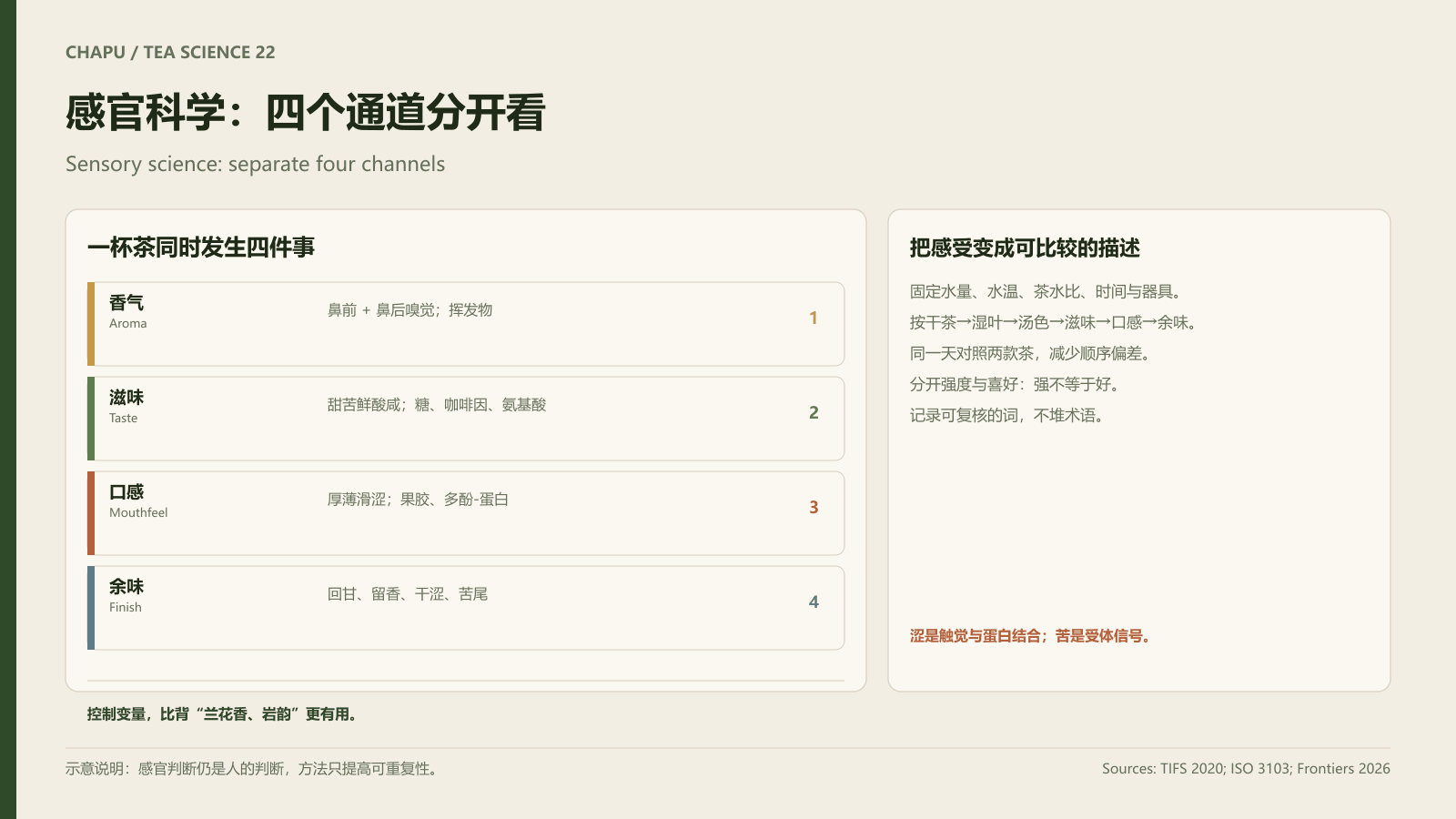
Tasting vocabulary is not there to make tea sound profound. It lets two people discuss the same thing. A useful term has three qualities: it points to a specific object (dry leaf, liquor, aroma, taste, mouthfeel, infused leaf), it carries intensity (none / weak / medium / strong), and another person can check it. Without these, even a beautiful word is a monologue.
Object first, then word
| Object | What to describe | Do not mix in |
|---|---|---|
| Dry leaf | Tight/loose roll, wholeness, colour, evenness, tips | “Floral” is not a dry-leaf shape term |
| Liquor | Colour, brightness, clarity/turbidity, depth | “Thick” is mouthfeel, not colour |
| Aroma | Family (floral/fruity/roasted/woody/grassy), height, persistence, purity | “Sweet” is taste, not aroma |
| Taste | Sweet, bitter, umami, sour, salty, aftertaste | “Silky” is mouthfeel, not taste |
| Mouthfeel | Thick/thin, silky/rough, astringent, coating, grainy | “Aromatic” is not mouthfeel |
| Infused leaf | Soft/hard, evenness, colour, liveliness, fragmentation | “Liquor colour” is not leaf colour |
ISO 6078 separates black tea terms into dry leaf, liquor, infused leaf, manufacture and general. It also warns that the same word can describe different objects: dull can describe dry leaf, infused leaf or liquor. Name the object before the adjective.
Aroma: families, not mysticism
| Family | Observable cue | Common in |
|---|---|---|
| Floral | Orchid, jasmine, osmanthus, rose, orange blossom | Light oolong, white tea, some black tea |
| Fruity | Peach, apricot, citrus, lychee, cooked fruit | Oolong, black tea, some white tea |
| Green | Fresh grass, spinach, bean, nori | Green tea, lightly oxidised tea |
| Roasted / nutty | Chestnut, walnut, toast, caramel | Roasted oolong, black tea, pan-fired green tea |
| Woody / aged | Cedar, dry wood, damp wood, medicinal | Post-fermented tea, aged tea |
| Creamy / sweet | Cream, honey, brown sugar | Black tea, some oolong |
“Orchid” is not one molecule; it is a group of volatiles giving a similar impression. “A clean, sweet floral note like orchid, strong in the hot cup and weaker in the empty cup” is more checkable than “orchid”.
Taste and mouthfeel: bitter, astringent, thick, silky
- Bitter: caffeine and some catechins activate bitter receptors.
- Astringent: polyphenols bind salivary proteins, producing drying, tightening and roughness.
- Umami: L-theanine, succinic acid and gallic acid contribute.
- Sweet aftertaste: sweetness returns after swallowing, linked to catechin hydrolysis and saliva changes.
- Thick: structure from pectin, soluble sugars and amino acids.
- Silky: low friction in the mouth, not “weak flavour”.
A tea can be bitter without astringency, astringent without bitterness, thick without being strong, or aromatic without much taste. Separate the dimensions.
Defect words: confirm before concluding
ISO 6078 and the green tea vocabulary list musty, stale, burnt, harsh, grassy/green (often under-withering or insufficient fixation), withered and smoky. A defect word points to a processing or storage problem, not simply “unpleasant”.
Principles:
- Describe before judging. Wet cardboard and mustiness first; “damp storage” second.
- Grade intensity. Slight vs clear vs undrinkable.
- Name the object. Dry-leaf mustiness, liquor mustiness and infused-leaf mustiness may have different sources.
- Do not romanticise defects. Mustiness is not “aged charm”; burnt is not “fire character”.
Intensity scale
Use 0–5 rather than “very / extremely”:
| Score | Meaning |
|---|---|
| 0 | None |
| 1 | Faint, needs attention |
| 2 | Light, clear but not dominant |
| 3 | Medium, balanced and recognisable |
| 4 | Strong, dominant but acceptable |
| 5 | Extreme, possibly unbalanced or defective |
Intensity is not preference. A 4 roast note can be pleasant; a 4 astringency may be hard to accept. Record them separately.
Record template
| Item | Example |
|---|---|
| Dry leaf | Tight roll, deep green with some white tips, even |
| Liquor | Pale yellow-green, bright, clear |
| Aroma | Hot: tender chestnut and fresh grass; warm: orchid, intensity 3; empty cup: weak |
| Taste | Umami 3, bitter 1, astringent 1, sweet aftertaste 3 |
| Mouthfeel | Medium thickness, silky, slight tightening |
| Infused leaf | Soft, even, yellow-green and bright |
| Defects | No mustiness, burnt or sourness |
Source boundary
This page can establish: tasting terms should be organised by object, intensity and observable cue; ISO 6078 and the green tea vocabulary provide systematic terms; bitter, astringent, umami, thick and silky are different dimensions; defect words point to processing or storage.
This page cannot establish: that one word maps to one chemical; that a specific tea must show a specific aroma; that terminology can replace personal preference. Judge with standard brewing, references and blind tasting; discard tea with mustiness or sourness on food-safety grounds.