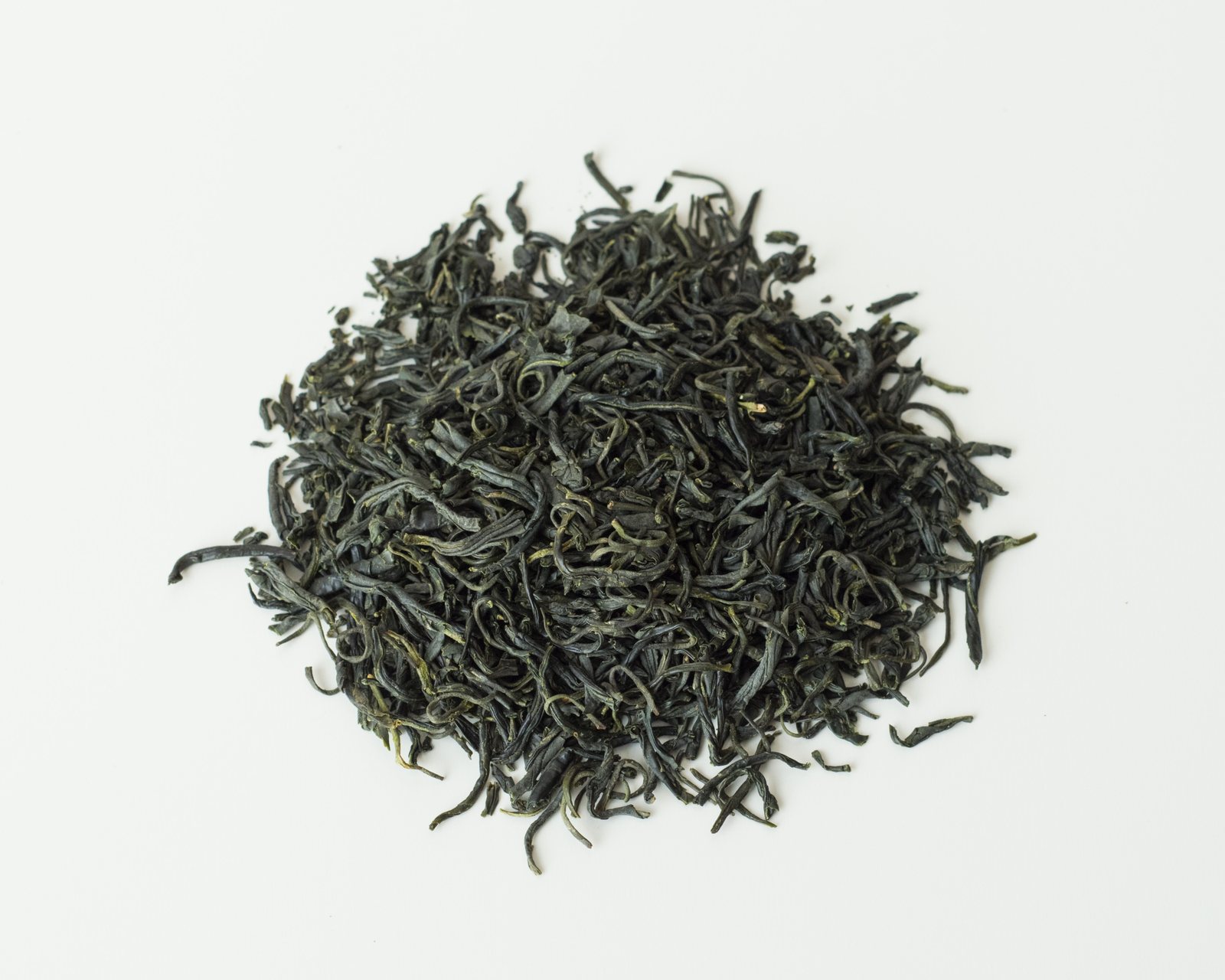
What it is: a Japanese green tea defined by its kill-green step
Kamairicha (kamairi-cha) is a Japanese green-tea category. Its defining feature is not a place and not a cultivar, but the kill-green step: fresh leaves go straight into a heated iron kettle or pan and are tossed at high temperature, without steam.
It is often grouped with “tamaryokucha”, but the two terms are not interchangeable. Tamaryokucha describes the shape — curled, granular, not needle-shaped. Kamairicha describes the process — pan-fired, not steamed. A tamaryokucha can be steamed; a kamairicha is pan-fired. Translating “tamaryokucha” as “kamairicha” mixes shape with process.
Process: 300–400°C, about 100 kg a batch, magatama shape
Japan's Ministry of Agriculture, Forestry and Fisheries gives several key parameters:
- the iron kettle is at about 300–400°C;
- one batch handles at most about 100 kg of fresh leaf;
- after firing, the leaves are rolled and dried, but not given the final straightening pass (seirei), so the finished tea is not needle-shaped but slightly curled like a magatama;
- both first and second flush can be used;
- the process is inefficient, which is one reason output is small.
The Gokase GIAHS account is more concrete: leaves are hand-tossed in an iron pan at about 300°C, then rolled and repeatedly dried until they form a magatama shape. Traditional production emphasises handwork, but modern producers may use machines for firing, rolling or drying. “Pan-fired” does not mean “entirely handmade”.
Geography: Miyazaki first, with Saga, Kumamoto and Oita traditions
The Japan Tea Central Association's 2026 data gives a national denominator of 33,400 ha of tea and 75,100 tonnes of aracha. Miyazaki ranks first in kamairicha output, with 1,110 ha of tea and 2,880 tonnes of aracha. That is a production-volume ranking, not a claim that Miyazaki is the only place that makes kamairicha.
Other documented areas include:
- Ureshino, Saga Prefecture: the Saga Prefecture page calls Ureshino a traditional kamairicha area and says it won the production-area award in the kamairicha section seven consecutive times; in 2025 it took first prize in the kamairicha section of the National Tea Fair. The local narrative traces the method to 1504, when a Ming potter called Hong Lingmin brought a Nanjing kettle and the leaf-pan-firing method.
- Kumamoto Prefecture: the GJTea Kumamoto page says the Hosokawa lord established a gozen tea garden in 1632; the pan-firing method was introduced by Korean carpenters who stayed after building Kumamoto Castle; Kajihara Tea Garden continues the tradition.
- Oita Prefecture: MAFF lists Oita as one of the main producing areas.
- Gokase, Miyazaki Prefecture: the GIAHS page says the tea gardens are at 500–800 m; kamairicha is less than 1% of Japanese tea; Korogi of the local Midori Teas has demonstrated hand pan-firing in Paris and the United States.
History: from 15th-century China to a Kyushu regional craft
The GIAHS page traces the arrival of pan-firing in Japan to the 15th century, from China. Early Japanese tea was not steamed-only; pan-firing also existed. After the 18th century, the steamed, needle-straightened system centred on Uji became dominant, and kamairicha retreated to parts of Kyushu as a regional craft.
This history should be distinguished from “kamairicha is a Japanese copy of Chinese green tea”. The kill-green principle is similar, but Japanese kamairicha uses Japanese cultivars, Japanese rolling and drying equipment, and its own shape, aroma and brewing conventions. It is not the same process system as Longjing or Biluochun; it shares the technical principle of pan-firing.
Flavour: kettle aroma, golden liquor, lower astringency — but not hojicha
Saga Prefecture's 2026 page describes kamairicha as having a kettle aroma (kamaka), a clear golden liquor, slight sweetness and a clean finish, with a magatama-shaped leaf. The GIAHS page also treats kamaka as a core concept. The aroma comes from hot iron contacting fresh leaf — Maillard reactions and lipid degradation — not from added flavouring or smoke.
The category's typical features are:
- Kettle aroma (kamaka): roasted soybean, toasted nut, a light “wok” note;
- Liquor colour: golden to light amber, warmer than typical steamed sencha;
- Taste: usually lower astringency, more direct sweetness, a smooth finish;
- Shape: curled magatama, not needle-shaped.
But it is not hojicha. Hojicha is finished tea that is roasted again at high temperature, turning brown with caramel and smoky notes. Kamairicha is pan-fired at the kill-green stage; the leaf stays green, only the shape curls and the aroma carries a kettle note. Calling kamairicha “Japanese hojicha” is a process-stage error.
Common misreadings
| Misreading | Problem | Better wording |
|---|---|---|
| “Kamairicha is hojicha” | Hojicha is re-roasted finished tea; kamairicha is pan-fired at kill-green | “A pan-fired green tea”, not “hojicha” |
| “Kamairicha is the same as Chinese pan-fired green tea” | The kill-green principle is similar, but cultivar, rolling, drying and shape differ | “A Japanese green-tea category sharing the pan-firing principle” |
| “Only Miyazaki produces kamairicha” | Miyazaki ranks first, but Saga, Kumamoto and Oita have traditions | “Miyazaki ranks first in output”, not “the only origin” |
| “300–400°C is the brewing temperature” | That is the pan temperature during kill-green | Give a separate brewing suggestion, such as about 80°C |
| “The magatama shape comes from the cultivar” | The shape mainly comes from skipping the straightening pass | “Curled because the leaf is not straightened”, not “cultivar-determined” |
| “Kamairicha has no astringency” | Astringency is usually lower, but still varies with cultivar, season and brewing | “Usually lower”, not “zero” |
Source boundary
This page confirms that kamairicha is a Japanese green-tea category killed in a 300–400°C iron kettle rather than by steam; that a batch handles at most about 100 kg; that the leaf is magatama-shaped because it is not given a final straightening pass; that the main producing areas are Miyazaki, Saga, Oita and Kumamoto; that Miyazaki ranks first in kamairicha output, with 1,110 ha of tea and 2,880 tonnes of aracha, against a national 33,400 ha and 75,100 tonnes; that the Gokase GIAHS page puts kamairicha below 1% of Japanese tea; that Ureshino traces its method to 1504 and Kumamoto traces its pan-firing to around 1632; and that Saga describes kamairicha as having a kettle aroma, golden colour, slight sweetness and a clean finish.
This page does not confirm the exact national kamairicha output, a complete producer list for each prefecture, a single cultivar ratio, a single processing specification, a fixed sensory profile for every product, or claims such as “kamairicha is exactly Chinese pan-fired green tea”, “kamairicha is hojicha” and “only Miyazaki produces kamairicha”. The page image is kamairicha dry leaf from Miyazaki, not a tea garden or a brewed cup.


