Start with the name
“Jeju green tea” is not a tea cultivar and it is not a grade. It means green tea grown and processed on Jeju Island. The island has more than one garden and more than one producer, so the name does not fix a style. Treating “Jeju” as a quality adjective is like treating “West Lake” as a grade of Longjing: it skips the information that actually matters — which garden, which maker, which year, which process.
The best-documented Jeju tea brand in export markets is O'Sulloc, the tea brand of Amorepacific. Its fields and museum have made “Jeju” legible as a brand, but a brand is not the whole island's tea industry. Other gardens exist; they simply have less documentation in English.
Three fields, and a great deal of stone
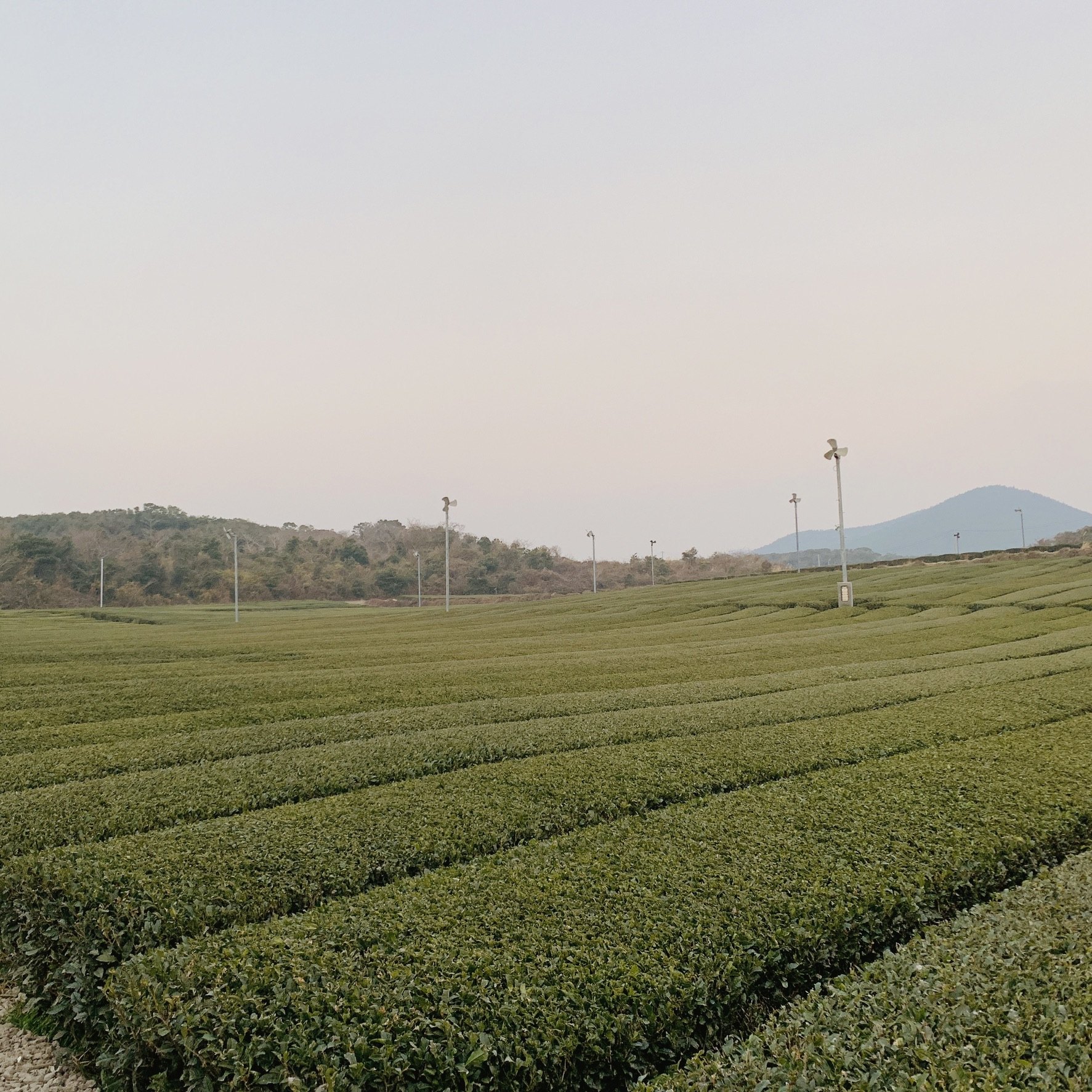
O'Sulloc's official material lists three organic tea fields on Jeju: Seogwang, Dolsongi and Hannam. It also operates one organic field at Gangjin, on the mainland. Seogwang sits in Seogwang-ri, Seogwipo, near Sanbangsan. The company says the site was stony ground that could not be farmed, and that it took more than twenty years of reclamation from 1983 to turn it into what it calls Korea's largest organic tea field.
That detail matters more than the scenery. The tidy rows were not a natural gift of volcanic soil. They are the visible end of a long project of land preparation, drainage, wind protection and organic management. A photograph of a green hillside does not show the years of work that made the hillside possible.
Cloud and fog from Hallasan are another documented condition. O'Sulloc says the moisture forms cloud and mist around the southern slopes, creating natural shade that improves leaf colour. Shade does change amino-acid and aroma-precursor levels in tea leaves; it is central to matcha and gyokuro. For ordinary Jeju green tea, cloud cover is one condition among many. It does not by itself predict sweetness in the cup.
Organic is the real common thread
O'Sulloc's official event page describes all three Jeju fields as 100% organic. The Seogwang page also calls the field organic. This is a management and certification claim, not a synonym for “volcanic soil, therefore clean.” A packet that says only “Jeju volcanic rock” but gives no certification body, no producer and no harvest year still leaves the buyer with an incomplete chain.
Dolsongi is the earlier field in the brand story: O'Sulloc's official event page says wasteland there was reclaimed in 1979 and became today's tea field, which it calls the setting of the brand's birth. Seogwang is a separate timeline: reclamation began in 1983 and took more than twenty years. The two dates belong to different fields; do not fold them into one origin story. The September 2001 museum opening is a third event.
Hannam is the field the company specifically describes as sitting on volcanic-ash soil. It is tempting to generalise that to every Jeju garden, but the sources do not. Volcanic ash is a soil parent material, not a flavour. What reaches the cup depends on cultivar, harvest timing, shade, kill-green method and drying.
Reading the cup
Jeju green tea can be fresh and grassy, or deeper and nuttier, depending on cultivar, season and processing. A shaded spring leaf tends to put sweetness and umami forward; a heavier kill-green or drying step pushes the aroma toward cooked chestnut or toasted soybean. Those are process differences, not proof of an island-wide house style.
“Sea-salt minerality” is common copy, but it has no stable sensory referent. Salt from sea air does not travel through the roots into the leaf, and volcanic rock does not add a measurable mineral taste to the infusion. The reliable descriptors are the ones tied to the leaf and the process: fresh grass, nori, chestnut, flowers, sweetness, astringency, finish.
To judge a bag, start with the dry leaf: even colour, no obvious stems or dust. Brew it cool enough — around 70–80°C — and keep the first infusion short. Good green tea can be light; it should not need boiling water and a long steep to taste of anything.
Timeline
| Date | Event | Note |
|---|---|---|
| 1979 | Dolsongi field reclaimed | The company says wasteland here was reclaimed in 1979 and became the setting of the brand's birth; this is not Seogwang's start. |
| 1983 | Seogwang reclamation begins | Stony ground was converted over more than twenty years into an organic tea field. |
| 2001 | O'Sulloc Tea Museum opens | Opened in September; the company calls it Korea's first tea museum. |
| Present | Three Jeju fields under organic management | Seogwang, Dolsongi and Hannam are described as 100% organic; Gangjin is a fourth field on the mainland. |
What to look for
- Producer and field. “Jeju” alone is too broad. A garden or factory name narrows the claim.
- Harvest year. Green tea is a fresh product; the harvest date is more useful than a geological adjective.
- Organic certificate. Look for the certification body and number, not just the word “natural.”
- Process. Steaming, pan-firing and drying change the aroma profile. One island can produce several styles.
- Storage. Green tea fears light, heat and moisture. Buy small packs, refrigerate after opening and drink them soon.
Sources and status
This page relies on O'Sulloc's official Jeju field page, its official organic-field page and a Korea Tourism Organization page. The company sources support the 1983 reclamation, the twenty-year conversion, the “largest organic tea field” claim, the three Jeju organic fields, the September 2001 museum opening and the cloud-shade condition. The Korea Tourism page independently supports the scale and Amorepacific's operation. Claims in the legacy draft — a 1973 government trial, a “Jeju native cultivar,” a blanket Japanese steaming method and a “volcanic mineral” flavour — had no adequate source and have been removed. Jeju green tea is a place name, not a cultivar, and this page no longer presents it as one fixed flavour.


