A region, not a brand
Hadong green tea (하동 녹차) is green tea from Hadong County in South Korea's Gyeongsangnam-do. It is first a geographical-indication region, and only then a product type. The county has many growers, cooperatives and brands; within the same region there are wild or semi-wild tea fields and cultivated gardens, hand-made tea and machine-made tea.
So “Hadong green tea” is not one company's pack, and it is not “all wild tea.” The official core is narrower: Hadong is Korea's first tea cultivation site, with about 1,200 years of tea history, wild tea fields preserved around Hwagae-dongcheon, and deokkeum as the signature process.
This page covers the regional identity, history, landscape, processing and industry boundary. Specific brands and grades still have to be read from the pack.
1,200 years: tea seeds from Tang in 828
Hadong's official starting point is specific: in 828, during the reign of Silla's King Heungdeok, Kim Daeryeom returned from Tang China with tea seeds, and the king ordered them planted on Jirisan. This is one of Korea's earliest documented tea-planting records, and Hadong calls itself the “first tea cultivation site.”
Three qualifiers matter:
- 828 is the year of the seed introduction and royal order, not the year a large Hadong tea industry already existed.
- Jirisan is in the Hadong area, but the exact location, scale and continuity of the earliest gardens cannot be reconstructed from the phrase “1,200 years.”
- “First tea cultivation site” is a Korean tea-history designation, not a UNESCO or FAO global title. The GIAHS listing is a separate agricultural-heritage programme.
In 2008, Hadong was registered as the “first tea cultivation site.” That strengthens its place in Korean tea history; it does not mean every Korean tea originates in Hadong. Boseong and Jeju have their own records and industrial paths.
Landscape: Seomjin River, Hwagae Stream and fog
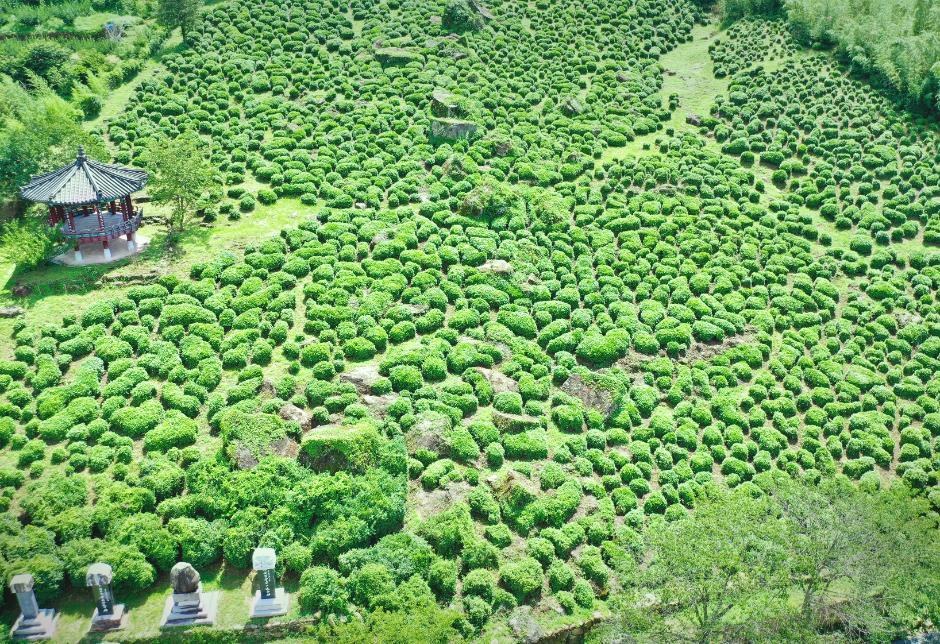
Hadong's tea fields lie along the Seomjin River and Hwagae Stream, on the southern slopes of Jirisan. The official climate description is fog, high humidity and a large day–night temperature range. Those conditions slow bud growth, help tenderness and reduce the stress of strong direct sun.
“Fog” is not a romantic detail; it describes daily changes in light, humidity and temperature. Fog lowers direct radiation and raises air humidity, but the slope still has to drain well, or the humidity becomes a disease problem. Hadong's fields are on draining hillsides, not on any flat ground.
The Hwagae-dongcheon wild tea field around Jeonggeum-ri in Hwagae-myeon is the county's best-known landscape. The official material treats it as a core wild-tea area. But “wild tea field” does not mean “unmanaged ancient-tree garden.” It includes long-naturalised populations as well as semi-wild and tended gardens. “All Hadong green tea comes from wild ancient trees” goes beyond the official position.
Processing: deokkeum, not steaming
Hadong's signature process is deokkeum. The county and RDA give this sequence:
- picking;
- deokgi — repeated pan-firing, turning and shaking the leaf;
- rubbing;
- drying;
- a final pan-fire;
- sorting and packing.
This is not Japanese steaming. Steaming fixes the leaf with steam; deokkeum uses pan heat and repeated turning to control enzymes, moisture and shape. It has similarities to Chinese pan-fired green tea, but the Korean hand rhythm, tools and grade system are its own.
Deokkeum is also not “nine steamings and nine sun-dryings.” That is a Chinese phrase pasted onto a Korean process; Hadong's official sequence does not contain it. “Repeated pan-firing, rubbing and a final pan-fire” is more accurate than a borrowed idiom.
The harvest usually runs from late April to late May, graded as Ujeon, Sejak, Jungjak and Daejak. The names borrow East Asian seasonal and “sparrow tongue” vocabulary, but in Hadong they map onto local picking times and raw-leaf standards.
Industry: 2,100 households, 1,048 ha, 2,230 tonnes
Hadong's 2008 official count:
| Measure | 2008 figure |
|---|---|
| Tea households | 2,100, about 45% of the national total |
| Tea area | 1,048 ha, about 23% of the national total |
| Output | 2,230 tonnes |
| Value | KRW 26.1 billion |
The numbers show Hadong's weight in Korean green tea: less than a quarter of the national area, but nearly half of the tea households. That points to a region of small, intensive growers rather than one large estate.
On 8 March 2006, Hadong was designated a “Hadong wild tea industrial special district.” The district framework links wild-tea conservation, farming communities, processing and tourism. It is not a synonym for “every Hadong tea is GI-certified.” Product-level certification and authorisation still apply.
Agricultural heritage: KIAHS and GIAHS
Hadong has two heritage layers:
- 2015: Korean Important Agricultural Heritage (KIAHS);
- 2017: FAO Globally Important Agricultural Heritage System (GIAHS).
GIAHS is a FAO programme. It recognises an agricultural system — biodiversity, traditional knowledge, landscape and community — not the quality of a single tea product. Hadong was listed for the combination of wild and semi-wild tea fields on the southern slopes of Jirisan, traditional deokkeum processing and tea-farming communities.
That explains why the Hadong story keeps returning to “wild tea” and “hand processing”: the heritage listing protects a system, not a batch of leaf. Writing “UN-certified best green tea” turns an agricultural heritage into a product rating.
Flavour and brewing: light fire, fresh, roasted
Hadong green tea usually takes a light-fire route: tightly rolled dry leaf, a pale green to yellow-green liquor, aromas of fresh leaf, roasted bean and nut, a fresh and sweet finish, and usually less astringency than Japanese steamed tea. Hand-made versus machine-made, Ujeon versus Daejak, makes a large difference; one “chestnut” note cannot cover the whole region.
Brewing advice:
- water: 70–80°C, lower for young buds;
- leaf: 3 g to 150 ml;
- time: 45–60 seconds for the first steep, then 15–20 seconds more each round;
- vessel: gaiwan or glass; avoid a long, sealed steep with boiling water.
Hadong green tea holds up for about three or four steeps. Its freshness comes from spring leaf and light firing, not from a high-amino-acid cultivar. Overbrewing turns the roasted note into bitterness.
Common errors
| Claim | Problem | Better wording |
|---|---|---|
| “Descended from Chinese small-leaf tea” | No cultivar-identification source | Do not state a cultivar origin; keep the 828 introduction story |
| “Jirihyang” | Not an official generic name | Do not use the commercial name |
| “Wild tea trees discovered in the 1970s” | No discoverer, location or tree-age evidence | Only the Hwagae-dongcheon wild tea field |
| “Mechanisation abandoned under Japanese colonial rule” | No industrial-history source | Do not write a colonial break |
| “Each batch is only a few to tens of kilograms” | No output source | Do not give batch weights |
| “All Hadong green tea is wild” | Official position includes wild/semi-wild and cultivated | State both within the region |
| “GIAHS is a tea-quality certification” | GIAHS is an agricultural-system heritage | Agricultural heritage, not a product rating |
Where it sits in Korean tea
Hadong's importance is not “oldest” or “most expensive.” It is the way three things are tied together: the wild-tea landscape on the southern slopes of Jirisan, the deokkeum tradition and smallholder tea communities. That makes it a different path from the larger-scale green tea of Boseong or the volcanic-island tea of Jeju.
For someone learning Korean green tea, Hadong is a good “traditionalist” reference: light fire, fresh, roasted, with more seasonal variation in hand-made lots. If you want a stable, inexpensive everyday green tea, Hadong also has machine-made tea — but that is not the cup in the GIAHS story.
Source boundary
Confirmed here: Hadong as a Korean GI green tea region; the 828 seed introduction and royal order; about 1,200 years; the 2006 wild tea special district; the 2008 figures of 2,100 households, 1,048 ha, 2,230 tonnes and KRW 26.1 billion; KIAHS 2015 and GIAHS 2017; the deokkeum sequence; the Hwagae-dongcheon wild tea field; and the harvest grades.
Not confirmed here: the cultivar composition of every garden, the age of every tree, a region-wide sensory standard, the GI authorisation of every brand, or the exact split between hand-made and machine-made tea. For a specific pack, read the label, producer and certification marks.


