First, the name
Gimhae Janggun-cha is a local tea from Gimhae, Gyeongsangnam-do, South Korea. Its proper name is Gimhae Janggun-cha / 김해장군차 / 金海將軍茶, not the generic “Gimhae green tea” and not a synonym for every green tea made in the city.
It is produced mainly as non-fermented green tea, but Gimhae also sells an oxidised / fermented product under the same local name. Calling it simply “green tea” misses half the range: Janggun-cha is a local tea name that can be processed as green or oxidised tea.
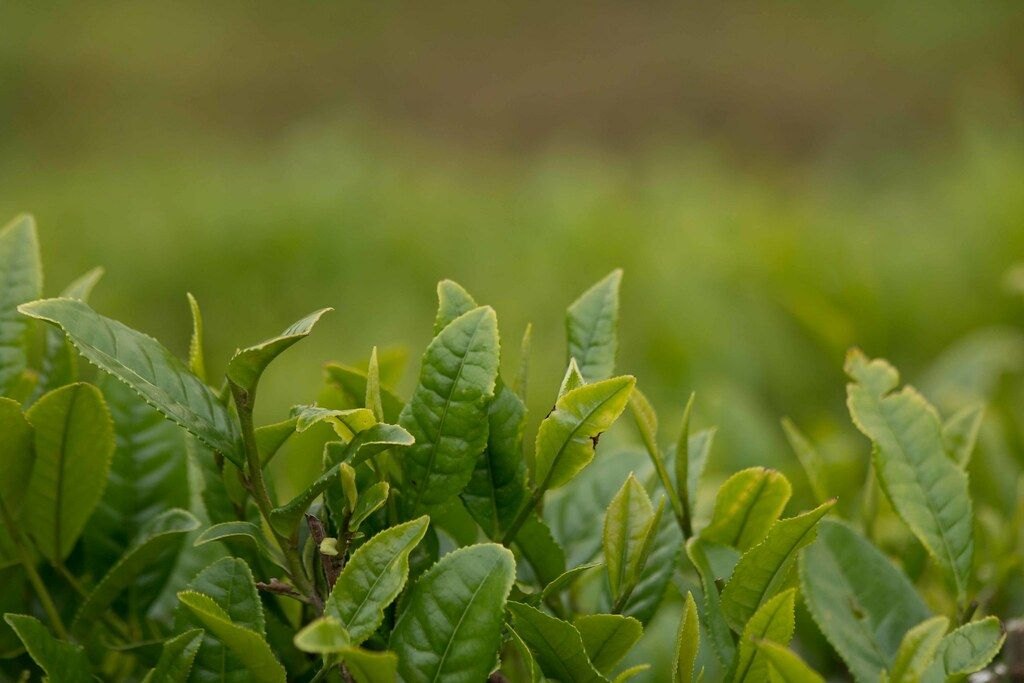
Its raw material is not a named Japanese cultivar. Official material repeatedly describes a large, thick-leaf local population: leaves larger and thicker than ordinary tea bushes, with higher catechin, amino-acid, vitamin and mineral content. That is a local population characteristic, not “Yabukita” or a single clone.
The name: two layers of recorded tradition
The history comes in two layers, and they should not be collapsed.
The first is the Queen Heo Hwang-ok tradition. Gimhae's official account says that in AD 48, Queen Heo, wife of King Suro of Gaya, brought tea seeds from India and planted them on Baekwolsan in Gimhae. The Joseon Buddhism History records this as “世传” — “it is handed down that” — not as a modern historical proof. It belongs to local origin storytelling; it is not safe to turn it into “Korean tea began in AD 48.”
The second is the King Chungnyeol naming story. Gimhae's monument page quotes the Sinjeung Dongguk Yeoji Seungnam: King Chungnyeol came to Gimhae while campaigning against Japanese raiders, saw the tea bushes, judged their aroma and taste the finest among teas, and named them “Janggun” (general). This is much later than the Heo story, but it explains the name rather than the origin of the plant.
A third documentary line comes from Yi Neung-hwa's Joseon Buddhism History (1869–1943): Baekwolsan has “bamboo-dew tea,” locally said to come from Heo Hwang-ok's Indian seeds; Geumgangsa has wild tea trees, and King Chungnyeol stopped his carriage and gave the name “Janggun”; Geumganggok produces a yellow tea, also called “Janggun tea.” All three are quoted by the city as documentary records and local tradition, not three independent scientific proofs.
The defensible formulation is: the name has a Goryeo-era documentary trail; the earlier origin is traced by local tradition to the Gaya period. Do not turn the legend into a chronology, and do not present “Korea's first tea” as a national consensus; it is Gimhae's local claim.
Wild clusters and the modern revival
The wild Janggun tea population grows on the slopes of Bunseongsan, around the old Chatjeon-dong area in Dongsang-dong and Daeseong-dong. The city's monument page describes plants growing in shaded slope and valley sites, in clusters of 2–30, with estimated ages of 5–50+ years. Those are field estimates, not exact ages for every bush.
Gimhae has promoted the tea since 1999, using selected mother plants from the wild clusters to raise seedlings and expand cultivation, processing and branding. The official tourism page gives this snapshot:
| Item | Official figure |
|---|---|
| Cultivated area | 62 ha |
| Growers | 40 |
| Wild clusters | 1.9 ha in three sites |
| Wild sites | Dongsang-dong Seojaegol, Chatbatgol, Sangdong Gamno Chatbatgol |
| 2016 production plan | 5 tonnes (25,000 cans of 40 g) |
These are not 2026 census numbers. They are useful for showing a small, concentrated local industry; they are not a basis for calculating a national market share.
Gimhae also says Janggun tea was selected as one of Korea's “teas of the year” for eleven consecutive years, 2008–2019. That is a city/industry award claim, not an international trade ranking. It is part of the local brand story, not proof of “world's best.”
Flavour and processing: large leaf, heat tolerance, sweet finish
The official flavour description has several clear markers:
- large, thick leaf — more substance and a different fibre/polyphenol balance than a small-leaf green tea;
- heat tolerance — the city says 100°C water still gives a deep flavour, unlike many tender green teas;
- aroma — a fresh wild-rose-like scent;
- taste — lower astringency than ordinary tea, with more sweetness and umami and a lingering sweet finish.
These claims are consistent with a large-leaf material: thicker leaves give a sturdier liquor and more infusions. But the official pages do not publish the full kill-green, rolling and drying specification, so “steamed” or “pan-fired” should not be asserted. What is confirmed is the product split: non-fermented green tea and fermented/oxidised tea.
The retail forms listed by the city are 40 g and 80 g canisters, with separate non-fermented and fermented products. That is a local specialty-gift format, not a bulk commodity. When buying, check the label for 비발효차 (non-fermented) versus 발효차 (fermented); “Janggun-cha” alone does not tell you which one you have.
Brewing: start at 100°C
The city only makes a broad claim: the tea holds up to 100°C water. It does not publish a gram/water ratio, steep time or number of infusions. A sensible starting point is:
| Item | Suggestion |
|---|---|
| Leaf | 3 g per 150 ml |
| Water | 90–100°C; use full boiling water if you want to test the official heat-tolerance claim |
| First steep | About 1 minute, adding 20–30 seconds per later steep |
| Vessel | Gaiwan or a small pot; avoid a long sealed steep |
| Adjustment | More leaf or longer time if thin; cooler water or shorter time if bitter |
This is an editorial starting point, not an official specification. The leaf is large and thick, so it opens more slowly than a tender green tea; a ten-second rinse will not give you much. At the same time, do not boil it like a Turkish concentrated tea, or the floral note will flatten.
Old-draft claims that do not survive
The old draft turned Janggun tea into a fully quantified “revival project,” but most of its numbers had no official source. These claims are removed:
| Old claim | Treatment |
|---|---|
| 1992 conversion from rice fields | Official material says promotion began in 1999; no 1992 node |
| 1995 first trial production | No official source |
| 1998 tea-growers association | No official source |
| 2005 organic certification | No official source |
| 200–300 tonnes/year, 30% market share | Contradicts the official 2016 plan of 5 tonnes; removed |
| Yabukita cultivar | Official material describes a large, thick-leaf local population, not Yabukita |
| “Gimhae-chui” cultivar | No official source |
| Dragon-king legend | Official documentary lines are Heo Hwang-ok and King Chungnyeol; no dragon king |
| “Korea's first tea garden” | The city calls it a local traditional tea; no national ranking |
The defensible version is: a large-leaf local tea from the Bunseongsan area of Gimhae, whose name is tied to a Goryeo-era record of King Chungnyeol's naming and whose local tradition reaches back to Queen Heo Hwang-ok; the modern industry dates from 1999, mainly produces non-fermented green tea and also makes an oxidised tea.
Where it fits in the Korean tea map
Korean green tea is usually associated with Boseong, Hadong and Jeju. Gimhae Janggun-cha is a different kind of place: not a large commercial estate, but a small origin built on wild clusters, local history and a city-led revival. Its value is not “high output” or “market share”; it is the survival of a local tea population and a continuous story from legend and documentary record to modern production.
If you know Boseong's sea-air green tea or Hadong's mountain tea, Janggun-cha makes a useful comparison: thicker leaf, better heat tolerance, a wild-rose aroma, a sweeter finish and less astringency. Start at 90–100°C with a short first steep, then adjust. That is the most honest way to meet the tea.


