First, the product boundary
“Gambung green tea” is easy to write as a vague regional sketch. The traceable object is more specific: Gamboeng Green Tea Peko Super, a product of PPTK (Pusat Penelitian Teh dan Kina, the Indonesian Research Institute for Tea and Cinchona).
The official product page gives four firm labels:
- Grade I green tea, sorted;
- raw material: young shoots of the Assamica and Sinensis varieties, picked to the p+1 and b+1m standards;
- appearance: round-rolled, glossy green;
- flavour: refreshing astringency, a natural roasted aroma, yellow-green liquor.
“Peko Super” is a product grade and leaf-style name. It is not a cultivar, and it is not a claim that the tea is “super” in some general quality sense. “Gambung ancient-tree green tea” or “Gambung single-tree tea” has no source and does not belong here.
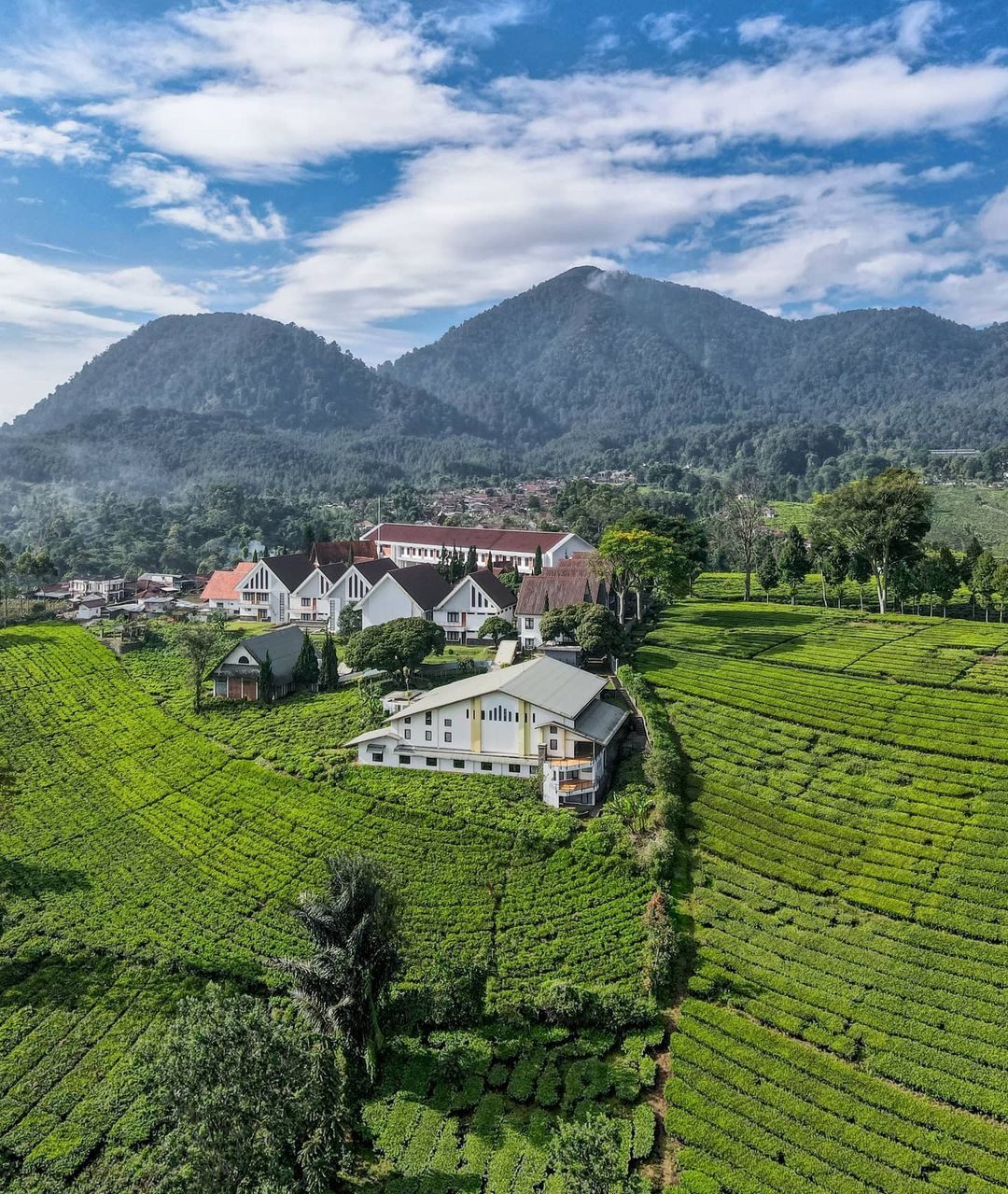
The place: a research estate in Ciwidey
Gambung lies in Ciwidey, Bandung Regency, West Java, at the foot of Mount Tilu. The PMC data article gives two useful numbers:
- about 600 hectares of tea plantation;
- most of the estate planted with tea, the rest left as natural forest.
That double identity matters: Gambung is both a commercial garden and a research estate. PPTK's official history traces tea and cinchona activity at Gambung to Kerkhoven's 1902 estate, while the institution itself was formally established in 1973 and later came under PT Riset Perkebunan Nusantara.
So 1902 is the start of the Gambung estate, not the birth year of this Peko Super product. 1973 is the institutional founding date of PPTK. The two dates should not be collapsed into one origin story.
The plucking standard: p+1 and b+1m
The official page gives the raw material as p+1 and b+1m. These are Indonesian tea-garden codes for young shoot combinations; usage is not perfectly uniform across regions and estates. This page preserves the official notation rather than inventing a “one bud and one leaf” translation.
What can be said safely:
- the leaf is young shoot material, not coarse old leaf;
- it comes from both Assamica and Sinensis, not one clone;
- the product is sorted and graded Grade I, not an ungraded bulk tea.
That is enough to place the product. Guessing the exact number of leaves behind p+1 or b+1m would go beyond the source.
Flavour: refreshing astringency, not bitterness
In Indonesian tea language, astringent describes a fresh, mouth-tightening sensation, not the harsh bitterness of overbrewed leaf. The official description breaks into four layers:
| Dimension | Official description |
|---|---|
| Appearance | round-rolled, glossy green |
| Taste | refreshing astringency |
| Aroma | natural roasted note |
| Liquor | yellow-green |
The “natural roasted” note suggests heat in processing, but the official page does not publish the kill-green, rolling or drying parameters. “Roasted aroma” should not be upgraded to “heavy charcoal roast” or “charcoal-fired” without a process source.
Total polyphenols 21–21.5%: a laboratory figure, not a clinical marker
The official page reports a laboratory total polyphenol value of 21–21.5%. That is a compositional measurement with a checkable range.
It does not automatically mean a particular physical effect. Polyphenol content varies with cultivar, season, processing and brewing, and a lab figure cannot be converted into a human outcome. This page treats the number as a product characteristic, not a promise beyond the measurement.
How to brew it: the official recipe
The official brewing advice is unusually complete:
| Item | Official suggestion |
|---|---|
| Leaf | 1–2 teaspoons, about 2–3 g |
| Water | 150–200 ml |
| Temperature | 70–80°C |
| Time | 2–3 minutes |
| Serving | hot or cold |
This is a low-temperature, short-infusion recipe for young green leaf. Boiling water amplifies astringency; if you want a stronger cup, increase to 3 g or extend to three minutes, but do not start heavy.
What not to confuse it with
- Gambung village: a place name, not a tea brand.
- Gamboeng: the spelling used in the product name, referring to the same Gambung area.
- Peko Super: a product grade and leaf-style name, not a cultivar.
- Indonesian green tea: not all of it comes from Gambung, and not all Gambung tea is Peko Super.
When buying, look for the product name, the Grade I designation and the PPTK/Gamboeng identity. “Indonesian green tea” alone is too broad to identify this tea.
Certainty and sources
The page keeps four layers: PPTK's official product page for identity, grade, plucking codes, flavour, laboratory data and brewing; PPTK's official history for the institution and 1973; the PMC data article for Ciwidey, Mount Tilu, the 600-hectare estate and the natural-forest share; and the Commons photograph for the garden landscape. Kill-green method, rolling parameters and “ancient-tree / single-tree” claims have no source and are left out.


