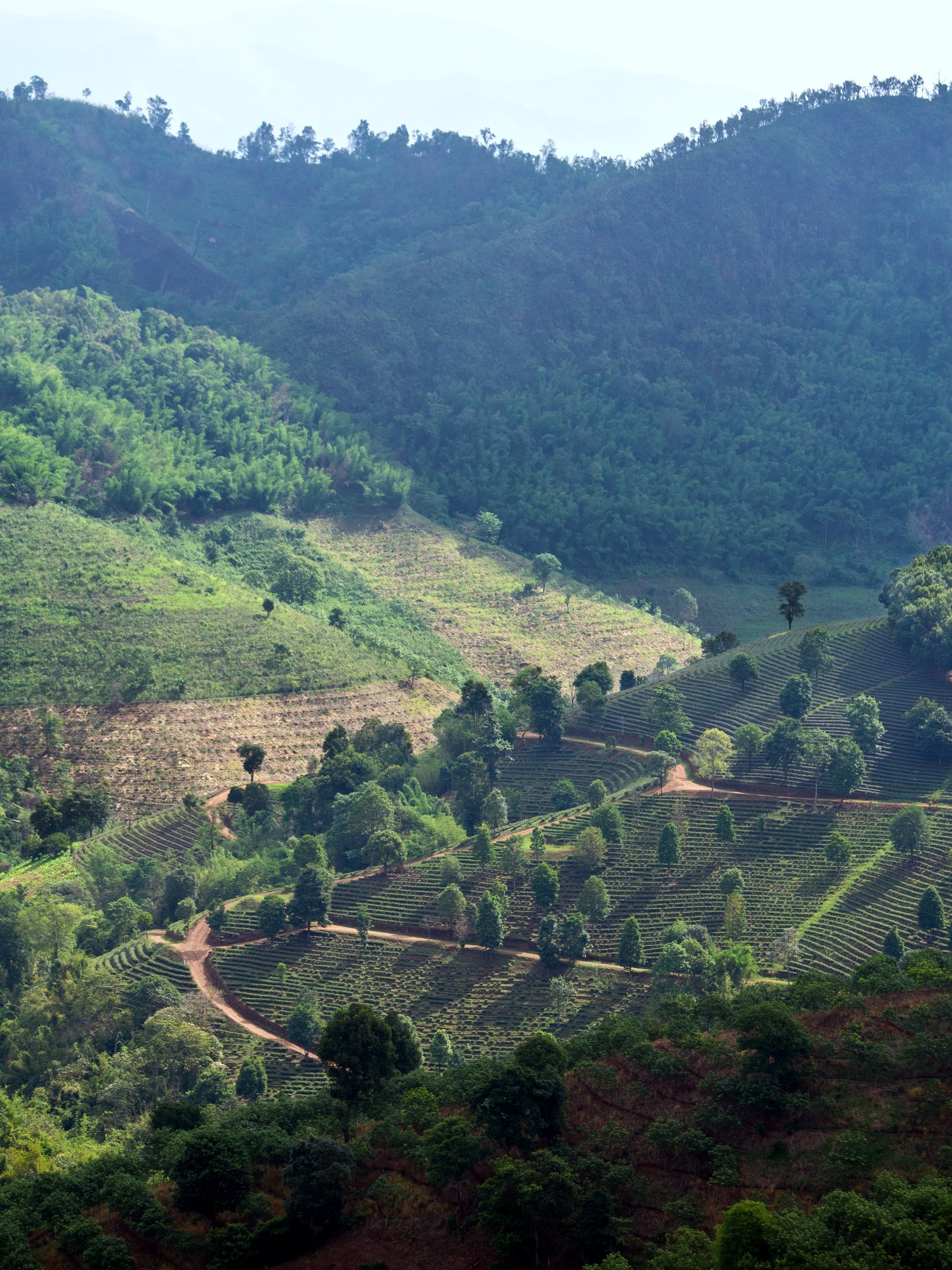
What it is — and what it is not
In Chiang Rai, “Doi Chang” first means coffee. Doi Chang village is a coffee-growing area, and Doi Chaang Coffee is a separate coffee brand. Cha DoiChang is a tea company. Its garden is not in Doi Chang village; it is in Pong Phrae, Mae Lao district, Chiang Rai, and it uses a natural stream that flows down from the top of Doi Chang.
That distinction matters. If you write “tea from the Doi Chang coffee village”, you have moved the garden to the wrong place and merged two brands. The Tourism Authority of Thailand page for Doi Chang describes coffee, temperate fruit and cherry blossom; it does not describe the Cha DoiChang tea garden.
The garden: 50 rai at 600 m
The official facts are compact:
| Item | Official position |
|---|---|
| Garden started | 1999 |
| Tea area | 50 rai, about 8 ha |
| Altitude | about 600 m |
| Location | Pong Phrae, Mae Lao, Chiang Rai |
| Water | natural stream from the top of Doi Chang |
| Average rainfall | about 2,500 mm a year |
| Output in 2017 | about 1,500 kg |
| Company founded | 2001, three shareholders |
| Processing | Taiwanese technology + local know-how |
Fifty rai is not a large estate. This is a small, product-diverse garden: low volume, several styles, and a brand built on flavour and place narrative. The 1,500 kg figure is explicitly a 2017 number, not a permanent capacity.
The product line: six teas, not one “Thai green tea”
The official product page lists six products:
| Product | Official positioning |
|---|---|
| Superior | For experienced tea drinkers; intense spring bouquet, very smooth |
| Premium | For younger drinkers; honey sweetness with a peach-skin note |
| Pure Green | Lower caffeine; suitable for older people, young people or before bed; described as a fresh walk in green forest |
| Red Oolong | Mature red-oolong style; suited to Chinese meals or greasy food |
| Eternity | Blended with Thai ginger, lemongrass, celery and safflower; the brand claims it helps blood pressure, cholesterol and triglycerides |
| Peaceful Rest | The brand claims it helps reduce blood sugar |
The last two need a clear boundary. The official site places them under “Tea for Health Improvement”. Those are brand marketing statements, not clinical trial results or approved health claims. This page records what the brand says; it does not turn that into “drinking this tea lowers blood pressure or blood sugar”.
What “Oolong Green Tea” means
“Oolong Green Tea” is not a strict tea classification. It is a product name. It places the tea somewhere between the semi-oxidised oolong style and the fresh green style: not Japanese steamed green tea, not a fully oxidised black tea. The name alone does not tell you the exact oxidation level or roast level. The only safe reading is that the brand itself uses the term.
Likewise, “Doi Chang” here is a brand name, not a protected geographical indication. It does not prove the leaf grows in Doi Chang village, and it does not give the tea the terroir of Doi Chang coffee. The official location is Pong Phrae, Mae Lao, at about 600 m.
Flavour and brewing
The official flavour notes for the four main styles are:
- Superior: intense spring bouquet, very smooth, aimed at experienced drinkers;
- Premium: honey sweetness with a peach-skin note, aimed at younger drinkers;
- Pure Green: fresh and lower in caffeine, positioned for evening drinking;
- Red Oolong: mature, red-oolong style, suited to oily Chinese meals.
The site does not give one official gram, temperature and time set. This page therefore does not present a set of numbers as the product standard. As an editorial starting point, try 5 g tea, 150 ml water, about 90°C, 30–60 seconds. Superior and Red Oolong can take a little more heat; Pure Green can go closer to 85°C if you want a lighter cup. These are editorial suggestions, not pack instructions.
Common misreadings
| Common shorthand | Problem | Better wording |
|---|---|---|
| “The tea comes from the Doi Chang coffee village” | The garden is in Pong Phrae, Mae Lao; coffee and tea are different entities | Cha DoiChang is a Mae Lao tea company using water from Doi Chang |
| “It is a royal project” | The official material does not describe a royal project | Do not add a royal-project story |
| “100% handmade” | The official material says Taiwanese technology plus local know-how, not all-handmade | Taiwanese technology + local know-how |
| “It is a Doi Chaang Coffee product” | Doi Chaang Coffee is a coffee brand | Cha DoiChang is a tea brand |
| “All Thai high-mountain green tea tastes like this” | This is one small garden's product line | Write about Cha DoiChang's six products only |
Source boundary
This page can confirm: Cha DoiChang is a tea company in Pong Phrae, Mae Lao, Chiang Rai; the garden started in 1999, covers 50 rai at about 600 m, uses water from Doi Chang, and produced about 1,500 kg in 2017; the company was founded in 2001 with three shareholders; it uses Taiwanese technology plus local know-how; its line includes Superior, Premium, Pure Green, Red Oolong, Eternity and Peaceful Rest.
This page does not confirm: exact retail prices, the precise oxidation and roast level of each product, the cultivar, stable annual volume, or any medical benefit. The image is a northern-Thailand tea-plantation reference photograph, not the Cha DoiChang garden in Mae Lao.


