"High mountains and mist make good tea" and "shade makes sweetness" are among the most repeatable lines in tea. They have truth in them, but neither is a switch. Shade changes light intensity and spectrum; altitude changes temperature, light, humidity and growth pace. Fresh-leaf chemistry shifts, while cultivar, season and processing keep pulling in other directions.
So when a label says "high mountain" or "shaded", do not translate it directly into "sweeter and more aromatic". Better questions are: shaded for how long, at what percentage, in which season; how high, with what day-night range and cloud cover; and what tea was the leaf finally made into?
Shade: turn the light down and see what the plant does
The most direct effect of shade is lower photosynthetically active radiation. With less light, the leaf does not need to turn as much carbon skeleton into polyphenols. The proportion of diffuse light rises, leaves become darker, larger and thinner, and the plant puts more resources into light capture and nitrogen metabolism.
Across trials, the common directions are:
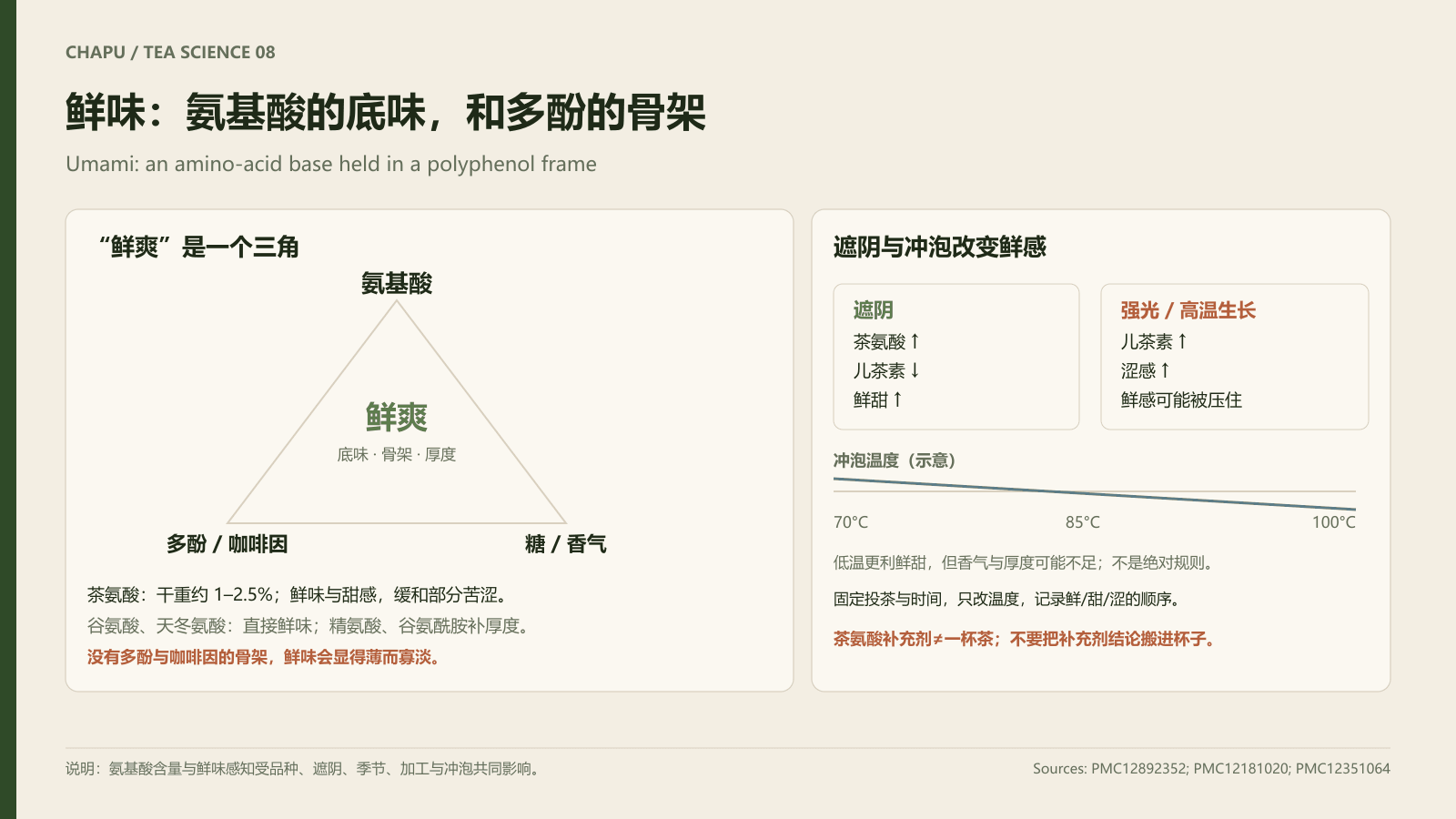
- More chlorophyll: shaded leaves are darker green; matcha and tencha colour deepens.
- More theanine and some free amino acids: nitrogen metabolism shifts toward amino acids, increasing fresh sweetness.
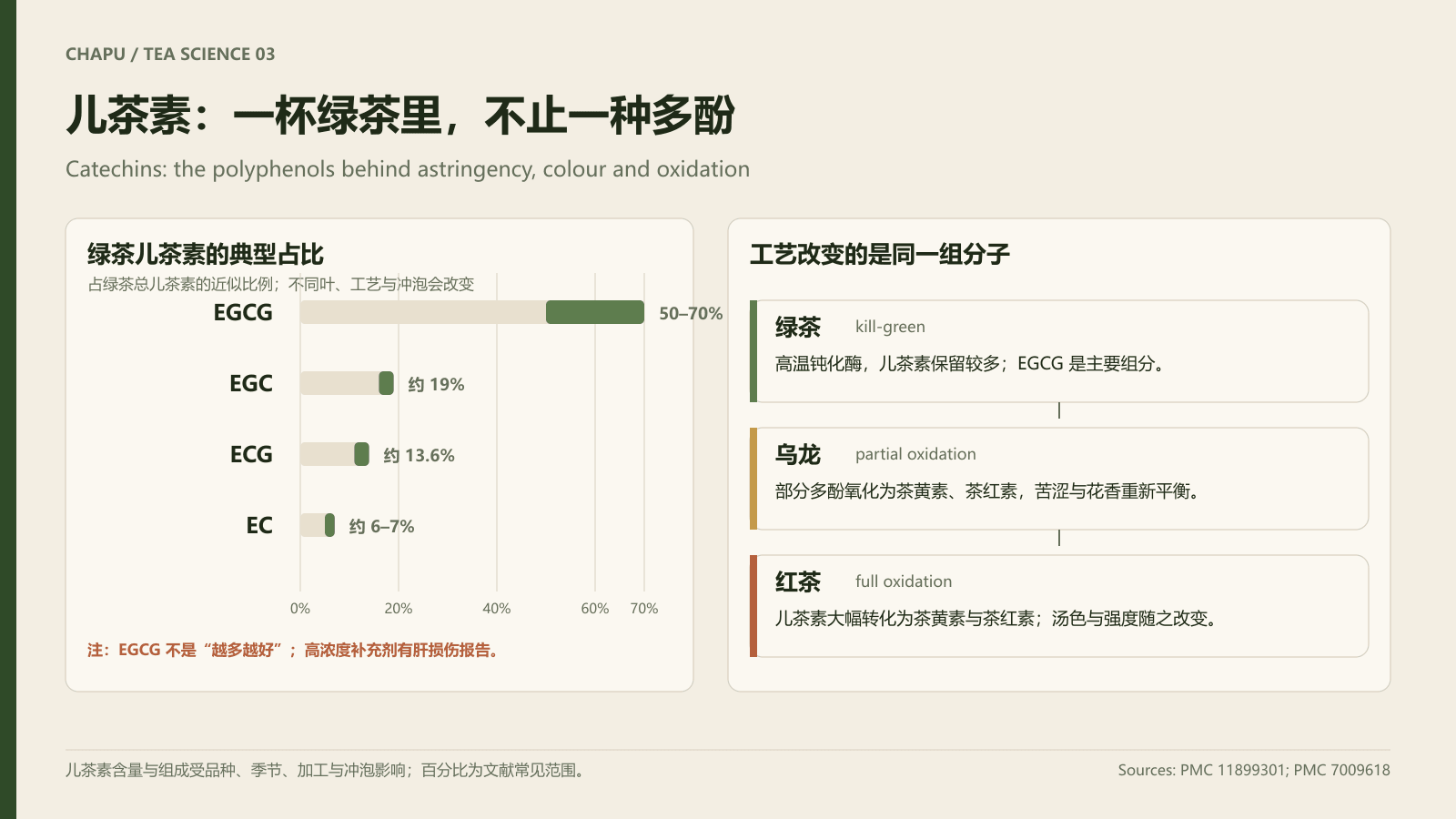
- Fewer catechins, some flavonoids and a lower phenol-ammonia ratio: astringency and drying diminish; green tea tastes softer.
- Caffeine may rise: results differ, but the matcha shading trial found higher caffeine.
- Aroma precursors shift: terpenes and glycosides may change, but the direction depends on cultivar, shade intensity and duration.
Japanese matcha and tencha are the classic shade process: cover the bushes for about 20 days before plucking, with 85–95% light reduction, to raise theanine, chlorophyll and fresh sweetness while suppressing bitterness. But this is a process built for a specific product, not a universal recipe. Shade too long or too heavy and photosynthesis, yield, roots and disease resistance all suffer.
Shade has a threshold
In the matcha trial, both 85% and 95% shade raised chlorophyll and theanine, but excessive shade was not always favourable for precursors such as glutamine. In the maize intercropping trial, around 50% moderate shade performed best in summer and autumn: amino acids and caffeine rose, polyphenols and the phenol-ammonia ratio fell. Shade has a ceiling; heavy shade is more like a targeted trade of yield and resistance for umami.
Practical variables still matter:
- Duration: 10–20 days before plucking is a common window. Too short and the chemistry barely moves; too long and the bush is drained.
- Intensity: 50–70% is common for improving summer-autumn green tea; 85–95% is typical for matcha and tencha.
- Season: shade pays more under hot, bright summer conditions. Spring famous green tea already has high amino acids; whether to shade depends on the style target.
- Cultivar: shade response varies by cultivar; not every bush will produce the same sweetness under the same net.
Altitude: not "higher is more aromatic"
As altitude rises, temperature usually falls by about 6.5 °C per 1,000 m; air thins and UV radiation strengthens; cloud and mist increase the diffuse-light fraction; day-night temperature range often widens. These factors slow leaf growth and shift carbon-nitrogen metabolism and aroma accumulation.
The high-versus-low altitude oolong study found some directions: in most cultivars, high-altitude samples had more free amino acids, polyphenols and soluble sugars, and scored higher for umami, sweetness and floral intensity; linalool, linalool oxide and geraniol were more prominent at altitude. But the same study stressed strong cultivar effects: some cultivars gained a lot at altitude, others barely differed.
A Xinyang Maojian study found 27 metabolites correlated with elevation, including EGCG, ECG, theanine and theogallin; high-elevation samples were more umami and mellow, while low-elevation samples had more catechins. Altitude is not "push everything good upward"; it changes a ratio of metabolites.
Altitude and aroma are not a straight line
The Lingtou Dancong comparison is a useful warning: total aroma compounds were highest at high altitude, then low altitude, and lowest at medium altitude; esters and indole were lower at medium altitude. "Higher altitude, stronger aroma" does not hold. Aroma is a joint product of cultivar, altitude, season and processing; a peak may appear at one altitude band and vanish at another, or a cultivar may barely respond.
"High mountain mist" adds another variable: diffuse light. Cloud reduces direct light and increases scattering, approximating light shade: leaf temperature is more stable, photosynthesis is steadier, amino acids are easier to retain. But too much cloud and too little sun reduce yield and sugar accumulation. The advantage of high-mountain tea often comes from a combination of cool, slow growth, diffuse light and good drainage, not from the altitude number alone.
Three confounders to read at the same time
| Variable | Why it matters | How to handle it |
|---|---|---|
| Cultivar | Genetic ceilings for amino acids, catechins and aroma precursors differ | Compare the same cultivar and plucking standard |
| Season and pick | Spring, summer and autumn differ greatly in amino acids and polyphenols | Fix the season or record picking dates; do not compare across seasons |
| Processing | Kill-green, shaking, oxidation and roasting amplify or suppress raw-leaf differences | Compare the same process and parameters, or at least record them |
Without these three controls, "high-mountain tea is sweeter" or "shaded tea is more savoury" may simply be a cultivar or processing difference. Comparing a high-altitude oolong with a low-altitude green tea on "umami" is not the same experiment from the start.
A testable way to drink it
To judge the real effect of altitude or shade, use a minimal contrast:
- Same cultivar and plucking standard: at least know the cultivar and tenderness.
- Same process and parameters: kill-green temperature, shaking level, oxidation time and roast level as close as possible.
- Blind tasting: hide altitude and price; record umami, sweetness, astringency, bitterness, aroma, aftertaste and infusibility.
- Record the environment: altitude, shade method, picking date and weather; do not just write "high mountain".
- Repeat: taste the same batch at least twice to avoid a one-brew accident.
This cannot prove "altitude is always better", but it can tell you whether the high-mountain label on this batch actually corresponds to a difference in the cup.
Four common misunderstandings
| Claim | Problem | A more careful reading |
|---|---|---|
| "Longer shade makes it sweeter" | Excessive shade lowers photosynthesis and resistance | Shade has a threshold; 85–95% is for matcha and tencha, not a universal recipe |
| "Higher altitude means stronger aroma" | Aroma and altitude are not monotonic | Peaks can occur; cultivar, season and processing matter greatly |
| "High-mountain tea always beats low-mountain tea" | Altitude is only one environmental variable | High mountains bring coolness, diffuse light and drainage, but also frost, cloud and yield limits; well-managed lowland gardens can also make fine tea |
| "Shaded tea is matcha" | Shade is a cultivation treatment; matcha is a product and process | Shaded green tea, tencha and matcha are not the same thing; shade is also used for other green teas |
Source boundaries
This page can confirm: shade generally raises chlorophyll, theanine and some free amino acids, and lowers catechins and the phenol-ammonia ratio; shade intensity and duration have thresholds, and excessive shade is not always better; altitude changes temperature, UV, diffuse light and growth pace; in some oolong and green tea trials, higher altitude correlates with more umami and floral aroma, but cultivar effects are strong and the aroma-altitude relationship is not monotonic.
This page does not confirm: the exact shade days, light reduction or altitude of a particular tea; the effect of one altitude band on all cultivars; or that a "high mountain" or "shaded" label by itself represents quality. To judge these environmental factors, control cultivar, season and processing, and return to blind tasting and repeated records.