Dry tea is not a sterile food. Leaves bring microbes from the field; withering, rolling, fermentation and storage introduce more. Most detections are Bacillus, Aspergillus, Penicillium and yeasts, which is not the same as “one sip causes infection”. The real concerns are mould growth and toxin accumulation after humid storage, and the risk for immunocompromised people.
Where the microbes come from
| Stage | Main sources | Common groups |
|---|---|---|
| Field | Leaf surface, soil, air, insects | Bacillus, Pseudomonas, yeasts, mould spores |
| Withering | Air, equipment, people | Bacillus, moulds, yeasts |
| Rolling / fermentation | Hands, equipment, moisture, temperature | Bacillus, lactic acid bacteria, yeasts |
| Drying | Hot air, drum, roast | Heat-resistant spores, some mould spores |
| Storage / packaging | Humidity, packaging, dust | Aspergillus, Penicillium, yeasts |
In black tea processing, Bacillus made up 77% of culturable bacteria; Aspergillus and Penicillium each 24% of fungi; Lactobacillus fermentum appeared in fermented leaf. “Microbe” is not a synonym for contamination; fermented tea has process-associated groups.
Common does not mean pathogenic
| Group | Common role | When to worry |
|---|---|---|
| Bacillus | Environmental bacteria, heat-resistant spores | High load plus damp product; immunocompromised people |
| Aspergillus | Environmental mould | Humid storage, visible mould, toxin risk |
| Penicillium | Environmental mould | Musty odour, clumping, discolouration |
| Yeasts | Fermentation and environmental yeasts | Damp, off-flavour, gas in packaging |
| Lactic acid bacteria | Post-fermentation participation | Generally non-pathogenic; poor control can sour |
The Canadian survey of 1,178 dried teas gives a realistic baseline: no high-load C. perfringens, S. aureus or generic E. coli; elevated presumptive B. cereus in 5 samples (0.4%) and Salmonella in 1 (0.08%). Pathogen positivity in compliant dry tea is low, but not zero.
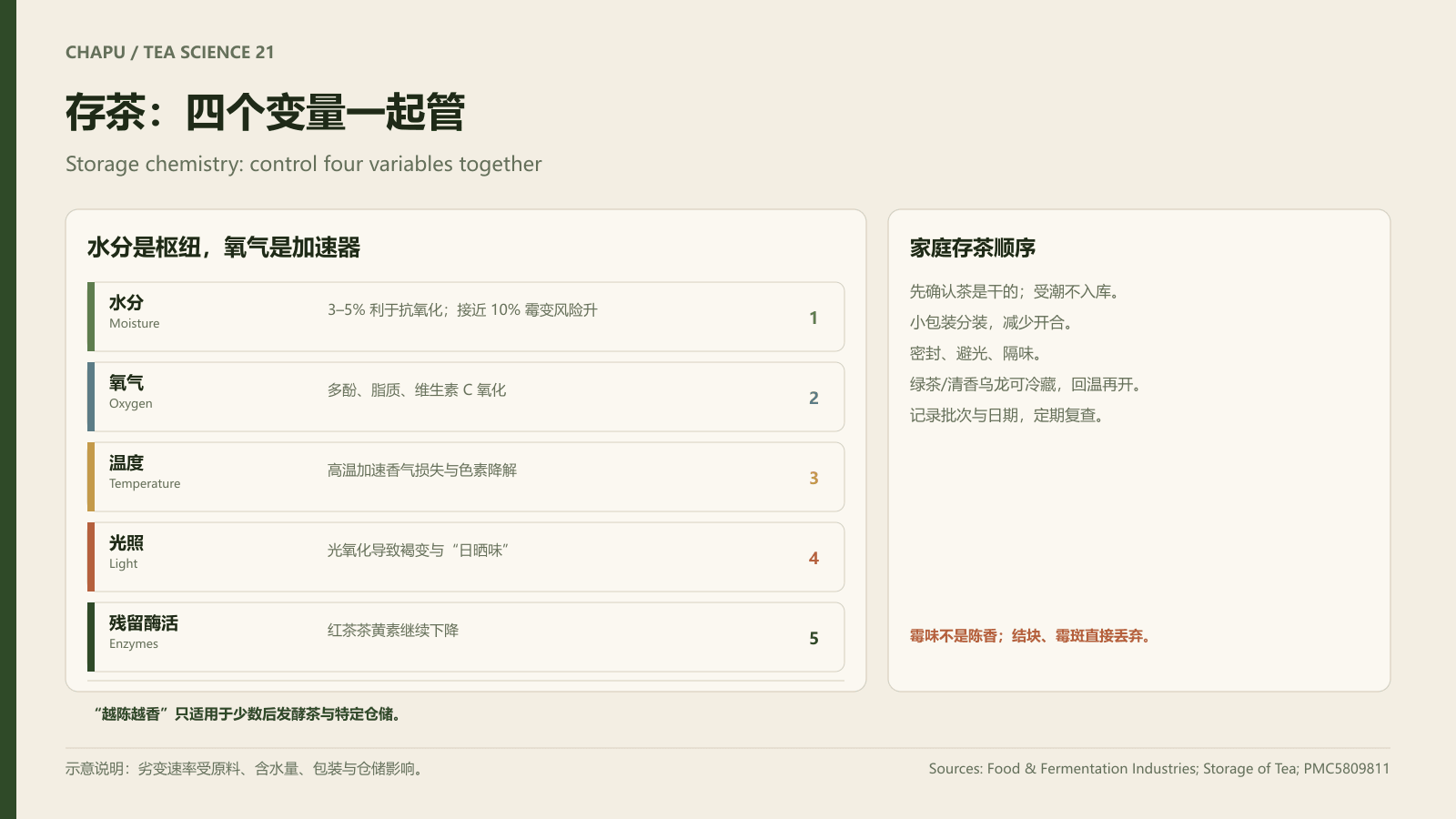
Water activity is the switch
Dry tea has low moisture, usually water activity 0.2–0.4, well below the minimum for most bacteria (>0.9) and moulds (about 0.6–0.7). In this range microbes are largely dormant. The problem is moisture uptake: relative humidity above 60% lets tea absorb water, water activity rises, and moulds grow.
“Musty” is not “aged”. Visible mould, clumping, damp cardboard odour, cloudy and irritating liquor are discard signals. Do not try to rescue with rinsing, sun-drying or “high-temperature sterilisation”; mycotoxins may already be present and heat-resistant.
Ochratoxin A and other toxins
Some studies detect ochratoxin A in commercial tea, especially humid-stored samples; others detect no mycotoxins. The conclusion is not “tea is always toxic”, but “storage decides risk”. Ochratoxin A is produced by some Aspergillus and Penicillium species and is associated with kidney risk under long-term exposure. Households cannot judge by smell alone; prevention and sourcing are the practical controls.
What brewing changes
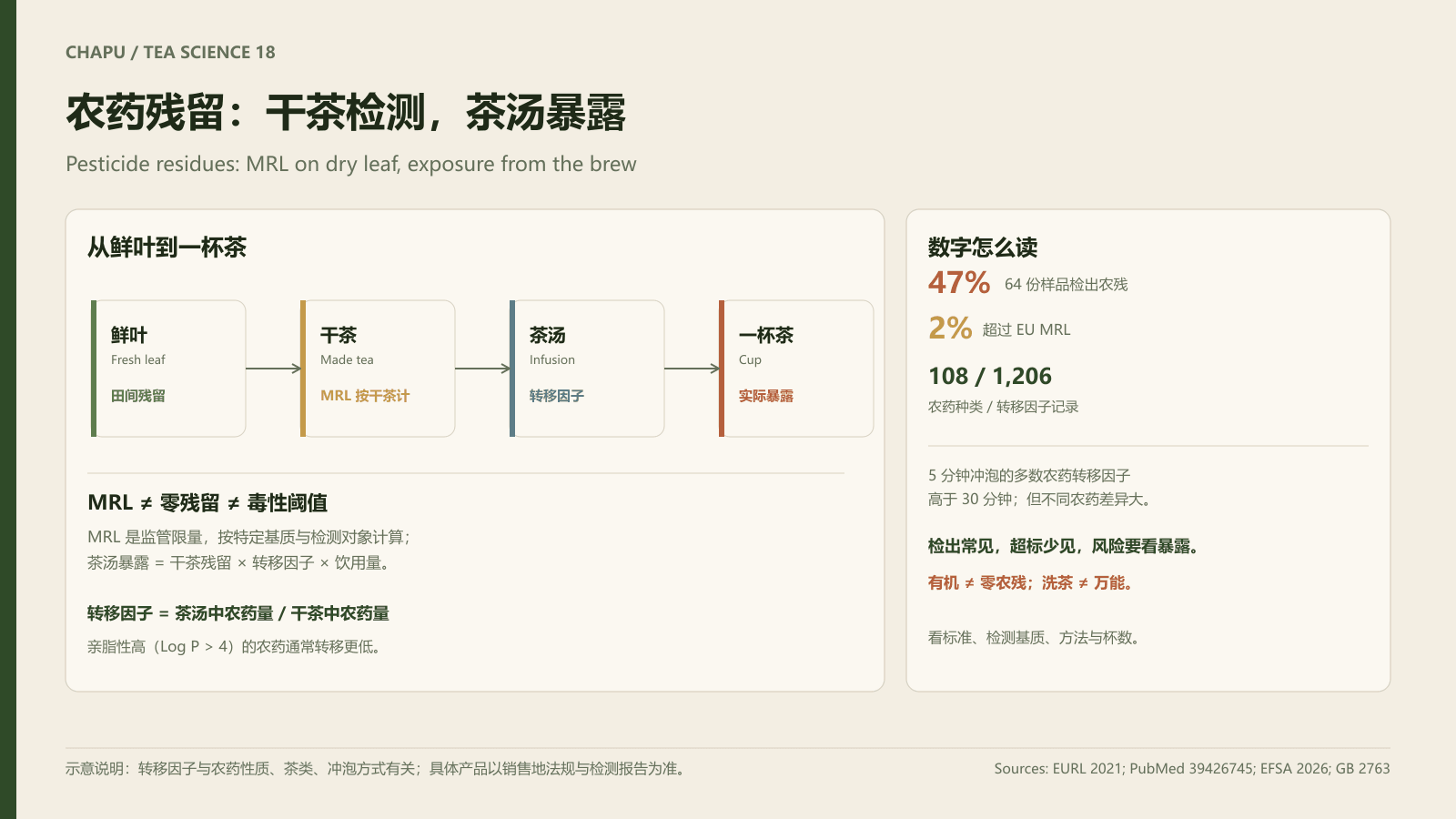
Hot water does not sterilise tea, but it dilutes and filters:
- most microbes remain in the spent leaf; liquor counts are usually lower than dry tea;
- spores are heat-resistant and survive a short boil;
- mycotoxins can dissolve in water and are not removed by brewing;
- powder or matcha ingests the whole leaf, so microbe and toxin exposure is higher than liquor.
“Brewing makes it safe” is only partly true. For mouldy tea, brewing is not a solution.
Practical steps
- Buy dry tea, not damp tea. Leaves should snap, not clump; no musty odour.
- Seal against moisture. Use a desiccant in humid seasons; avoid repeated fridge opening.
- Check source and testing. Choose products with microbiological and toxin testing, especially post-fermented and herbal blends.
- Immunocompromised people need more caution. Chemotherapy, transplant, HIV, long-term steroids: avoid raw tea powder and suspicious mouldy tea.
- Do not make “fermented tea” at home. Household conditions cannot control moisture, temperature and microbial succession; post-fermentation is not “leave it and it improves”.
Source boundary
This page can establish: dry tea commonly carries Bacillus, Aspergillus, Penicillium and yeasts; pathogen positivity in compliant dry tea is low; humid storage raises mould and toxin risk; brewing reduces some microbes but not toxins; powder exposure is higher than liquor.
This page cannot establish: the exact microbial load of a specific batch; that every mould produces toxins; whether a home “aged tea” is safe. Check test reports and storage records; discard musty, clumped, discoloured or gas-producing tea on food-safety grounds.