Tea can contain detectable lead, cadmium, arsenic and aluminium. That does not automatically mean “tea is toxic”. Risk assessment looks at intake, absorption, frequency and population, not a “detected” label. Separate the source, leaf age, processing, brewing and the difference between brew and powder before judging the risk.
Where the elements come from
| Source | Possible elements | Comment |
|---|---|---|
| Soil and parent rock | Lead, cadmium, arsenic, aluminium, manganese | Acidic soils can mobilise metals; geology varies by origin |
| Root uptake | Cadmium, manganese, aluminium | Tea plants can accumulate some elements |
| Atmospheric deposition and rain | Lead, arsenic, cadmium | Higher near industry and roads |
| Fertilisers and pesticides | Cadmium, arsenic, lead | Impurities depend on input quality |
| Processing equipment and packaging | Lead, tin, aluminium | Metal machinery, solder and packaging migration |
| Storage and transport | Lead, cadmium | Dust, packaging and cross-contamination |
The UK Committee on Toxicity scoping paper groups the main routes as “processing contamination” and “acidic soils”, with rainfall, atmospheric dust, pesticides and fertilisers as additional sources. A batch's metal content cannot simply be blamed on “the soil”.
Leaf age and tea type
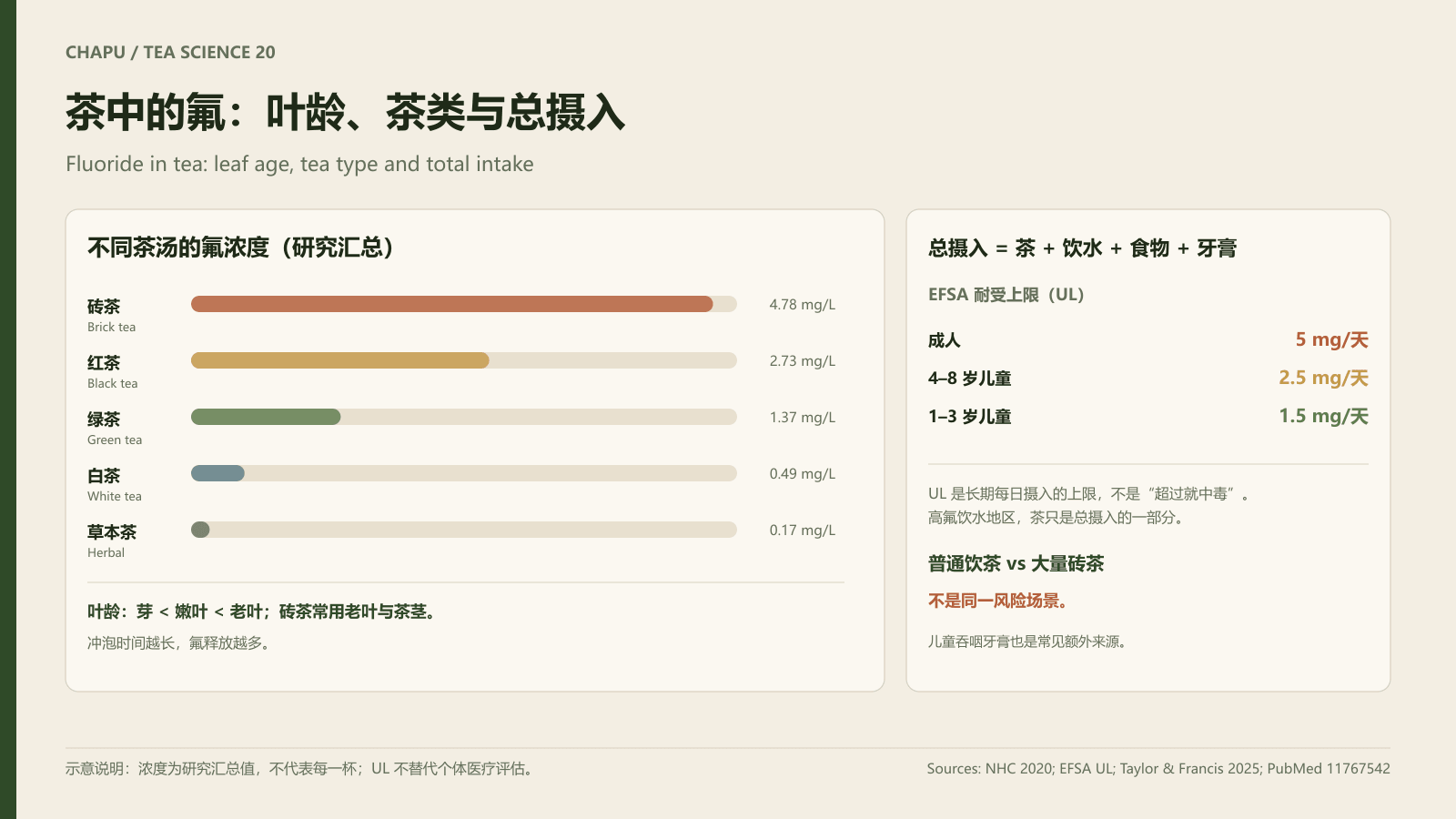
Different parts of the tea plant accumulate elements differently. In general, mature leaves, stems and brick-tea raw material contain more fluoride and some metals; buds and young leaves are lower. Studies of fluoride show the highest accumulation in mature leaves and the lowest in roots; metals show similar positional differences.
Processing also matters: pile fermentation, roasting and compression can change moisture and temperature, which affects extraction. Tea powder or matcha grinds the whole leaf and is eaten, so exposure is usually higher than brewing and discarding the spent leaf. Comparing “brew testing” with “powder testing” as if they were the same matrix leads to the wrong conclusion.
How much reaches the brew
A 2013 study of brewed tea detected aluminium, lead, arsenic and cadmium; concentrations differed between 3- and 15-minute brews, and some samples exceeded the authors' aluminium limit. A 2024 Iranian black tea study used 1 g tea, 45 mL water at 90 °C for 10 minutes: hazard quotients for arsenic, cadmium and lead were ≤0.01 for children and adults, and lifetime cancer risks for arsenic and lead were within the accepted range.
These findings are not contradictory: detection is common, and risk depends on concentration, number of cups and population. One test, one origin or one tea type cannot represent all tea.
Standards and the word “detected”
China's GB 2762 sets contaminant limits for lead, cadmium and arsenic in food; the EU has its contaminants regulation; EFSA assesses lead, cadmium and arsenic. Limits are set by food category and test matrix. Brew, dry leaf and powder do not share the same limit.
“Detected” only means the analytical method can see it. Whether it exceeds a standard is a second question. Whether it poses a health risk is a third. They cannot substitute for one another.
Practical ways to reduce exposure
- Do not rely on one high-leaf-age tea. Rotate brick tea, mature-leaf tea and young-leaf tea; do not treat border-market brick tea as a daily large-volume drink.
- Control brew time. Some elements leach more with longer brewing; avoid prolonged boiling of strong tea.
- Count the whole leaf for powder or matcha. Eating the leaf gives higher exposure than brewing; check the origin and test report.
- Look for origin and testing. Choose products with compliant testing and traceability; do not turn “a certain region is always contaminated” into a conclusion.
- Higher-risk groups need more care. Pregnancy, childhood and impaired kidney function: total exposure should include water, food and other sources.
Four common misreadings
| Claim | Problem | More defensible reading |
|---|---|---|
| “Lead was detected, so the tea is toxic” | Detection limit, concentration and exposure all differ | Check the standard, level and cups, not just presence |
| “Organic tea has no heavy metals” | Organic certification mainly covers pesticides and production | Soil, air and processing can still contribute |
| “Brew and powder are the same” | Powder eats the whole leaf, giving higher exposure | Assess separately; do not share one limit |
| “Tea from region X is always over the limit” | Variation within a region is large; batch and processing matter | Use specific tests and batches, not regional stigma |
Source boundary
This page can establish: tea can contain detectable lead, cadmium, arsenic and aluminium; sources include soil, roots, atmosphere, fertilisers, processing equipment and packaging; leaf age, tea type, brew time and brew-versus-powder form change exposure; some studies find low risk in compliant brews, but this does not represent every product; standards depend on food category and matrix.
This page cannot establish: the exact content of a specific brand, batch or origin; the health effect of one cup for one person; that all metals carry the same risk. For a specific product, consult the test report and the rules of the selling market; during pregnancy, childhood or kidney disease, ask a clinician or dietitian rather than self-diagnosing by stopping tea.