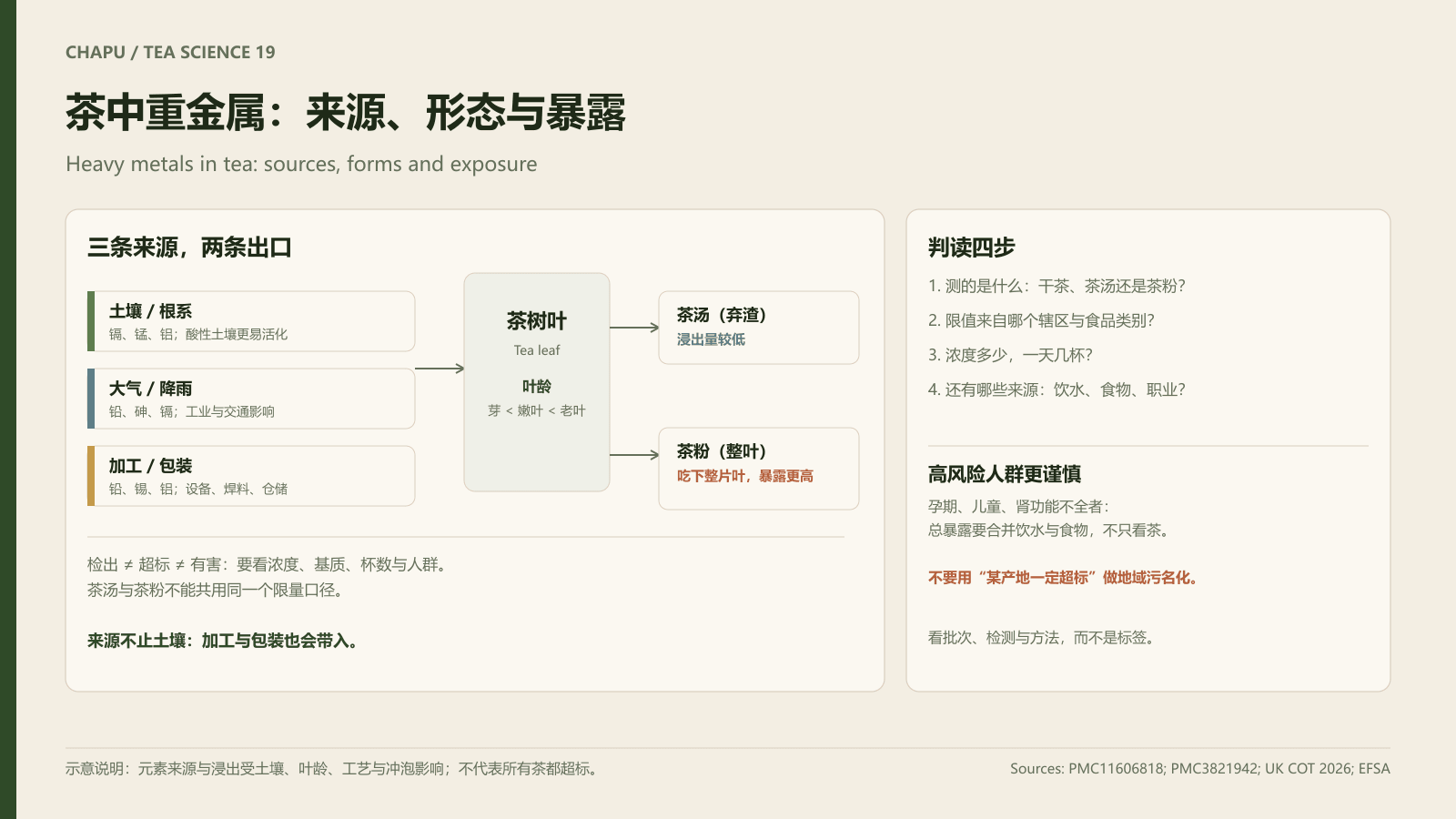
The question is not whether tea contains fluoride, but which leaves, which tea, how it is brewed and how much is drunk. Tea plants take fluoride from the soil, and older leaves accumulate more. Brick tea is often made from mature leaves and stems, so its fluoride content is usually higher than young-leaf tea. For most ordinary tea drinkers the risk is low; for people who drink large volumes of high-fluoride brick tea, water and other sources must be counted together.
How fluoride is distributed in the tea plant
| Part | Accumulation tendency | Comment |
|---|---|---|
| Mature leaf | Highest | Long growing period, continuous accumulation; brick tea often uses old leaves |
| Stem | Relatively high | Common in brick tea |
| Bud | Lower | Premium green and white tea often uses buds or young leaves |
| Root | Lowest | Takes up from soil and transports upward |
A 2025 scoping review of 88 studies reports mature leaves at about 808 µg/g and roots at about 30.86 µg/g. Brew time correlated strongly with fluoride release (r = 0.82), and a 30-minute black tea bag reached 6.01 mg/L. Mean brew concentrations were brick tea 4.78 mg/L > black tea 2.73 > green tea 1.37 > white tea 0.49 > herbal tea 0.17. These are pooled research values, not a guarantee for every cup.
Why brick tea gets attention
Chinese official guidance is direct: tea-type endemic fluorosis is caused by long-term, large-volume drinking of brick tea with excessive fluoride. Brick tea uses old leaves, stems and sometimes tea dust, and usually contains more fluoride; common black, green and scented tea is lower. In affected areas, annual brick-tea consumption can range from several kilograms to more than ten kilograms, with boiling and additions such as butter or milk, so total fluoride intake is far above ordinary tea drinking.
Historical research also reports water-soluble fluoride of 533.89–617.32 mg/kg in brick tea from Sichuan and Yunnan; butter tea and tsampa add more. These numbers describe “brick tea + large volume + long term” as a distinct risk scenario, not the experience of one cup of green tea.
Total intake includes water and food
Fluoride comes from more than tea:
- Drinking water: naturally high in some areas, or artificially fluoridated.
- Food: marine fish, some grains, fluoride-containing food additives.
- Toothpaste and oral products: swallowing toothpaste is a common extra source in children.
- Occupational and environmental exposure.
EFSA's tolerable upper intake levels (UL) are 5 mg/day for adults, 2.5 mg/day for children aged 4–8 and 1.5 mg/day for children aged 1–3. A UL is a long-term daily intake unlikely to pose risk; it is not an “above this you are poisoned” switch, nor a guarantee that below it everyone is safe. Total intake should add water, food, tea and other sources.
Brewing and selection
- Do not use old-leaf brick tea as a daily large-volume drink. In particular, avoid long-boiled strong brick tea.
- Control brew time. Fluoride release increases with time; a 30-minute bag brew is much higher than a short infusion.
- Young-leaf tea is usually lower. Green tea, white tea and premium black tea contain less old leaf, but this does not mean “zero fluoride”.
- Check water fluoride. If drinking water is high in fluoride, tea is not the only variable; if water is low, tea need not be feared disproportionately.
- Be more conservative for children and pregnancy. Assess total intake against age-specific ULs and ask a clinician or dietitian when needed.
Four common misreadings
| Claim | Problem | More defensible reading |
|---|---|---|
| “Drinking tea causes fluorosis” | It requires long-term large-volume high-fluoride brick tea and other conditions | Ordinary tea drinking and endemic fluorosis are different scenarios |
| “All tea is high in fluoride” | Leaf age, tea type and brewing vary widely | Young-leaf tea is usually lower than old-leaf brick tea |
| “Fluoride is poison, so less is always better” | Fluoride is also an essential trace element; deficiency increases caries risk | Look at total intake and the UL, not zero |
| “Rinsing removes fluoride” | Fluoride is inside the leaf; a brief warm rinse has limited effect | Leaf age, amount and brew time matter more |
Source boundary
This page can establish: tea plants accumulate fluoride, with mature leaves above young leaves; brick tea is usually higher than common black, green and scented tea; brew time affects release; EFSA ULs are 5 mg/day for adults, 2.5 mg/day for children 4–8 and 1.5 mg/day for children 1–3; China has a documented endemic fluorosis scenario from long-term high-fluoride brick tea.
This page cannot establish: the exact fluoride content of a specific brand, batch or origin; the risk of one cup for one person; that one UL applies to every population. For a specific product, consult the test report; in high-fluoride areas, for children, during pregnancy or with kidney disease, combine total intake with clinical advice.