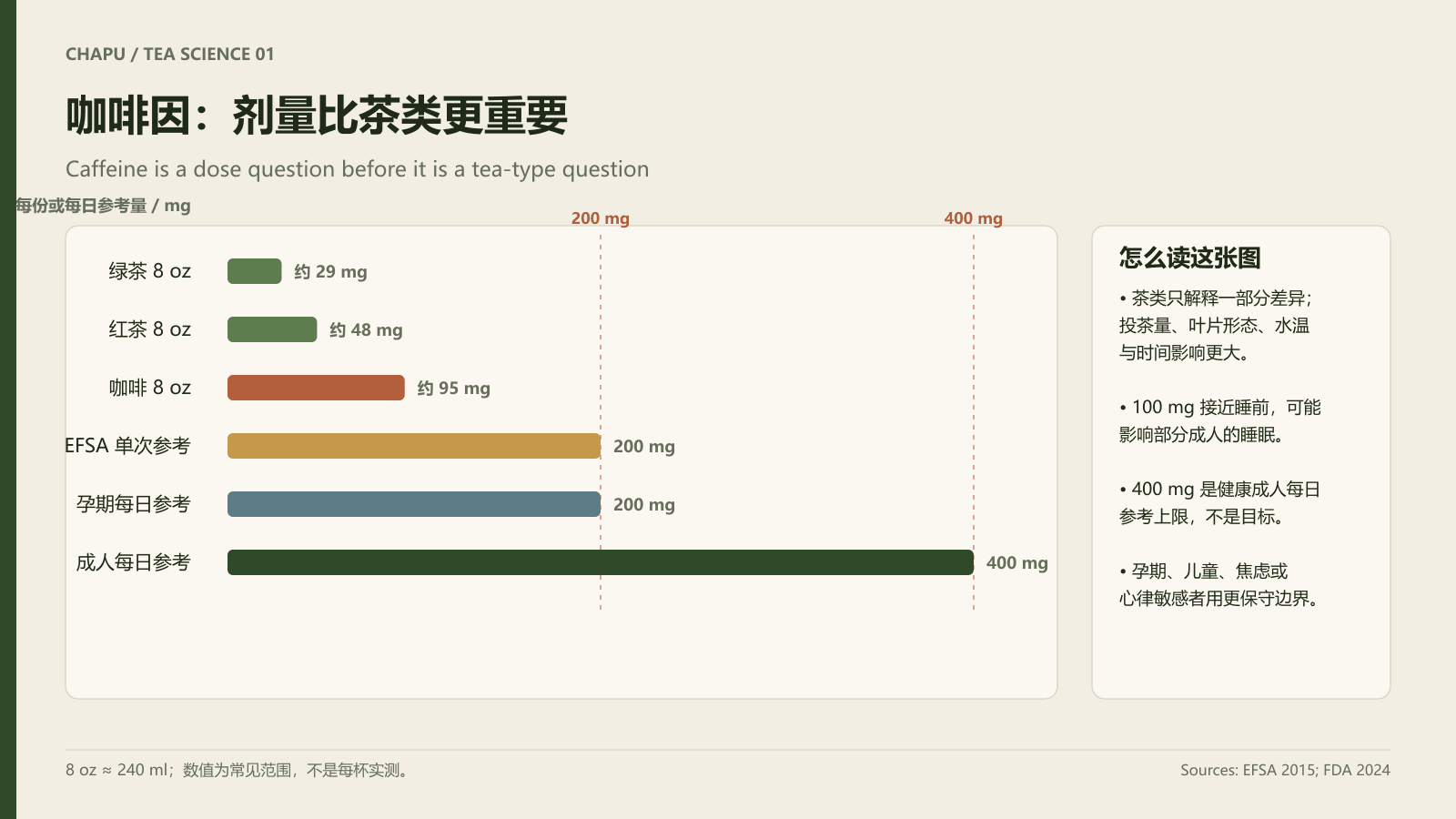
“Green tea is low-caffeine, black tea is high-caffeine” is only half true. What reaches the cup depends on four variables: leaf amount, caffeine content of the leaf, extraction rate and cup volume. Tea type is background, not destiny. Once you can estimate, you no longer need a contradictory caffeine table.
A usable estimate
[ \text{caffeine in cup} \approx \text{leaf grams} \times \text{leaf caffeine content} \times \text{extraction rate} ]
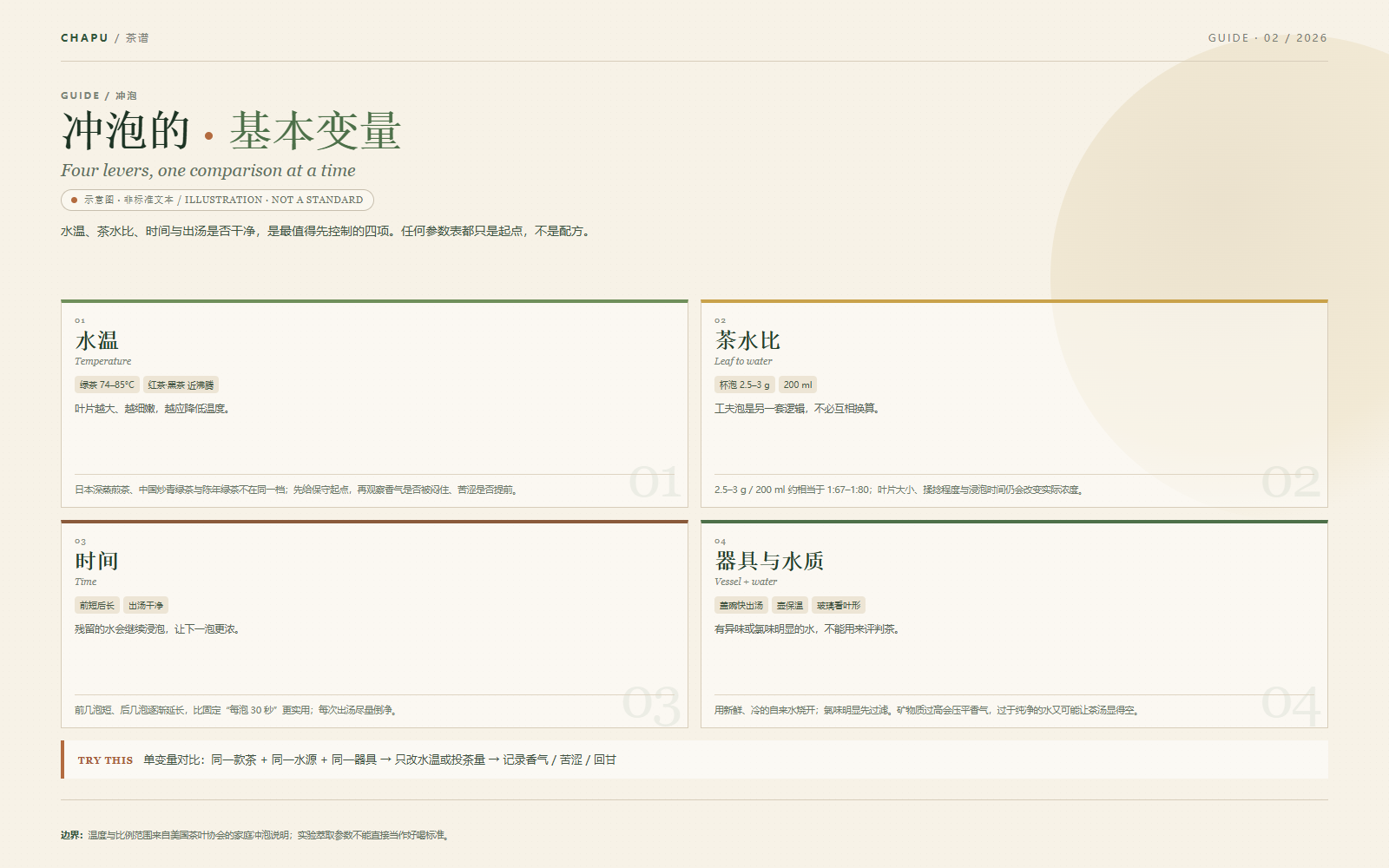
Dry tea usually contains about 2–4% caffeine. Buds and spring tea may be higher; mature leaf and stem may be lower; cultivar, origin and season matter. Extraction rate depends on water temperature, time, leaf fragmentation and infusion number.
Example: 2 g leaf at 2.5% caffeine contains 50 mg theoretically. If a 5-minute hot infusion extracts 80%, the cup holds about 40 mg. With 4 g leaf, 3.5% caffeine and 90% extraction, the cup holds about 126 mg. The difference comes from leaf amount and extraction, not the word “tea type”.
Extraction is neither instant nor linear
The classic study with 3.125 g in 200 mL found about 34.6% caffeine extracted at 30 seconds, 50.9% at 1 minute, 72.7% at 2 minutes and 91.5% at 5 minutes. Caffeine enters the liquor faster than catechins, which is why the first infusion can feel stimulating while later infusions still carry taste.
A Japanese green tea study adds another angle: 6 g sencha in 180 mL hot water for 1 minute; increasing water to 340 mL lowered caffeine and EGCG concentrations by about 30%, and theanine/arginine by about 40%, so the caffeine-to-theanine ratio rose. More water does not simply mean weaker tea; the components extract at different rates. Cold water at 5°C needed 12 hours for a clear rise; cold brew is not caffeine-free.
Tea type and form
| Type / form | Typical range (8 oz / 240 mL) | Comment |
|---|---|---|
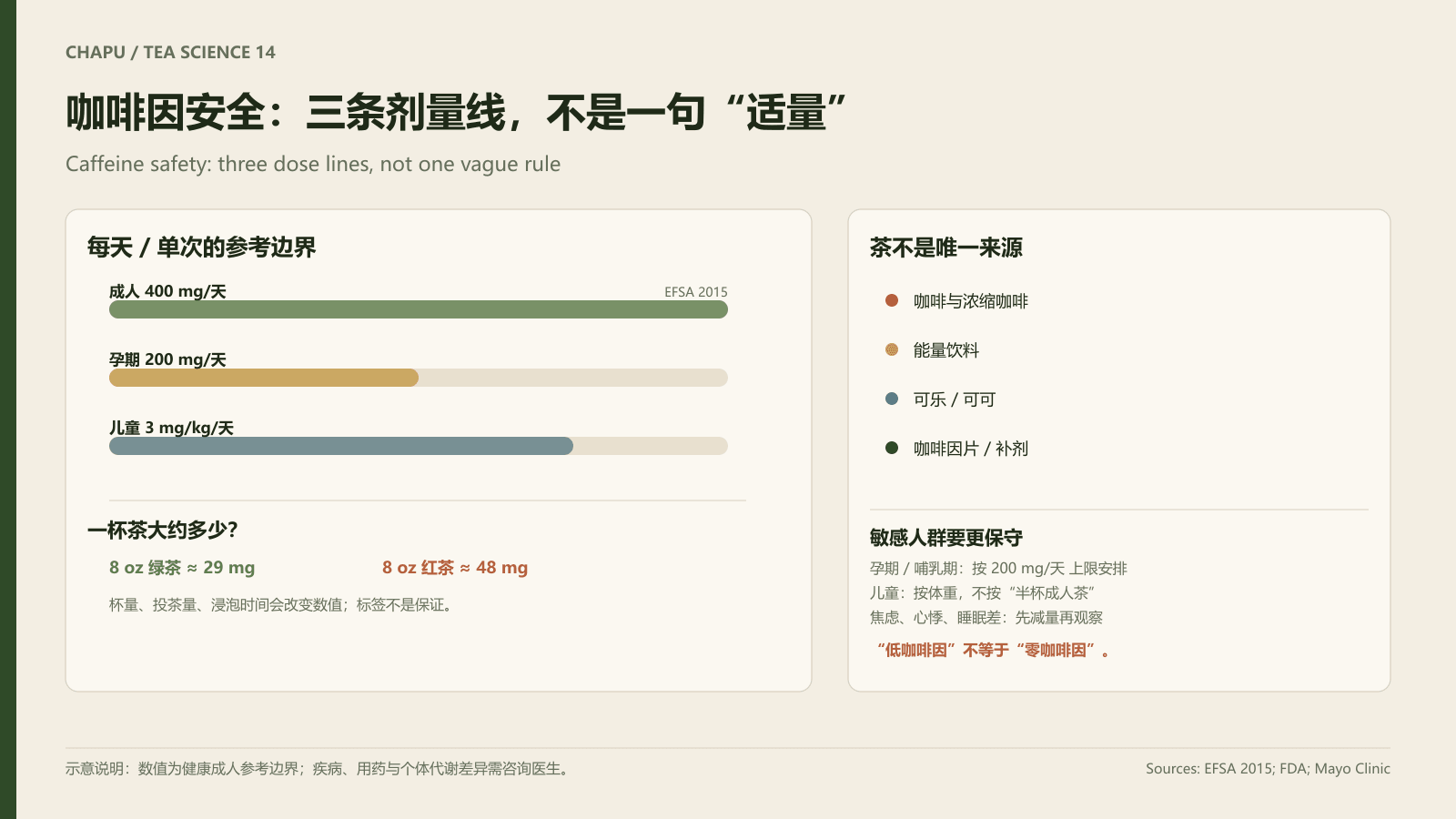
| Green tea | about 29 mg | Lower leaf amount or bud-heavy tea may be less |
| Black tea | about 48 mg | Broken tea bags extract faster; a short steep can still be high |
| Oolong | about 30–50 mg | High leaf amount in gongfu brewing can raise concentration |
| White tea | about 15–30 mg | Mature leaf and stem do not guarantee the lowest |
| Matcha / powder | Whole leaf ingested | No spent leaf discarded; full intake |
| Cold brew | Time replaces heat | 12+ hours approaches a short hot infusion |
These are ranges, not guarantees. Broken tea bags expose more surface area and extract caffeine quickly; whole leaf is slower but can catch up with a longer steep.
From cups to the daily boundary
EFSA reference values: healthy adults 400 mg/day, pregnancy 200 mg/day; children's data are insufficient, with 3 mg/kg/day as a reference. Convert “a few cups” into milligrams.
Example: 40 mg per cup, five cups = 200 mg. If two of those are 80 mg strong brews, total reaches 360 mg. Add coffee, cola, energy drinks and caffeine supplements, and 400 mg may be exceeded.
Lower or raise the cup
To lower:
- Reduce leaf amount; it is more direct than shortening the steep.
- Shorten the infusion, especially the first 1–2 minutes.
- Lower water temperature; but low-temperature green tea may lose aroma.
- Use whole leaf rather than broken tea bags.
- Discarding the first infusion removes only part of the caffeine, not all.
To raise:
- Increase leaf amount.
- Raise temperature and extend time.
- Use broken leaf or powder.
- Combine several short infusions rather than one very long steep.
Common misreadings
| Claim | Problem | More defensible reading |
|---|---|---|
| “Green tea has no caffeine” | Camellia sinensis naturally contains caffeine | It may be lower, not zero |
| “White tea is lowest” | Leaf age, stem and leaf amount matter | Look at leaf composition and brew |
| “Pouring off the first infusion removes caffeine” | The first infusion already extracts a large share | Discarding reduces only part |
| “Cold brew is caffeine-free” | 12+ hours still extracts caffeine | Time replaces temperature; not zero |
| “Tea is gentler than coffee” | Depends on cup size and strength | Count milligrams, not drink type |
Source boundary
This page can establish: cup caffeine depends on leaf amount, leaf content, extraction rate and volume; caffeine extracts quickly in the first minutes; water, temperature, leaf fragmentation and infusion number change extraction; 8 oz green tea is about 29 mg and black tea about 48 mg; EFSA adult reference is 400 mg/day.
This page cannot establish: the exact milligrams of a specific tea or infusion; that everyone responds to caffeine the same way; that “number of cups” alone determines whether the limit is exceeded. Exact values need laboratory testing; pregnancy, children, palpitations or sleep sensitivity should plan total intake with clinical advice.