The caffeine question is rarely “can I drink tea?”. It is how much in total, at what time, and for whom. EFSA, the FDA and clinical references do not give one “moderate” line. They give several reference lines split by population.
Three common reference lines
| Group | Reference line | Note |
|---|---|---|
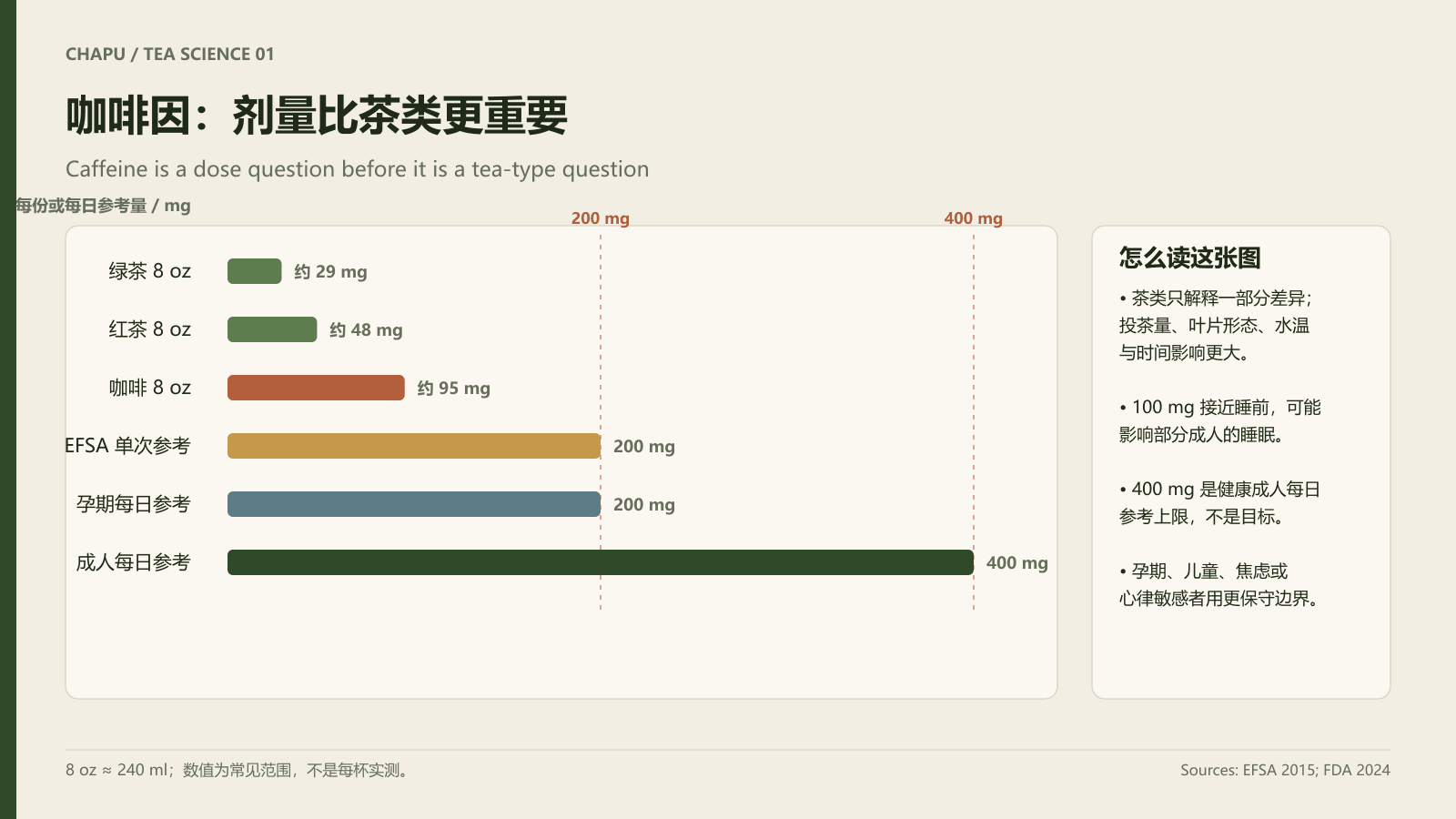
| Healthy non-pregnant adults | 400 mg/day | Spread across the day; a single 200 mg dose is also generally not a safety concern |
| Pregnancy | 200 mg/day | Total from coffee, tea, cola, energy drinks and supplements |
| Breastfeeding | 200 mg/day | Single and daily intakes up to 200 mg are generally not a safety concern for breastfed infants |
| Children and adolescents | 3 mg/kg body weight/day | EFSA considers the data insufficient; 3 mg/kg is a usable reference basis. A 40 kg child is about 120 mg/day |
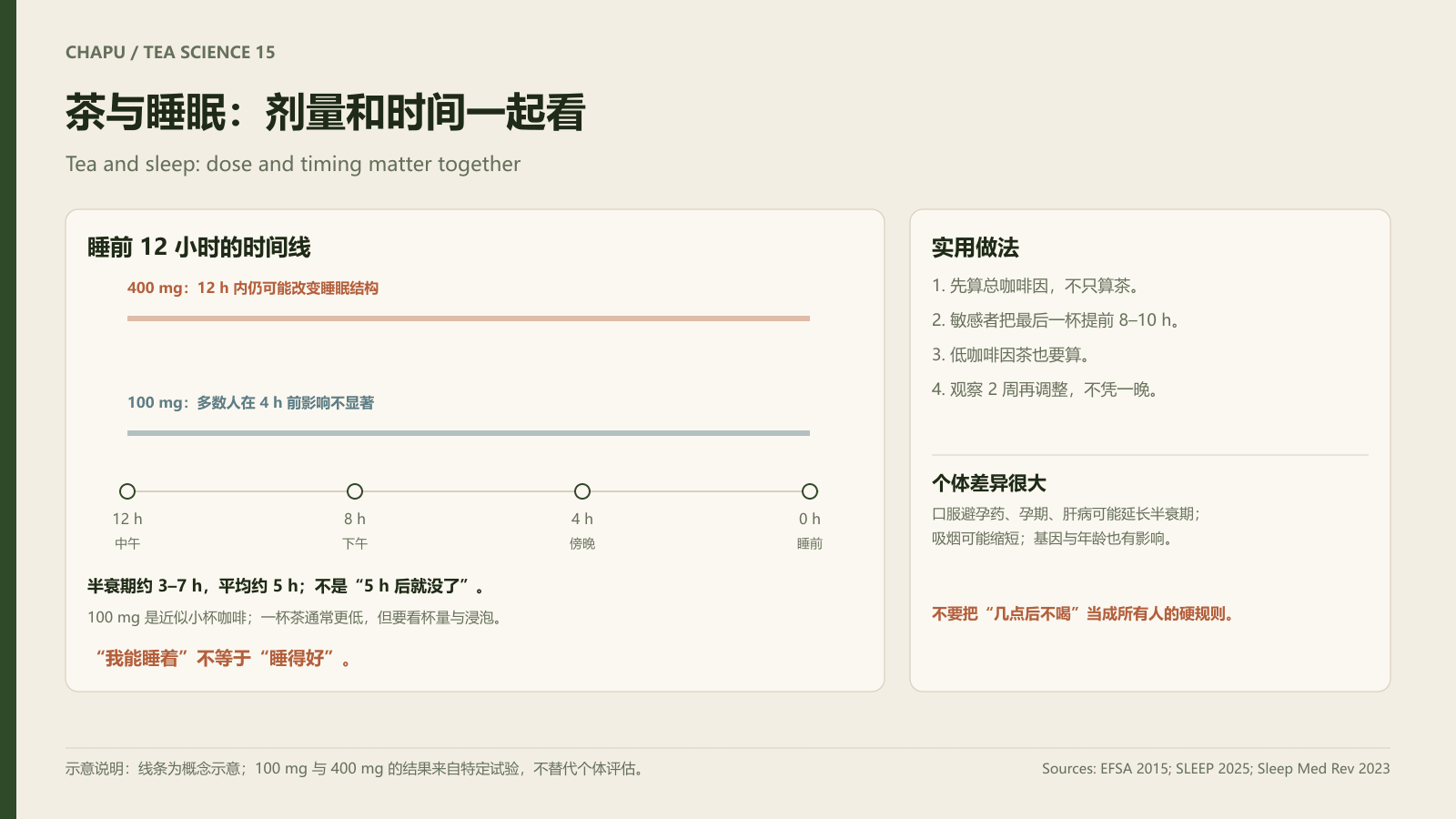
| Bedtime-sensitive adults | Around 100 mg | For some adults, caffeine near bedtime can affect sleep onset and architecture |
These are “no safety concern” references, not a toxicity threshold and not a licence to drink unlimited amounts. Metabolism, medication, anxiety and sleep habits change the actual response.
Tea is only one source
An 8 oz (about 237 mL) cup of green tea contains roughly 29 mg of caffeine; black tea about 48 mg. These are references, not label guarantees. The actual dose depends on:
- Leaf amount: 3 g and 6 g are not the same cup.
- Steep time: one minute and five minutes extract different amounts.
- Water temperature and leaf size: both affect extraction.
- Tea type and origin: cultivars and grades differ.
Coffee, espresso, cola, cocoa, energy drinks, caffeine tablets and supplements may add more within the same day. “Total caffeine” means all of them.
Pregnancy, children and sensitive groups
Pregnancy is not “no tea at all”. It is keeping total caffeine within 200 mg/day and choosing lower-caffeine, weaker infusions. Breastfeeding also calls for keeping single and daily intake within 200 mg; caffeine enters milk and infants metabolise it more slowly.
Children should not be estimated as “half an adult cup”. Weight-based 3 mg/kg is more sensible: a 40 kg child about 120 mg/day, a 20 kg child about 60 mg/day. Energy drinks, cola and chocolate count too.
For people with anxiety, palpitations, tremor, reflux or poor sleep, the personal safe dose may be below the general line. Reduce the dose, move the last cup earlier, and observe for two weeks. That is more useful than memorising a number.
Four common misreadings
| Claim | Problem | More defensible reading |
|---|---|---|
| “Tea is natural, so caffeine is harmless” | Natural does not mean dose-free | Caffeine has a clear dose–response |
| “Decaf means zero caffeine” | Decaffeination usually leaves a small residue | Sensitive people still count the total |
| “Tea wakes me up, so I can drink it at bedtime” | Half-life is hours; effects can be delayed | Sensitive people move the last cup 8–10 hours earlier |
| “Adults can have 400 mg, so children get half” | Children should be dosed by weight, not half cups | 3 mg/kg/day is the better reference |
What to do in practice
- Count all sources: tea, coffee, cola, energy drinks, supplements.
- Set the limit by group: 400 mg for adults, 200 mg in pregnancy, 3 mg/kg for children.
- Move sleep earlier: sensitive adults stop 8–10 hours before bed; 100 mg may still matter.
- Start weaker: less leaf and a shorter steep is more direct than switching to “low-caf” tea.
- Ask a clinician with disease or medication: rhythm problems, anxiety disorders, liver disease and some drugs change caffeine metabolism.
Source boundary
This page supports: EFSA's reference is 400 mg/day for healthy non-pregnant adults, 200 mg/day in pregnancy, and 3 mg/kg/day for children and adolescents; a single 200 mg dose is generally not a safety concern for healthy adults; about 100 mg near bedtime may affect sleep in some adults; 8 oz green tea is about 29 mg and black tea about 48 mg.
This page does not support: the exact caffeine content of a specific tea bag or hand-brewed cup; a personalised “can I drink this” answer; caffeine as a substitute for sleep, medication or treatment. Pregnancy, children, rhythm problems, anxiety disorders and medication users should use more conservative limits and ask a clinician or pharmacist.