“I can drink tea and still fall asleep” is not the same as “tea does not affect sleep”. Caffeine can let someone fall asleep while still changing sleep architecture, reducing deep sleep and increasing night awakenings. To judge the effect, put dose, timing and individual metabolism together.
Dose and timing are two variables
Caffeine's effect on sleep has a clear dose–time relationship:
- Higher dose, larger effect. A weak cup and a strong cup are not the same dose; tea, coffee, energy drinks and supplements add up.
- Closer to bedtime, larger effect. The body needs time to clear caffeine; the same dose in the afternoon and at bedtime is not the same.
- Sensitive people have a lower threshold. Anxiety, palpitations or poor sleep may mean slower sleep onset at a dose that bothers no one else.
A randomised crossover trial compared 400 mg caffeine at different times. Sleep architecture changed even when caffeine was taken 12 hours before bedtime; effects were larger closer to bedtime. This does not mean everyone must stop 12 hours earlier. It means the time window matters more than a slogan.
Half-life: not “gone after five hours”
Caffeine's half-life is about 3–7 hours, averaging around 5 hours. Half-life is the time for blood concentration to fall by half, not the time to clear completely. At an average of five hours, caffeine taken 10 hours before bed may still leave about a quarter in the body. For a sensitive person, that residue can be enough to change sleep.
Half-life varies:
- Pregnancy, oral contraceptives and liver disease may prolong it.
- Smoking may shorten it.
- Genes, age, body weight and medication also change metabolism.
“My friend drinks it and is fine” is not a personal estimate.
Caffeine in a cup of tea
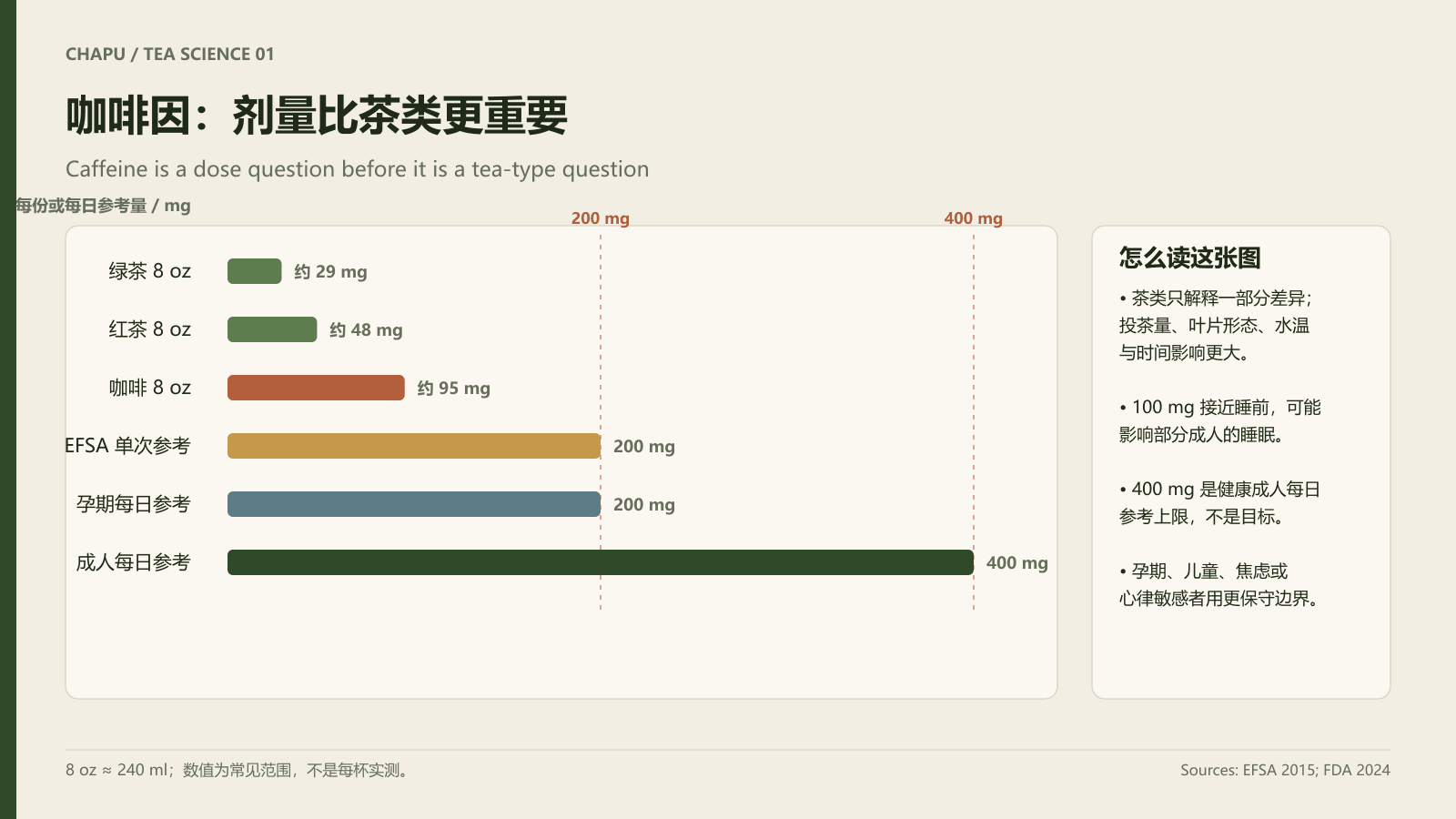
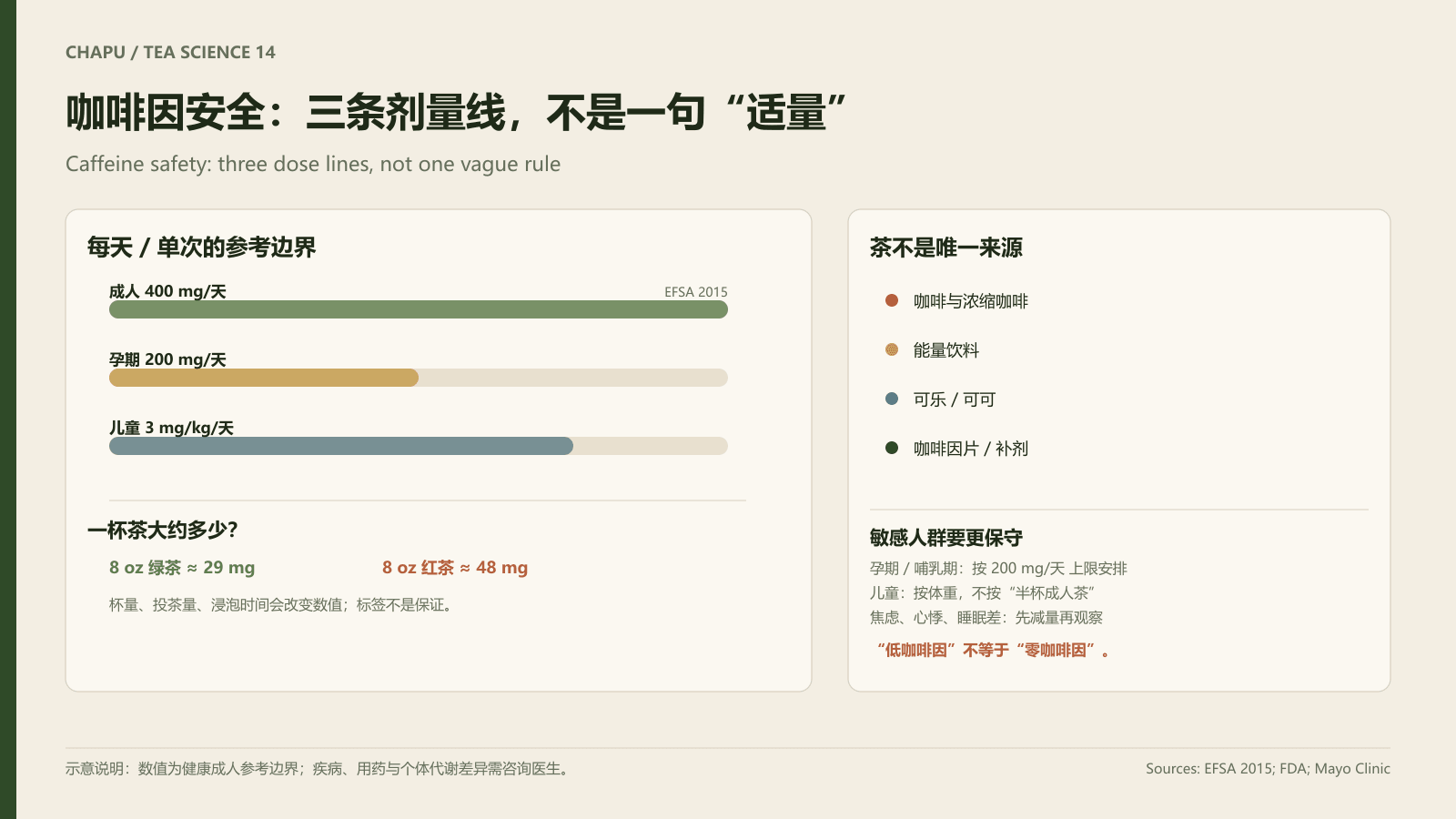
An 8 oz (about 237 mL) cup of green tea contains roughly 29 mg; black tea about 48 mg. Actual content depends on leaf amount, steep time, water temperature, leaf size and tea type. About 100 mg is roughly a strong cup of tea or a small coffee, but brewing changes the number a lot.
What to do in practice
- Count total caffeine: not only tea, but coffee, cola, energy drinks and supplements.
- Sensitive people move the last cup 8–10 hours earlier: not everyone needs this, but it is an easy starting point.
- Count low-caffeine tea too: decaffeination usually leaves a residue; “low” is not “zero”.
- Use less leaf and a shorter steep: more direct than switching tea type.
- Observe for two weeks: record last-cup time, sleep onset and night awakenings; do not decide from one night.
“I fall asleep” is not “I sleep well”
Caffeine may shorten the subjective time to sleep while lowering sleep efficiency, reducing deep sleep and increasing awakenings. “Did I fall asleep?” is not enough. Also ask:
- How long did sleep onset take?
- How many times did I wake?
- Did I feel restored in the morning?
- Was I sleepy during the day?
If those answers worsen, the dose or timing needs adjustment even if sleep onset still happens.
Four common misreadings
| Claim | Problem | More defensible reading |
|---|---|---|
| “I can fall asleep after tea, so tea does not affect sleep” | Subjective onset is not normal architecture | Also check awakenings, deep sleep and daytime function |
| “Caffeine is gone after five hours” | Half-life is not complete clearance | A quarter may remain after 10 hours |
| “Low-caffeine tea is unlimited” | Low-caf still has residue, and other sources count | Sensitive people still count total and timing |
| “Everyone should stop tea after a fixed hour” | Metabolism and sensitivity vary | Use an 8–10 hour window as a start, then adjust |
Source boundary
This page supports: caffeine's effect on sleep depends on dose and timing; 400 mg 12 hours before bedtime may still change sleep architecture; half-life is about 3–7 hours, averaging about 5; pregnancy, oral contraceptives, liver disease and smoking change half-life; 8 oz green tea is about 29 mg and black tea about 48 mg.
This page does not support: the exact sleep change for a person after a specific cup; one universal “last cup time”; tea as a substitute for sleep hygiene, medication or treatment of sleep disorders. Persistent insomnia, snoring with gasping or excessive daytime sleepiness deserves clinical assessment, not only cutting tea.