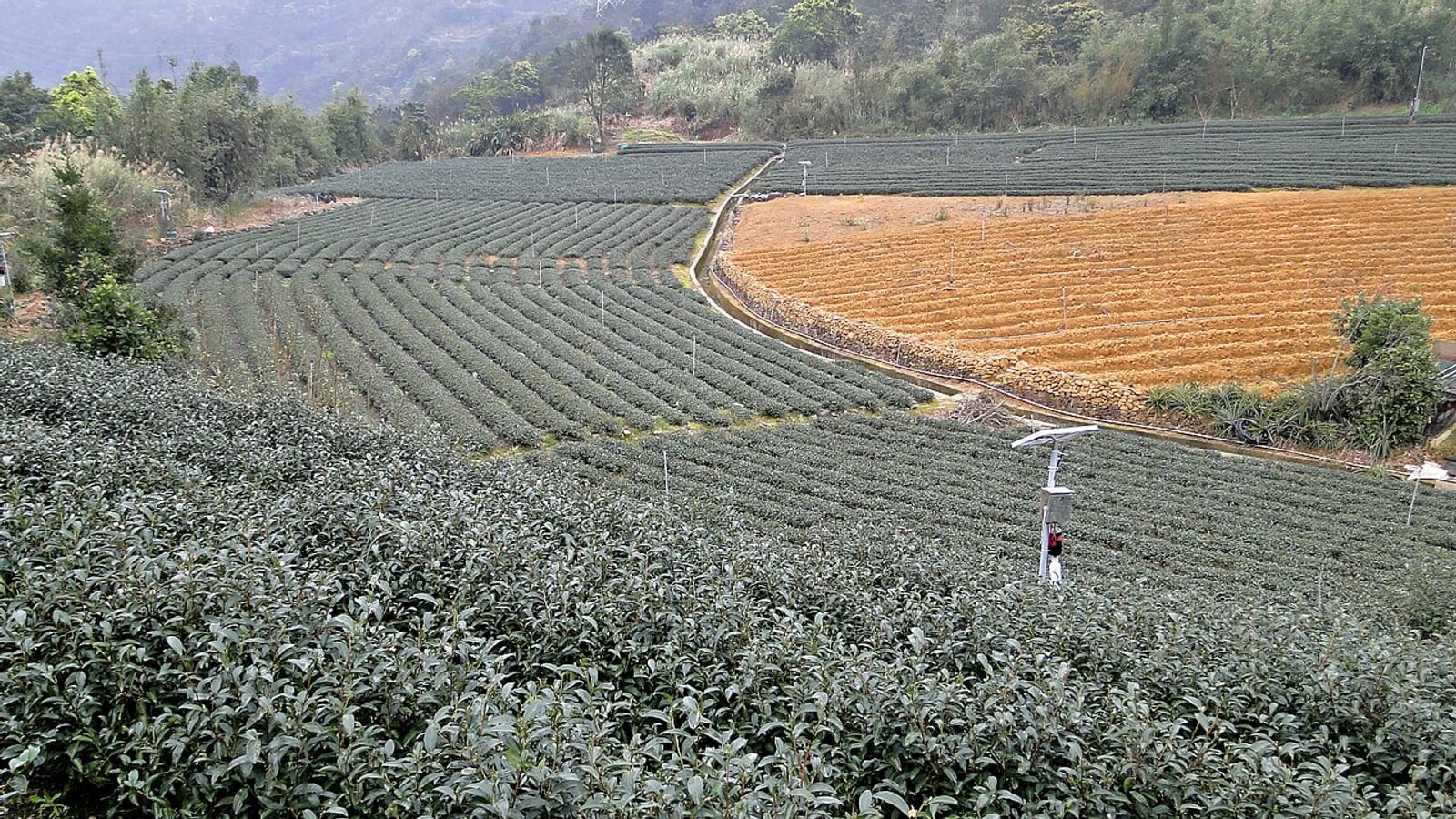
What it is
Jin Xuan is a tea cultivar bred at Taiwan's Tea Research and Extension Station. Its official designation is Taicha No. 12, named by the Taiwan agriculture authorities in 1981. Its experimental code was 2027, hence the colloquial Taiwanese name “27仔”. The cross is usually given as Tainong No. 8 as the mother and Yingzhi Hongxin as the father; the breeder was Wu Zhenduo. The plant is large, with thick leaves, high bud density, an early flush and high yield. It is used mainly for pouchong and oolong, and also for green and black tea.
Where the milky aroma comes from
Jin Xuan is best known for a “milky” note. The natural aroma comes from volatile esters and terpenes in the cultivar, expressed under light oxidation and suitable processing. It is not present in every batch: altitude, season, plucking tenderness and processing all matter. Many “milk oolong” products on the market are cheaper oolongs flavoured with food additives, which is a different product from natural Jin Xuan.
How to tell them apart
Packaging and price are only clues. Check three things: the cultivar is stated as Taicha 12 / Jin Xuan; the origin and altitude are given; the aroma is natural rather than a loud, candy-like additive. Natural Jin Xuan's milky note is usually soft and sits alongside floral and herbal notes; it fades after three or four infusions instead of staying uniformly sweet.
Common misunderstandings
Jin Xuan is not a synonym for “milk oolong”, and not every Jin Xuan must have a milky note. It is not exclusive to high-mountain tea: it grows at lower elevations too, with a different profile. When a package says “Jin Xuan oolong”, check that the process is oolong, not green or black tea.
Brewing notes
For lightly oxidised Jin Xuan, use 90–95°C water, about 5 g per 100 ml, and short first infusions. To bring out the milky note, do not drop the temperature too low, but avoid a long closed steep. For roasted or aged versions, use close to 100°C. If the aroma is as sharp as flavouring, suspect flavouring before blaming the cultivar.
What to check
Ask whether the tea is single-cultivar Jin Xuan, where it was grown, and whether the milky note is natural. A low price and a loud, uniform aroma are reasons to ask more questions, not proof of flavouring. For high-mountain Jin Xuan, check altitude and season; for roasted versions, check the roast date. The cultivar name should describe the plant, not merely the flavour.
Source boundary
This page relies on a Guangdong agriculture technology page and an English cultivar profile. Parentage and the 1981 naming are publicly documented; the chemistry of the natural milky note is still an area of research. This page explains it at the sensory and processing level and does not claim that every Jin Xuan has the note.