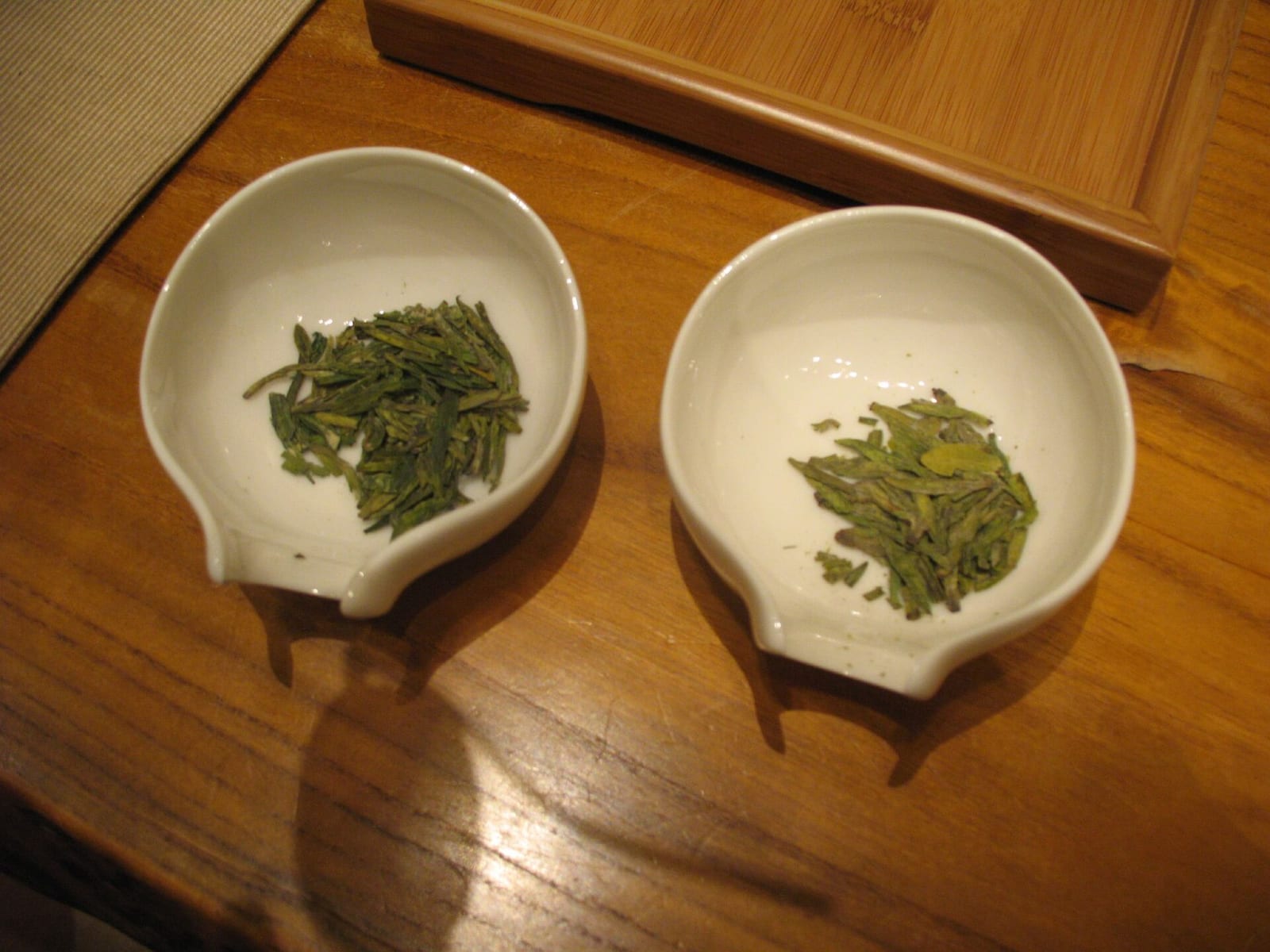
Longjing 43 is the clonal cultivar that made Longjing tea earlier, more even and more consistent — but it is not the Longjing population, and it is not all Longjing tea.
The short answer
Longjing 43 was selected from a single bush in the Longjing population at the Tea Research Institute of the Chinese Academy of Agricultural Sciences and propagated vegetatively. It buds early, shoots evenly and grows compactly, suits flat green tea, and typically gives a yellow-green flat leaf with chestnut or clean floral aroma. The gain is early, even, stable tea; the cost is a narrow gene pool and a narrower flavour spectrum. Longjing tea also comes from populations, other cultivars and different districts; 43 is one main line, not the whole map.
Breeding and spread
Selection began in the 1960s from the Hangzhou Longjing population, choosing early and good-quality bushes and multiplying them by cuttings. Early budbreak brings spring tea to market sooner; even shoots make fixation and shaping easier to standardise. It later spread to Zhejiang, Sichuan and Guizhou, and “Longjing 43 grown elsewhere” became common. GI Longjing rules constrain origin; cultivar is only one input.
Plant characters
A shrub with medium leaves, a semi-open frame and dense branching; shoots are yellow-green, plump and tender. Budbreak is earlier than the population by several days to a week. Yield is steady and suits dense planting and mechanical picking, but clonal gardens are genetically narrow and buffer poorly against frost, drought and disease. The same clone in mountain, hill and plain gives clearly different aroma and texture.
Processing and liquor
Longjing 43 suits flat green tea: spreading, first pan, resting, final pan. Hand position and pan temperature decide flatness, colour and aroma. A good lot is flat and smooth, with intact shoots, a tender yellow-green liquor, clean chestnut or orchid notes, a fresh entry and quick sweetness. Under-fixed leaf keeps green grassiness; over-panned leaf turns toasty and thin. Machine and hand are not simply high and low; temperature, leaf load and motion must match.
Versus the population
The Longjing population is a long-standing, seed-propagated local group with uneven plants and shoots, later budbreak, more complex aroma and a thicker body. Longjing 43 is even, early and stable, with a cleaner, more consistent aroma. Both can make Longjing tea, but they are not the same thing. The market uses “43” and “population” as grade labels; they are actually differences of cultivar and propagation, not automatic rank.
Market and identification
Prices range from everyday to premium, and core versus outer districts differ sharply. Dry leaf should be flat, straight and naturally coloured, not oily or dead green. Aroma should be clean chestnut, young bean or orchid, not scorched. Taste should be fresh with sweetness, not astringent or hollow. GI, provenance and picking date say more than the number 43.
43 and Longjing districts
GI Longjing is divided into West Lake, Qiantang and Yuezhou districts, and 43 can be planted in many places; core districts still emphasise local populations and terroir. 43 is early, even and stable, suited to standardised production; the population is later, more varied and thicker, suited to traditional style. Read district and picking date before cultivar; within one district, 43 and population can differ sharply in price and flavour.
Hand versus machine
Hand Longjing relies on pan temperature and hand motions through the first and final pans, giving a flat, smooth leaf and fine aroma layers. Machine tea uses shaping and drying units: efficient and even, but easy to over-flatten or over-fire. 43 is even and suits standardised machine work; populations are uneven and benefit from hand sorting. In both, under-fixation leaves grassiness and over-panning turns scorched and bitter; temperature and leaf load must match.
Brewing
80–85°C in a glass or white gaiwan, 1:50, about one minute for the first infusion. Tender shoots turn bitter in boiling water; wet the leaf with a little water, then fill along the wall. Second infusion 40–60 seconds, then lengthen. Do not cover and stuff.
Misconceptions
Longjing 43 is not automatically authentic Longjing; origin and process decide GI status. It is not “better” than the population; the styles differ. And not all Longjing is 43.